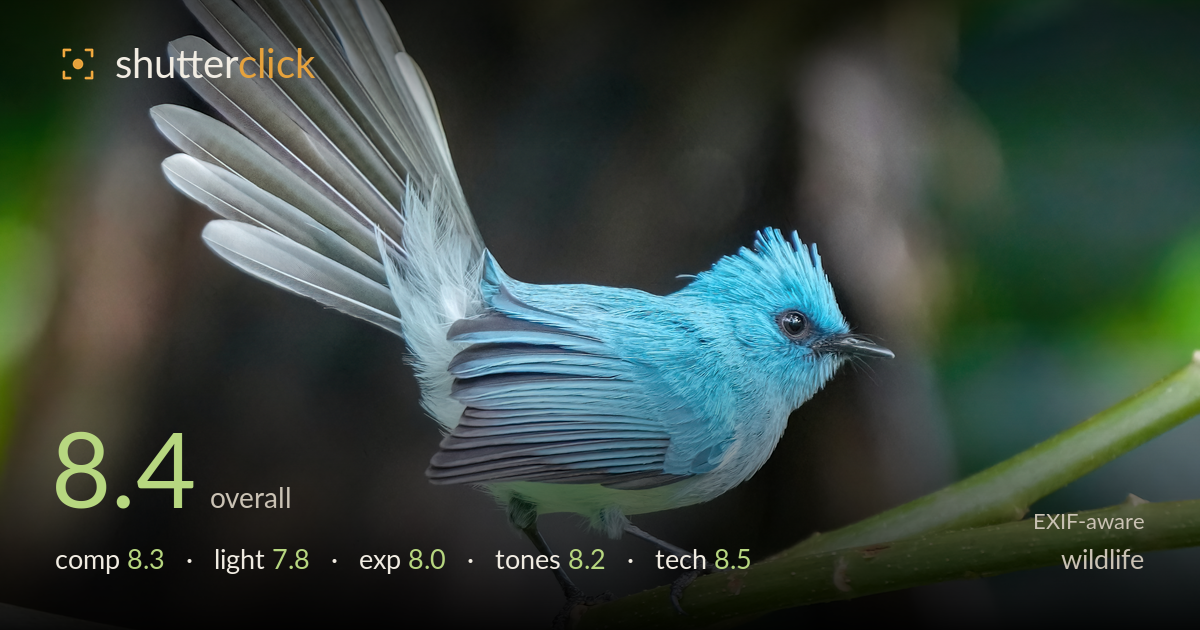
Blue flycatcher with tail fanned
Photo by Giles Laurent

| Focal length | 600 mm |
| Aperture | f / 6.3 |
| Shutter | 1/640 s |
| ISO | ISO 5000 |
| Exp. comp. | 0.0 EV |
| Shot at | 12:48 · Dec 14, 2022 |
A crisp, characterful bird portrait carried by a spectacular fanned tail and a clean, sharp eye. The pose is the standout — the raised tail sweeping into the upper-left balances the leaning body beautifully and gives the frame energy. The soft dark background pushes the pale blue plumage forward with real separation. What most holds it back is the diagonal branch, which grows heavy in the lower right and competes visually with the subject, and light that sits fairly flat and diffuse, muting texture on the breast. Small crops and timing tweaks would refine an already strong image.
The fanned tail is the composition — it fills the upper left and lends dynamic diagonal energy that a static perch shot would lack. The bird sits nicely off-centre with room to look into, and the leaning posture reads as intent. The branch provides a natural leading line, but its thick fork in the lower right becomes a competing mass and the wood tone edges toward the same green as the background. A touch more breathing room above the tail tip, which nearly kisses the frame edge, would help.
Soft, diffuse forest light gives even, shadowless coverage across the plumage — flattering for the delicate blue but flat in modelling. There's a hint of directionality from the right that catches the eye and beak, which is what rescues the shot from looking wholly flat. The tail feathers, backlit slightly, gain some translucency and separation. More raking light would carve texture into the breast and crest; as it stands the feather detail relies on resolution rather than shaping shadow to reveal it.
Exposure is well judged for a pale subject against a dark backdrop — the light blue plumage holds detail without clipping to white, and the underparts retain gradation. The dark background sits low without blocking up into dead black, preserving the faint texture of the out-of-focus foliage. The eye retains a catchlight and the beak keeps definition. At ISO 5000 there's little sign of lifted shadows crushing detail. A hair more exposure on the breast could have opened the midtones further without risking the highlights.
The cool blue of the bird plays cleanly against the muted green-and-brown backdrop — a pleasing complementary balance that keeps the subject dominant. White balance reads natural, neither too cool nor pushed. The faint yellow-green wash on the belly adds a subtle accent. The green branch is a touch saturated and pulls attention, and the background greens verge on muddy in places. Overall contrast is gentle and suits the soft-light rendering, with the tail's grey gradations handled smoothly from dark base to pale tips.
Strong execution from the 200-600mm at 600mm. Focus lands precisely on the near eye, which carries a clean catchlight, and sharpness extends convincingly through the crest and breast feathers — critical for wildlife. f/6.3 gives just enough depth to hold the head and body sharp while melting the background into smooth bokeh, aided by the long reach and working distance. ISO 5000 is a reasonable trade under dim forest canopy; the ILCE-1's files keep noise controlled and detail intact with only mild softening in the shadows. The one caution is 1/640s — adequate here because the bird held still, but marginal for a species this twitchy, and the tail tips show the faintest hint of softness that a faster shutter would have locked down. Given the light, pushing to 1/1000s at ISO 8000 would have been a defensible insurance against motion. Lens choice and focus discipline are exactly right for the subject.
What would elevate it
Tags
Shot something like this?
Expert photo critique, on demand — scored across six categories, EXIF-aware. Start with 3 free critiques, no credit card.
critique my photo — free