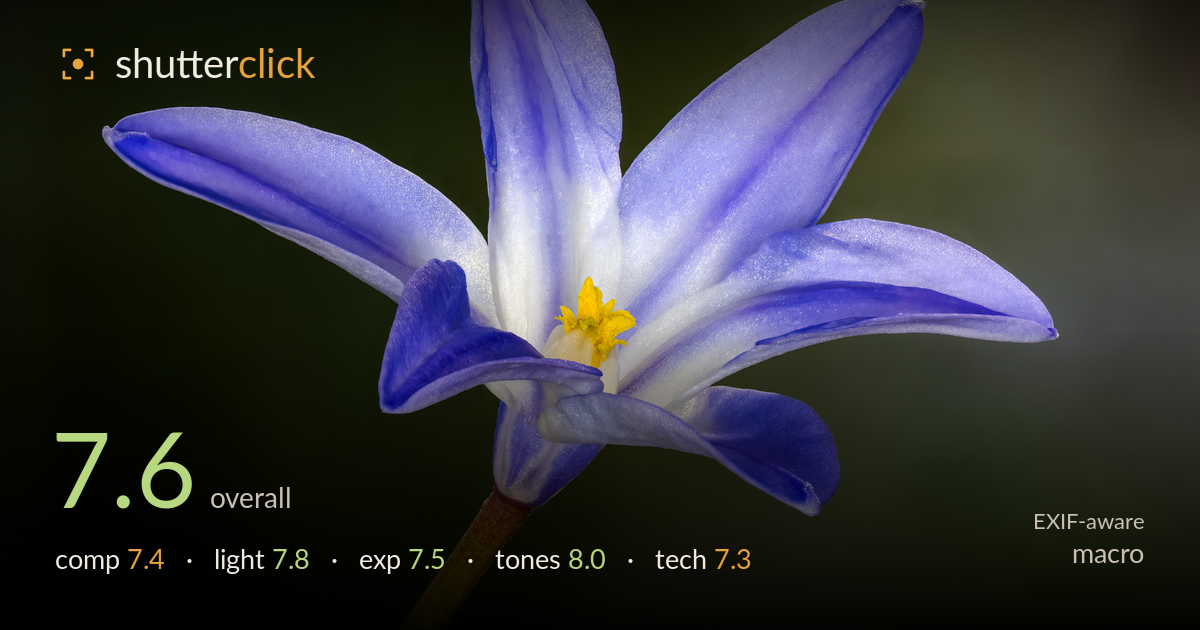
Blue glory of the snow in bloom
Photo by Ermell

| Focal length | 60 mm |
| Aperture | f / 5.6 |
| Shutter | 1/50 s |
| ISO | ISO 200 |
| Exp. comp. | 0.0 EV |
| Shot at | 17:09 · Apr 10, 2022 |
A clean, well-executed macro of a Chionodoxa bloom, with genuinely lovely colour rendering and a background that isolates the flower completely. The blue-to-white petal gradient and the yellow anthers form a tidy focal core. What most holds it back is depth of field: at f/5.6 the front-facing petals and stamens are sharp, but several rearward petal tips and the far edges fall soft. The stem drops out of the bottom edge awkwardly, and the arrangement crowds high in the frame. Focus stacking and a touch more breathing room below would elevate an already competent image.
The star form is captured near-symmetrically and reads clearly against the dark backdrop. Placement sits high, leaving heavy empty space top-right while the stem is clipped at the bottom edge, which feels abrupt rather than resolved. The diagonal stem entering from lower centre gives a small anchor but its cropping undercuts it. Centring the bloom works for this radial subject, though slightly more room beneath the flower would let the stem breathe. The lower-left petal tip nearly touches the frame edge, tightening the composition uncomfortably.
Soft, diffuse light wraps the petals evenly, avoiding hard specular hotspots and preserving the delicate translucency of the blue tips. Direction appears frontal-to-slightly-side, which keeps the flower legible but flattens some of the petal ribbing that raking light would sculpt. The dark, unlit background gives strong subject separation. Shadow within the throat stays gentle and detailed. A little more directional side light would add dimensionality to the petal surfaces and emphasise the fine sparkling texture already faintly visible across the blooms.
Exposure is well judged for the subject. The white petal cores hold detail without clipping, and the saturated blue tips retain gradation rather than blocking up. The dark background sits low without crushing to pure black, keeping a natural falloff. The yellow anthers read cleanly at the centre. Midtones on the petals are placed sensibly, giving the flower luminosity against the muted surround. Nothing appears accidentally dark or blown; the histogram would show a controlled spread anchored by the bright bloom against a deep field.
Colour is the standout. The violet-blue to white petal gradient is rendered with beautiful subtlety, and the yellow stamens provide a clean complementary accent. White balance looks accurate, with the whites reading neutral rather than blue-cast. The muted olive-green background complements the blue without competing. Contrast is well controlled, keeping petal veins and the frosted surface texture visible. Saturation is rich but restrained, avoiding the plasticky over-punch macro flowers often suffer. A cohesive, natural palette that lets the subject sing.
At f/5.6 on the 60mm macro, depth of field is the limiting factor. The front stamens, throat and near petals sit sharp, but the rearward petal tips and the far left and right edges soften noticeably, and the upright rear petal loses crispness. For a subject this three-dimensional, a focus stack of several frames or a smaller working aperture around f/8 would carry the whole bloom sharp without pushing far into diffraction on Micro Four Thirds. ISO 200 keeps the image clean with no visible noise, an ideal choice. 1/50s is adequate on a static, sheltered subject, though any breeze risks blur at this magnification, so a tripod or faster shutter would add insurance. Focus placement itself is sensible, landing on the reproductive centre. The lens resolves fine petal texture beautifully where the plane of focus falls. The core issue is not sharpness quality but sharpness distribution across the flower's depth.
What would elevate it
Tags
Shot something like this?
Expert photo critique, on demand — scored across six categories, EXIF-aware. Start with 3 free critiques, no credit card.
critique my photo — free