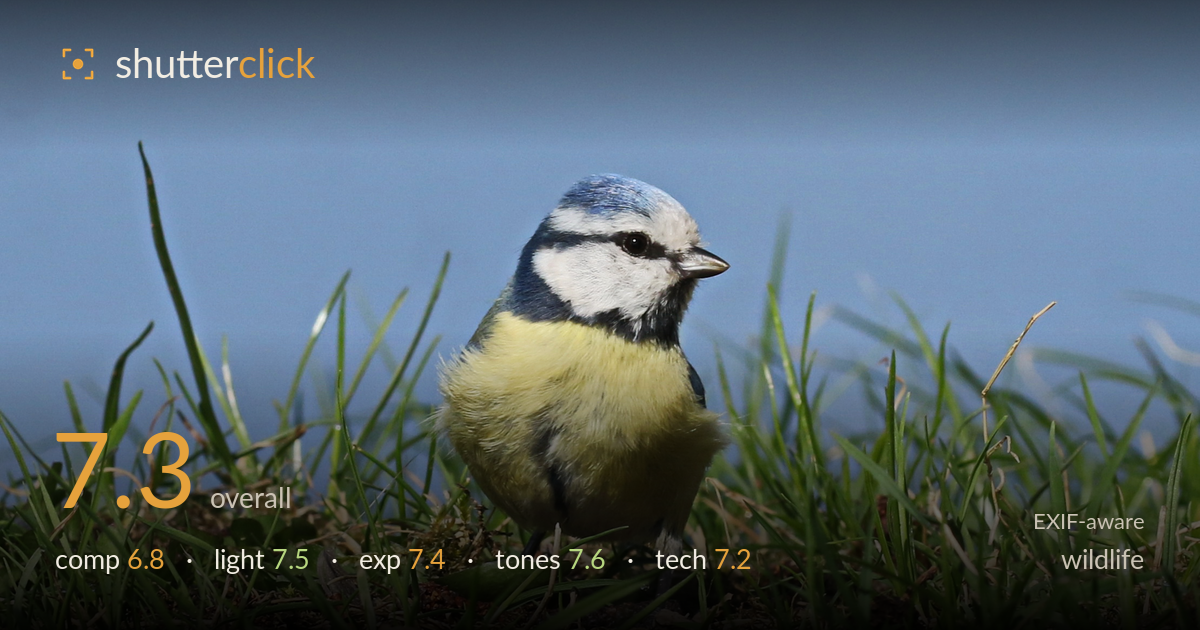
Blue tit in the grass
Photo by Kora27

| Focal length | 220 mm |
| Aperture | f / 10.0 |
| Shutter | 1/640 s |
| ISO | ISO 400 |
| Exp. comp. | 0.0 EV |
| Shot at | 10:48 · Apr 20, 2018 |
A clean, appealing portrait of a blue tit at eye level, with the low ground-level perspective lending intimacy and the plain blue backdrop isolating the bird beautifully. The plumage colour renders naturally and the exposure holds both the yellow breast and white cheek. What most holds the shot back is the grass: several blades cross directly in front of the bird's body and feet, cluttering the lower frame and competing for attention. Focus lands close to the eye but the sharpest plane sits slightly forward. A cleaner foreground and a touch more critical eye sharpness would lift this from a good bird record to a strong one.
The low, eye-level shooting angle is the strongest choice here — it puts the viewer in the bird's world and separates it against the smooth blue background. The bird sits slightly left of centre with room to look into, which works. The grassy berm grounds the scene, but the foreground blades cutting across the breast and legs are distracting and pull focus from the subject. A cleaner sightline, achieved by shifting position or waiting for the bird to hop to an open patch, would tidy the frame considerably.
Soft, slightly frontal daylight, likely from a lightly overcast or hazy sky, wraps the bird evenly and keeps the white cheek from blowing out while still holding shadow detail in the flanks. A small catchlight sits in the eye, giving it life. The light is flattering and reveals plumage texture well, though it's a touch flat — a lower, more raking angle would have added modelling to the breast and back. For a ground-level wildlife shot, the timing and quality are well judged.
Exposure is well controlled. The white cheek patch retains texture without clipping, the yellow breast holds saturation and detail, and the shadowed underside keeps enough information to read. The blue background sits at a pleasant mid-brightness that doesn't fight the subject. Nothing looks accidental here — the balance across a tricky range of white, yellow and dark markings is handled cleanly. If anything, a marginal lift in the darkest flank shadows would open the underbelly slightly, but the current rendering is honest and safe.
Colour rendering is natural and pleasing — the yellow breast is warm without being oversaturated, the blue crown and wing read true, and the white cheek stays neutral. White balance is accurate for the daylight conditions. The blue background provides a complementary contrast to the yellow, a happy pairing that makes the bird pop. Contrast is moderate and appropriate for the soft light. The green and straw tones in the grass are equally believable. A restrained, well-judged palette overall with no colour casts to correct.
The 100-400L at 220mm is a sound pairing with the 7D Mark II for this subject, and f/10 gives generous depth of field for a small bird at close range — sensible for keeping the whole head and body sharp. The trade-off is that f/10 also brings the intervening grass blades closer to acceptable focus, adding to the foreground clutter, and it demanded a slower shutter than ideal. At 1/640s motion is frozen adequately for a mostly static bird, though a small buffer would have been welcome for any head turn. ISO 400 keeps noise negligible. Focus appears to sit just in front of the eye — the beak and cheek edge read crispest while the eye itself is a hair soft, the most common miss in bird work. Opening to around f/6.3 would have thrown the grass further out of focus, allowed a faster shutter, and let a single-point focus lock the eye more decisively.
What would elevate it
Tags
Shot something like this?
Expert photo critique, on demand — scored across six categories, EXIF-aware. Start with 3 free critiques, no credit card.
critique my photo — free