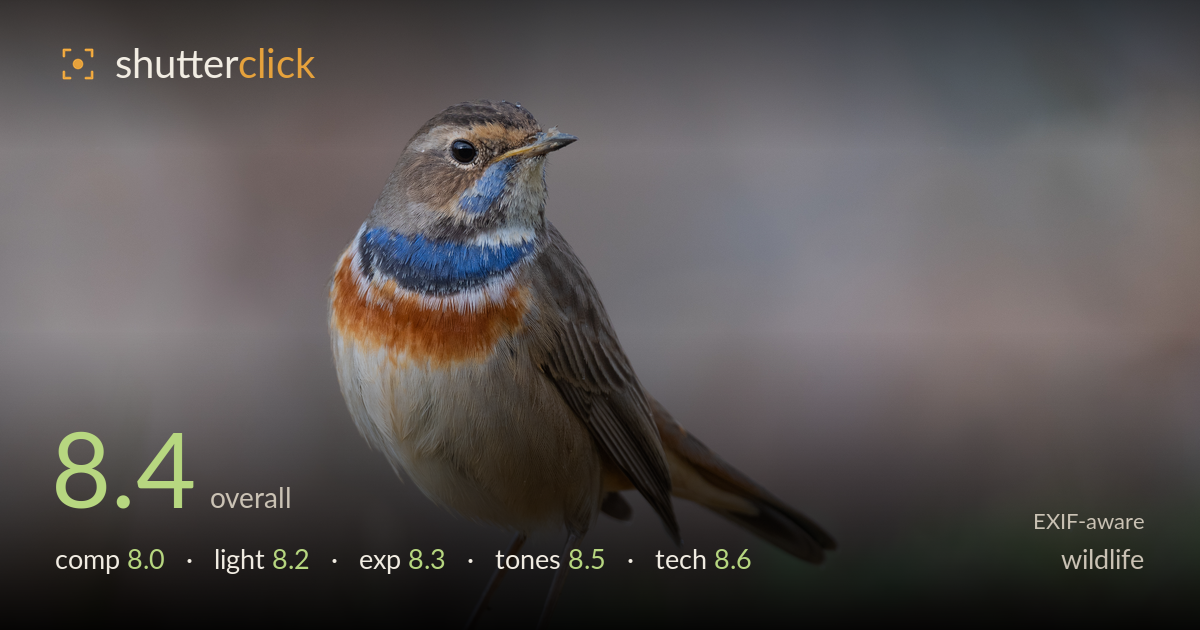
Bluethroat perched on a rock
Photo by El Golli Mohamed

| Focal length | 500 mm |
| Aperture | f / 5.6 |
| Shutter | 1/640 s |
| ISO | ISO 320 |
| Exp. comp. | 0.0 EV |
| Shot at | 15:17 · Dec 16, 2023 |
A clean, well-executed bluethroat portrait where the diagnostic throat colouring reads with impressive clarity against a creamy, uncluttered background. The near-eye-level perspective and the natural perch give the frame authenticity, and the light flatters the plumage without harshness. What holds it back most is the placement: the bird sits well left with its gaze directed into the frame, which is correct, but the tight top margin and the slightly heavy rock at the base crowd the composition. A touch more breathing room above and a cleaner base would elevate an already strong image. The feather detail and separation are the standout achievements here.
The bird is placed left of centre facing into the frame, which gives its gaze somewhere to travel and is the right instinct. Negative space on the right is generous and softly rendered, isolating the subject well. The perch grounds the shot naturally. Two things pull against it: the head sits close to the top edge, leaving little headroom, while the foreground rock occupies a large, slightly bottom-heavy wedge. A frame that lifted the bird marginally and trimmed the rock would balance better and keep attention on the plumage.
Soft, diffused light wraps the bird evenly, revealing the blue, chestnut, and cream throat bands without blowing the whites or crushing the browns. A small catchlight sits in the eye, giving it life, and the directional quality subtly models the breast and flank feathers. The overcast or shaded quality suits the delicate plumage — hard midday sun would have blocked up the dark wing and glared the white belly. The only limitation is a slight flatness; a hint more directional light would add dimensional shape to the body.
Exposure is well judged for a tricky subject that mixes near-white belly with dark wing feathers. The whites retain texture rather than clipping, and shadow detail in the wing and tail holds up. Midtones on the brown crown and back are placed cleanly. The overall brightness reads deliberate and controlled, with the background falling to a soft, even tone that doesn't distract. No obvious blown highlights on the breast, which is the easiest place to lose detail here. A very minor lift in the darkest wing edges is all that could be argued.
Colour handling is a highlight. The blue gorget, rust band, and cream underparts separate cleanly and read as natural rather than oversaturated. White balance sits neutral-to-warm, complementing the earthy perch and muted background. The background's soft browns and touches of green create a harmonious, non-competing palette. Contrast is gentle and appropriate for feather detail, with smooth tonal gradation across the breast. Nothing looks pushed. If anything, the palette is a shade muted overall, but that restraint serves the subject's subtle colouring well.
The 500mm f/5.6 on a D500 is an ideal wildlife pairing, and it shows. At f/5.6 the depth of field is shallow enough to melt the background into creamy bokeh while keeping the near-side of the bird sharp — the eye is tack-sharp with a clean catchlight, which is the single most important thing in a bird portrait. Feather detail across the breast, throat bands, and wing coverts resolves crisply, indicating focus landed precisely on the plane that matters. ISO 320 is low, delivering clean files with no visible noise, and 1/640s comfortably froze this largely static, perched subject. The APS-C crop gives useful reach with this lens. The only technical caveat is depth of field: at f/5.6 and this distance the tail and far flank drift slightly soft, and the far foot is less crisp than the near one. Stopping to f/7.1 or f/8 would have carried more of the body sharp while the background remained smooth. A minor point against otherwise excellent execution.
What would elevate it
Tags
Shot something like this?
Expert photo critique, on demand — scored across six categories, EXIF-aware. Start with 3 free critiques, no credit card.
critique my photo — free