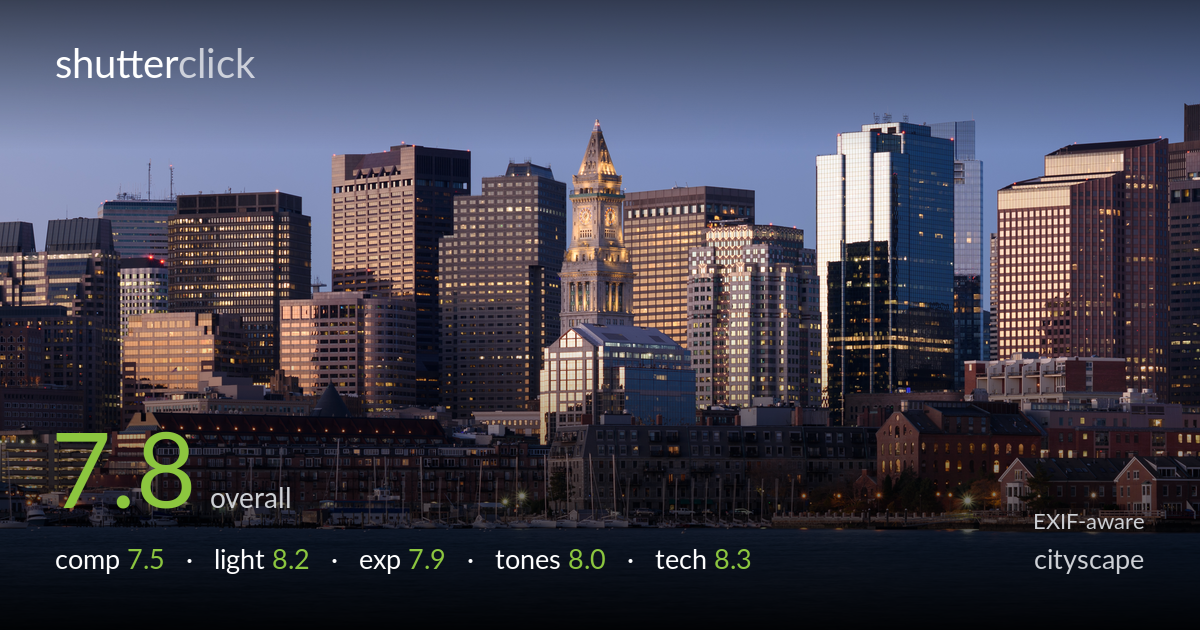
Boston skyline at blue hour
Photo by King of Hearts

| Focal length | 105 mm |
| Aperture | f / 8.0 |
| Shutter | 2.0 s |
| ISO | ISO 100 |
| Exp. comp. | 0.0 EV |
| Shot at | 06:08 · Nov 12, 2016 |
A clean, technically assured blue-hour panorama of a full skyline, well timed so ambient sky and interior window light sit in near-perfect balance. The stitched multi-frame execution is careful — sharp detail across the whole run and a level waterline. What most holds it back is the ultra-wide format itself: at this extreme aspect ratio the skyline reads as a continuous band with no dominant anchor or entry point, and the flat frontal 105mm perspective compresses depth. The water occupies a large, near-featureless lower third that adds little. Strong material, one step short of a composition with a clear focal hierarchy.
The panoramic sweep captures the whole waterfront cleanly, and the horizon is level with buildings placed high enough to give the skyline room. But the extreme aspect ratio spreads attention evenly with no dominant anchor — the eye wanders without a clear entry or resting point. The tall clock tower near centre is the natural focal candidate but isn't emphasised. The lower third is a large expanse of calm, near-empty water that carries little interest and could be trimmed to strengthen the balance between city and foreground.
The timing is the standout. Shooting at blue hour catches the sky in a deep, even gradient while building interiors and street lights glow warm — that ambient-to-artificial balance is exactly what a cityscape wants, with neither the sky gone black nor the windows blown out. The soft residual daylight still models the building facades so the towers read as three-dimensional rather than flat silhouettes. Direction is frontal and even, which keeps everything legible but sacrifices the drama a raking side light would bring.
Well judged for the difficult blue-hour dynamic range. The two-second exposure at ISO 100 gathers enough light to hold shadow detail in the darker buildings while keeping the lit windows and street lamps from clipping to pure white. The sky retains a smooth gradient with no banding. Midtones sit comfortably. The water is rendered slightly dark and flat, and a touch more shadow lift in the foreground buildings would reveal detail currently sinking, but there's no accidental underexposure here — the choices read as deliberate.
The blue-to-warm colour interplay is the tonal strength — a cool sky and water against the amber window glow gives the frame a classic dusk mood. White balance is handled sensibly, keeping the sky believably blue without letting the tungsten interiors go sickly orange. Contrast is moderate and appropriate, preserving detail from the darkest towers to the brightest lit panes. Saturation is restrained and natural. The overall grade is coherent; the water could carry slightly more tonal separation to avoid reading as a flat slab.
Execution is the strongest aspect. At 105mm, f/8, ISO 100 and a two-second exposure on a D750, this is clearly a tripod-based multi-frame stitch, and the craft shows: detail is crisp across the entire width, the stitch is seamless with no visible seams or parallax errors, and verticals stay acceptably upright despite the long focal length. f/8 sits in the lens's sweet spot, delivering front-to-back sharpness appropriate for a distant skyline. ISO 100 keeps noise negligible even in the sky and shadowed water. The two-second shutter smooths the harbour to a calm sheen without over-softening it. Focus is accurately placed on the buildings. The 105mm choice compresses perspective, flattening the sense of depth between near and far towers — a shorter focal length from a different vantage would restore some layering — but for a stitched panorama the tight lens gives the resolution payoff. Overall a technically clean, well-planned capture with no significant execution faults.
What would elevate it
Tags
Shot something like this?
Expert photo critique, on demand — scored across six categories, EXIF-aware. Start with 3 free critiques, no credit card.
critique my photo — free