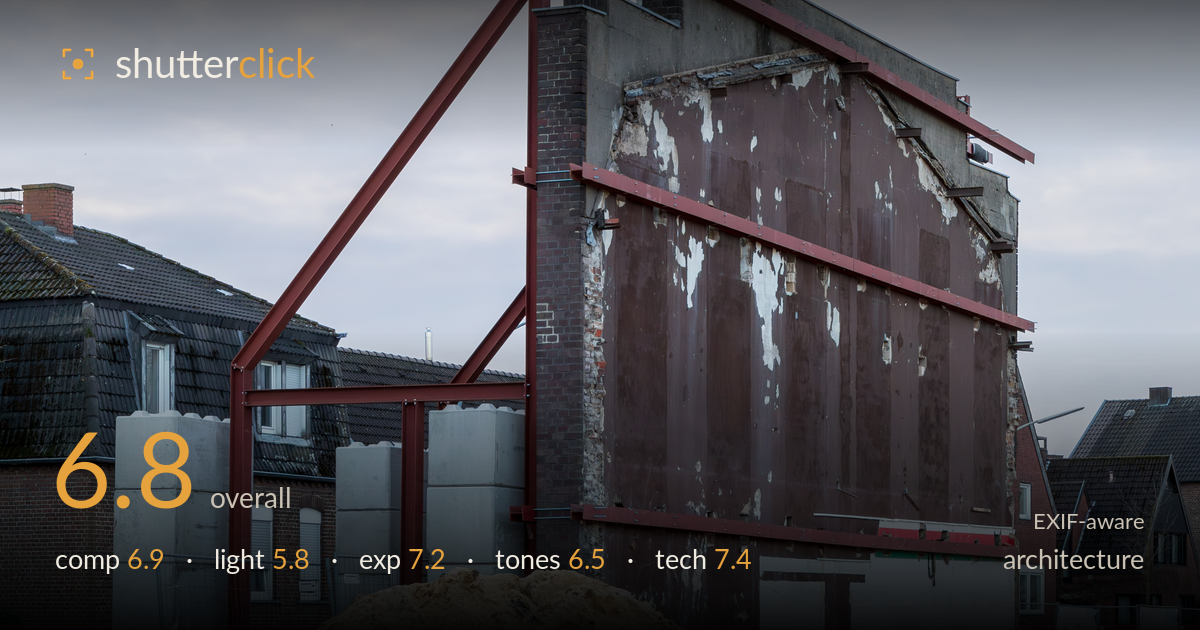
Braced wall of a demolished building
Photo by Dietmar Rabich

| Focal length | 56 mm |
| Aperture | f / 11.0 |
| Shutter | 1/100 s |
| ISO | ISO 3200 |
| Exp. comp. | 0.0 EV |
| Shot at | 08:55 · Jan 7, 2018 |
A compelling document of demolition-in-progress: the party wall of a razed building, now propped by raw red steel bracing, becomes an accidental monument. The exposed brown wall with its ghost-marks of former rooms is the frame's strongest element, and the diagonal strut cutting into the sky gives real graphic tension. What most holds it back is the flat, overcast light, which drains the scene of the texture and depth this subject is built on. The sand pile crowds the lower half without adding much, and the busy background terraces compete for attention. A stronger sense of geometry and cleaner separation would lift this from documentation to statement.
The braced wall anchors the frame well, and the diagonal steel strut driving up into the sky is the most dynamic line here, breaking the boxiness effectively. Vertical lines are kept largely true, appropriate for the subject. The sand pile, however, dominates the lower third and its rounded mass fights the hard geometry above rather than supporting it. The surrounding houses and cluttered right edge dilute the isolation the main wall deserves. A higher angle or a step left would have thinned the sand and cleaned the base of the structure.
The heavy overcast delivers flat, shadowless light that robs the peeling wall and coarse steel of the raking texture that would make them sing. The white sky is featureless, giving the top of the frame nothing to hold the eye. On a subject this dependent on surface — flaking render, brick, weathered metal — directional light near golden hour, or a low sun skimming the wall, would have carved out relief and depth. As shot, everything sits on one tonal plane, and the mood reads grey rather than atmospheric.
Exposure is well controlled for difficult conditions. The bright overcast sky is held just short of full clipping, retaining faint cloud structure, while shadow detail in the dark brown wall and roof tiles stays open and readable. Midtones across the sand and pavement sit naturally with no muddiness. The histogram is skewed bright by the sky but the decision looks deliberate and no key detail is lost. Nothing here needs rescuing — a slightly darker sky in post could add a touch more presence to that blank upper zone.
The muted palette suits the derelict subject, and the oxblood steel against the brown wall and pale sand forms a coherent, earthy scheme. White balance is neutral, perhaps a hair cool, reinforcing the grey mood. The problem is the flat sky, which flattens overall contrast and leaves the image feeling low in energy. The green algae staining on the roofs and the yellow cabinet add welcome accents. A modest contrast lift and a warmer treatment of the wall's browns would give the tones more grip without betraying the subdued reality.
Settings are sound for the situation. At 56mm and f/11 the entire scene sits within a deep, sharp focus zone appropriate for architecture, with front-to-back detail well resolved on the sand, steel and background terraces. The 1/100s shutter is comfortable for a static subject handheld with the IS lens. The one questionable call is ISO 3200 — under this much daylight, even overcast, there was room to drop several stops for cleaner shadows, and some noise is visible in the darker wall areas on close inspection. f/11 with a lower ISO and slightly slower shutter would have been the cleaner path here, or opening to f/8 if depth allowed. Focus is accurate and the lens is well suited to the subject, with minimal distortion at this focal length and verticals kept largely honest. Overall execution is competent and controlled; the ISO is the only real inefficiency in an otherwise technically clean frame.
What would elevate it
Tags
Shot something like this?
Expert photo critique, on demand — scored across six categories, EXIF-aware. Start with 3 free critiques, no credit card.
critique my photo — free