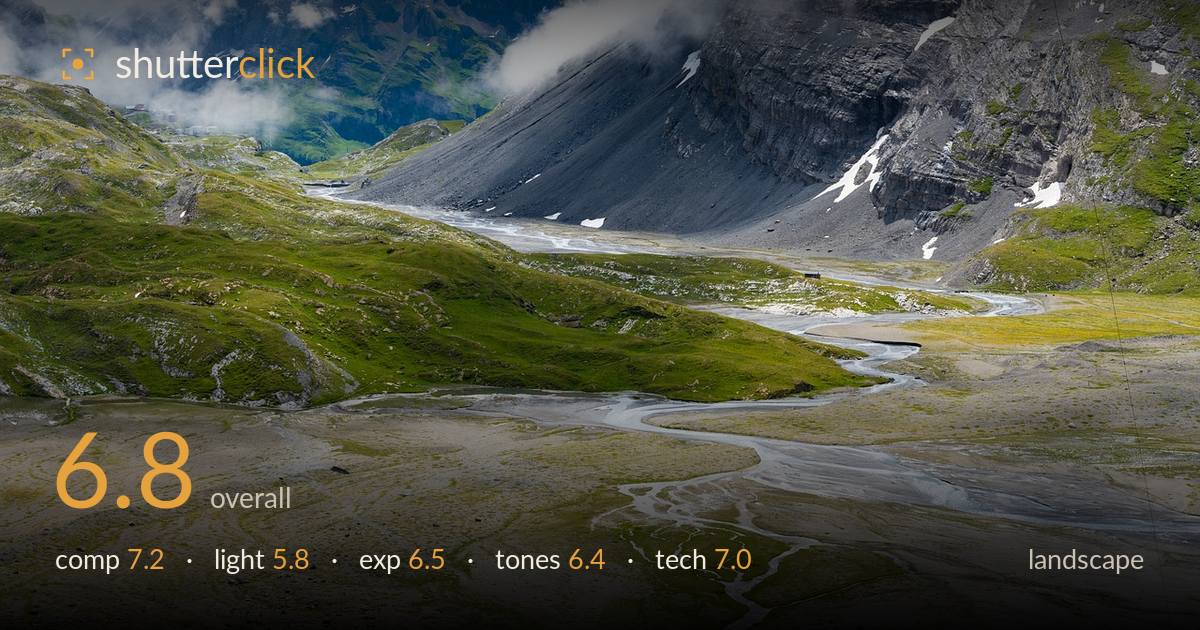
Braided streams through an alpine valley
Photo by susnpics

No EXIF metadata in this file
Technical analysis based on visual assessment only.
A strong sense of alpine geography carries this frame: braided glacial streams sweep from foreground to the dark scree slope and cloud-shrouded peaks, giving genuine depth and scale. The braided river channels are the real asset, forming natural leading lines that pull the eye through the valley. What most holds it back is flat, overcast light that mutes contrast and drains dimensionality from the terrain, plus a couple of distracting diagonal wires cutting across the right side. The composition is competent but the frame lacks a decisive anchor point. Cleaner light and one intrusion removed would lift this considerably.
The braided streams work hard as leading lines, threading the eye from the sandy foreground up into the valley and toward the scree slope. Layering front-to-back is genuine and gives real depth. The high vantage suits the subject. Weaknesses: the frame lacks a single decisive focal anchor, so the eye wanders, and the thin diagonal cables on the right intrude on an otherwise natural scene. The foreground washland reads a little empty and undifferentiated. A composition that resolves those streams to a clearer convergence point would tighten it.
Flat, diffuse overcast light dominates and it is the main limiting factor. The cloud cover softens shadows to the point that the terrain loses modelling — the grassy hummocks and scree read as one tonal mass rather than sculpted relief. The clinging cloud on the peaks adds atmosphere and mood, which is a genuine plus, but the light does nothing to reveal texture in the valley floor. Raking side light near golden hour, or a break in cloud spotlighting the streams, would give the landscape the dimensionality it currently lacks.
Exposure is handled sensibly for difficult conditions. The bright overcast sky and white cloud stay mostly under control without significant clipping, and shadow detail in the dark scree slope is retained. Midtones sit a touch flat, which is partly the light and partly a conservative exposure that leaves the histogram bunched in the middle. There is little pure black or clean white to give tonal snap. A slightly bolder exposure with a small contrast lift in post would open up the tonal range without risking the highlights.
The green-and-grey palette is faithful to the alpine setting, and white balance reads neutral and believable. Greens are natural rather than oversaturated, which suits the documentary honesty of the scene. The trouble is the tonal range feels compressed under the flat light — everything sits in a narrow midtone band with muted contrast, so the image reads slightly grey and lifeless overall. A gentle contrast curve and a touch more separation between the cool scree and the warm grass would give the tones more life without pushing into artificiality.
Sharpness holds well across the frame, with detail resolved from the foreground washland through to the distant cloud-wrapped ridges, suggesting a well-chosen aperture and a focus point that keeps the whole scene acceptably sharp — appropriate for a deep landscape. Noise is not an issue in this daylight capture. The lens choice frames the valley cleanly without obvious distortion, and the horizon-free composition avoids any levelling concerns. The main technical blemish is the pair of thin diagonal cables crossing the right third; these are cloneable in post but detract from an otherwise clean rendering. Depth of field is well judged for the subject, keeping foreground texture and background peaks legible together. Overall execution is solid and dependable — the image is technically sound, and the limiting factors are creative (light and contrast) rather than a failure of craft. Careful cleanup of the wires and a modest contrast recovery would push the technical quality from competent to polished.
What would elevate it
Tags
Shot something like this?
Expert photo critique, on demand — scored across six categories, EXIF-aware. Start with 3 free critiques, no credit card.
critique my photo — free