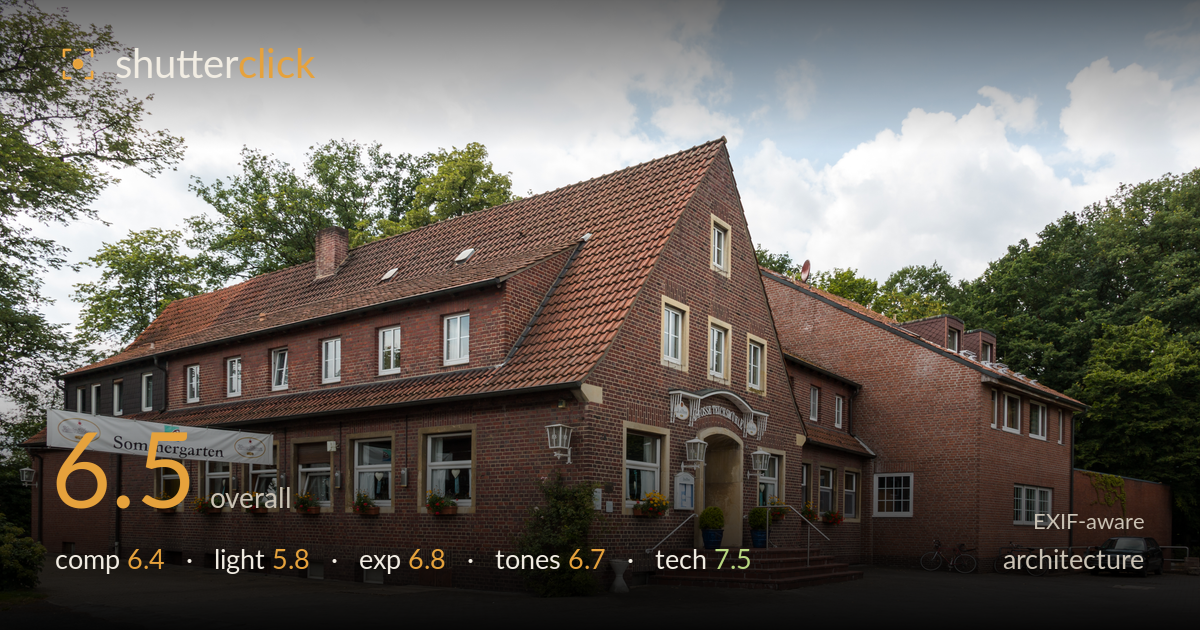
Brick gasthaus under overcast sky
Photo by Dietmar Rabich

| Focal length | 15 mm |
| Aperture | f / 8.0 |
| Shutter | 1/160 s |
| ISO | ISO 100 |
| Exp. comp. | 0.0 EV |
| Shot at | 14:40 · Jul 15, 2016 |
A clean, well-executed documentary record of a brick gasthaus, let down mainly by flat midday light and slight keystoning. The three-quarter angle reads the building's mass and roofline well, and the brick and tile hold plenty of colour and texture. Verticals lean inward at the corners, the sky sits blown and featureless, and the foreground paving is dead space that adds nothing. As an architectural catalogue image it succeeds; as a photograph with atmosphere it stops short. Softer directional light and corrected verticals would lift it from a competent record to something more considered.
The three-quarter viewpoint is the right call, showing both the gabled facade and the receding wing so the building's volume reads clearly. The gable peak sits comfortably off-centre and the roofline carries the eye across the frame. What weakens it is the large expanse of empty grey paving across the bottom third, which pads the frame without purpose, and the parked car and bikes at the right edge clutter an otherwise clean corner. A tighter crop lifting the lower foreground would concentrate attention on the architecture.
Flat, high overcast light sits over the whole scene, softening shadows to the point where the roof planes and brick relief lose their modelling. The gable and side wing read as similar tonal values, so the building's three-dimensional structure is flattened. There are no directional shadows to carve out the tile ridges or window reveals. Overcast can flatter architecture when texture matters, but here it robs the pitched roof of the depth that raking side light would restore. Timing closer to a low sun would help.
Exposure is handled sensibly for the conditions. The brick and roof tiles hold full detail across the midtones, and shadow areas under the eaves and in the trees retain information rather than blocking up. The sky is the weak point: the brighter cloud masses are clipped to pure white with no recoverable detail, an almost inevitable result of the flat overcast and the building being metered correctly. A graduated filter or a second exposure for the sky would have preserved some tonal separation up top.
White balance is neutral and believable, with the warm reds of the brick and roof rendered naturally against the muted greens of the surrounding trees. Contrast is moderate and suits the documentary intent, though the flat light keeps the overall tonal range slightly compressed in the mid-values. The brickwork carries pleasing colour variation and the flower boxes add welcome warm accents. The sky's lack of tone leaves the upper third feeling empty, and a touch more contrast overall would give the image more presence.
Settings are well chosen for the task. At 15mm on the EF-S 15-85, f/8 sits in the lens's sharp aperture range and delivers front-to-back depth of field with everything from the near paving to the far wing rendered crisply. ISO 100 keeps noise negligible and preserves the fine detail in the brick coursing and roof tiles. 1/160s is more than adequate for a static subject handheld. Focus is accurate across the facade. The main technical shortcoming is optical: the 15mm wide angle introduces visible keystoning, with the building's vertical edges converging inward toward the top, and some barrel distortion bowing the horizontal lines. A perspective correction in post, or shooting from further back with a longer focal length, would straighten the verticals. Overall the capture is technically sound and clean; the execution is confident, and only the uncorrected wide-angle geometry holds the technical marks back from higher.
What would elevate it
Tags
Shot something like this?
Expert photo critique, on demand — scored across six categories, EXIF-aware. Start with 3 free critiques, no credit card.
critique my photo — free