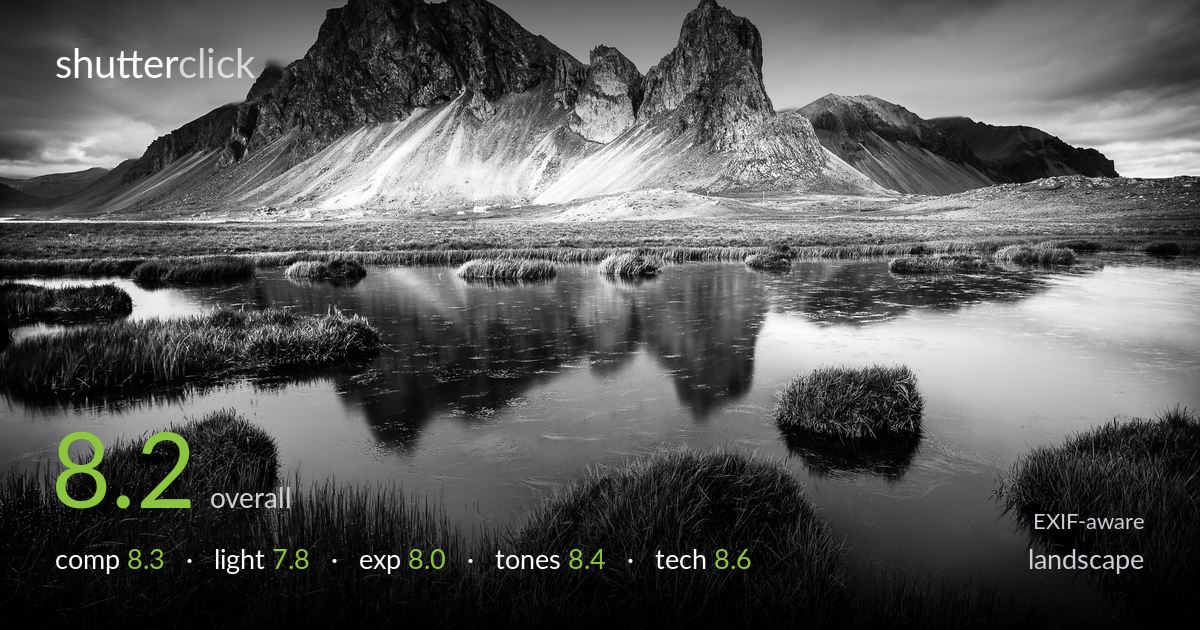
Brooding peak reflection
Photo by Martin Sojka

| Focal length | 21 mm |
| Aperture | f / 16.0 |
| Shutter | 2.5 s |
| ISO | ISO 50 |
| Exp. comp. | 0.0 EV |
| Shot at | 12:21 · Jul 24, 2011 |
A confident black-and-white landscape built on a strong foreground-to-peak relationship, with the grass tussocks and reflecting tarn carrying the eye to Eystrahorn's jagged ridge. The reflection of the mountain anchors the lower half and rewards the wide lens. What most holds it back is a slightly heavy, undifferentiated foreground mass at the bottom edge where the darkest grass loses separation, and a sky that, while moody, drifts toward flat grey on the right. The mountain face catches good directional light, but the overall mood is contemplative rather than dramatic. A strong, repeatable composition with refinement left mostly in the tonal edges.
The frame layers cleanly: textured grass foreground, a still tarn carrying the mountain reflection, and the dramatic ridgeline above. Placing the peaks in the upper third with reflection below is the right instinct, and the scattered tussocks create rhythm and depth across the water. The horizon sits well above center, giving the foreground room to work. The bottom-edge grass mass is a touch heavy and slightly competes with the cleaner mid-water tussocks. A small foreground anchor on the left would balance the rightward visual weight of the secondary peaks.
Directional light rakes across the main mountain face, separating the bright scree slopes from the shadowed ridges and giving the peaks genuine form. The overcast sky softens overall contrast, which suits the brooding mood but flattens the right-hand portion where cloud detail thins to grey. The foreground sits in even, diffuse light that renders the grass texture without harsh shadow. Timing reads as overcast rather than golden or blue hour; a break in the cloud catching the peaks would have lifted the drama considerably.
Exposure is well managed across a wide brightness range. Highlights on the bright scree and the water surface hold detail without clipping, and the sky retains tonal information rather than blowing out. The deepest foreground grass approaches pure black and loses some texture, which costs separation at the bottom edge, but this reads as a deliberate weighting toward the mountain. The reflection retains midtone gradation nicely. Lifting the darkest foreground shadows a touch would recover detail without flattening the contrast.
The monochrome conversion is the image's strongest asset. Contrast is well judged, with crisp separation between the sunlit scree and shadowed rock, and a smooth tonal range through the water and reflection. Mid-tone gradation in the sky carries the mood, and highlight roll-off on the bright slopes is controlled. The blacks in the foreground are deep, perhaps marginally crushed, but they ground the frame. A slightly more open shadow point would add foreground texture while preserving the dramatic tonal weight overall.
The settings are textbook for this scene. f/16 on the 21mm Distagon delivers front-to-back sharpness across the foreground grass, water, and distant peaks, and at this focal length f/16 stays clear of significant diffraction softening. ISO 50 keeps the file clean with maximum dynamic range, which shows in the smooth sky gradation and clean shadows. The 2.5-second exposure smooths the water surface just enough to render a glassy reflection while keeping the grass crisp, implying a tripod and either calm conditions or a deliberate slow shutter. The Zeiss lens resolves fine detail in the scree and grass blades convincingly, and corner-to-corner rendering is strong. Focus appears placed well into the scene, holding both near grass and far ridgeline acceptably given the deep depth of field. Only the slow shutter risks slight movement in any breeze-blown grass, but the foreground tussocks read sharp. A focus-stack would be unnecessary here given the aperture and subject distance; the single frame holds up well.
What would elevate it
Tags
Shot something like this?
Expert photo critique, on demand — scored across six categories, EXIF-aware. Start with 3 free critiques, no credit card.
critique my photo — free