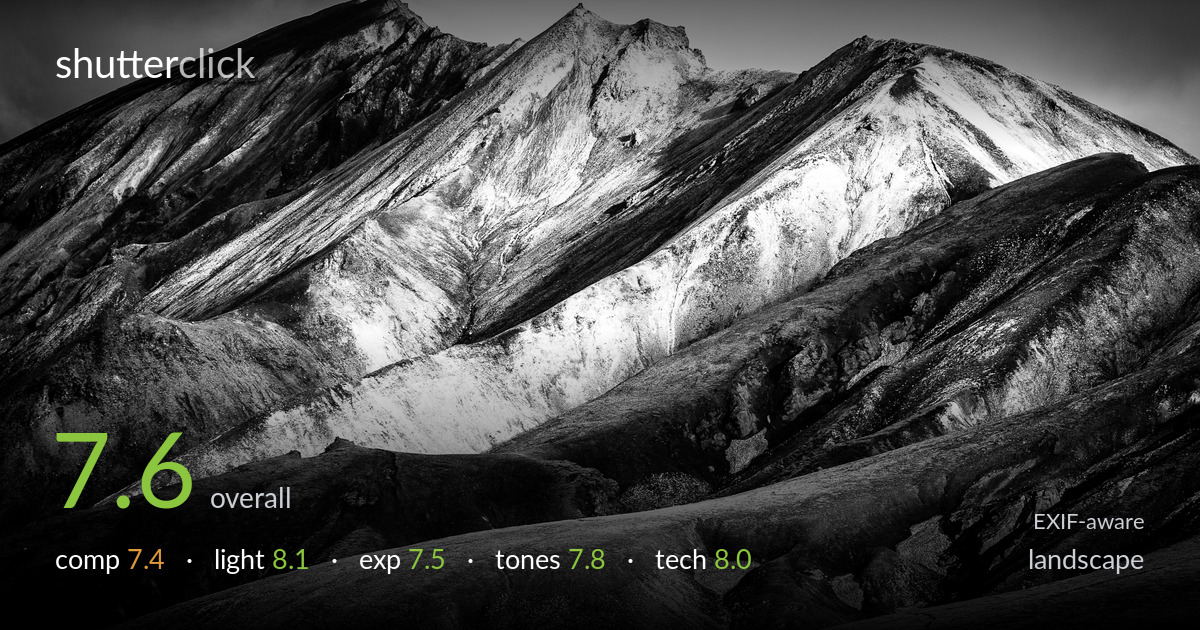
Brooding volcanic ridges
Photo by Martin Sojka

| Focal length | 200 mm |
| Aperture | f / 5.6 |
| Shutter | 1/500 s |
| ISO | ISO 100 |
| Exp. comp. | -0.33 EV |
| Shot at | 17:36 · Jul 21, 2011 |
A muscular, high-contrast monochrome study of volcanic ridges that reads more as abstract form than literal landscape — and that's its strength. The raking light carves out the diagonal ridgelines beautifully, separating the bright scree slopes from the dark flanks. The dramatic sky adds weight. What holds it back is a slightly undefined focal hierarchy: the eye wanders across many ridges without a clear anchor, and the deepest shadows have clogged to pure black in places, swallowing detail. A more selective frame and a touch of shadow recovery would sharpen the impact of an already commanding image.
The layered diagonal ridgelines create strong rhythmic movement from lower-right toward the peaks, and the brooding sky balances the dense lower two-thirds. The telephoto compression stacks the ridges into a satisfying tangle of form. The weakness is hierarchy: the bright central scree slope competes with the secondary peak and the foreground ridges, so the eye keeps moving without settling. The peaks sit high and slightly crowded against the top edge. A frame that gave the dominant ridge clearer primacy, or a little more sky breathing room, would resolve the tension.
The directional, raking light is the photograph's engine — it skims across the slopes and reveals every fold, gully, and texture in the volcanic surface, sculpting the diagonal ridges into three dimensions. The contrast between sunlit scree and shadowed flank gives real depth despite the compressed telephoto perspective. The overcast, turbulent sky adds mood without flattening the scene. The only caution is that the light is hard enough that some shadow flanks go fully opaque, losing the subtler tonal transitions that would have added another layer of dimension.
The -0.33 EV bias protects the bright scree highlights well — they retain texture rather than blowing out, which is the right priority here. The sky holds its gradient nicely. The cost is in the shadows: several of the darkest flanks have clamped to pure black, dropping detail that the raking light suggests was there. For this much dynamic range, the exposure is a reasonable compromise, but a slightly brighter capture with highlight pulled back in post, or bracketing, would have preserved more of the deep tonal information.
The black-and-white treatment suits this volcanic terrain — colour would only distract from the form and texture. Contrast is punchy and well judged for the dramatic mood, with clean white scree against near-black rock. Mid-tone gradation on the lit slopes is the strongest tonal asset, rendering the grain of the ash and rock. The deepest shadows have lost separation, however, reading as flat black mass rather than detailed dark. Lifting those shadows a touch and softening the contrast curve slightly would restore gradation without weakening the drama.
The settings are well matched to the conditions. At 200mm on the 5D Mark II, 1/500s comfortably eliminates any hand-shake at that focal length, and the telephoto compression is exactly the right tool for stacking these ridgelines into the dense, layered composition that gives the image its graphic power. f/5.6 provides ample depth of field for a distant subject at this distance — everything from the foreground ridges to the peaks falls within acceptable focus, and sharpness across the frame looks crisp where the light catches it. ISO 100 keeps noise non-existent, preserving clean tonality in both the sky and the textured slopes. The EF70-200mm f/4L is a sharp, well-corrected lens and it delivers here, resolving the fine grain of the volcanic surface. Focus appears accurately placed on the mid-ground ridges. The only refinement worth considering would be a polariser to manage any subtle atmospheric haze, though the contrast suggests conditions were already clear. Technically this is clean, deliberate work.
What would elevate it
Tags
Shot something like this?
Expert photo critique, on demand — scored across six categories, EXIF-aware. Start with 3 free critiques, no credit card.
critique my photo — free