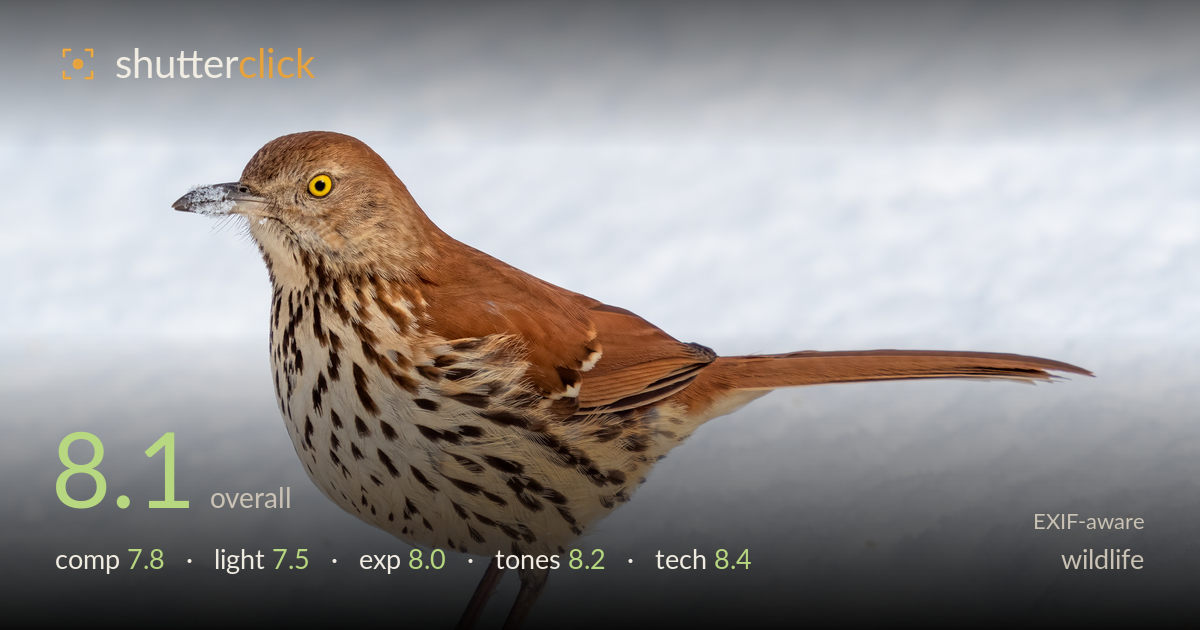
Brown thrasher on fresh snow
Photo by Rhododendrites

| Focal length | 190 mm |
| Aperture | f / 6.3 |
| Shutter | 1/640 s |
| ISO | ISO 400 |
| Exp. comp. | 0.7 EV |
| Shot at | 15:56 · Feb 20, 2021 |
A crisp, eye-level portrait of a brown thrasher on snow, with the tack-sharp yellow eye anchoring the frame and a clean white field isolating the bird beautifully. The low shooting angle earns the intimacy that separates a good wildlife shot from a snapshot. What holds it back most is composition: the bird sits low and slightly left with the long tail running to the far right edge, leaving a large empty upper zone. A touch more space ahead of the beak and less behind the tail would balance the gaze. Detail in the rufous plumage and speckled breast is excellent throughout.
The low, eye-level perspective is the strongest choice here, placing the viewer in the bird's world and rendering the snow as a soft, uncluttered canvas. The subject reads clearly against the white. However, the composition leans bottom-heavy, with the bird low in the frame and a wide swath of empty snow above. The long tail nearly touches the right edge while the beak has little breathing room, so the gaze feels cramped rather than open. Shifting weight to give the look-direction more space would settle the balance.
Soft, bright light from the front-left models the head and breast gently, and the snow acts as a natural reflector filling shadows under the chin and belly. A small catchlight in the eye adds life. The overall effect is clean but a little flat — the diffuse quality flattens the texture of the rufous back and wing feathers, and the highlights on snow verge on featureless. Lower, more raking side light near golden hour would rake across the plumage and add dimensional shadow to the snow.
The +0.7 EV compensation is a smart call, keeping the snow bright and white rather than the muddy grey an unaided meter would deliver. The bird's midtones sit well and the speckled breast retains full detail. Highlights on the brightest snow are pushed close to clipping but hold just enough texture to read as a surface rather than blown paper. Shadow detail in the darker wing markings is preserved. A cleaner histogram overall — deliberate and well-controlled for a high-key scene.
The rufous browns of the back and tail are rich and natural, contrasting handsomely against the cool white snow. White balance is neutral, letting the snow read clean without a colour cast while the warm plumage stays believable. The tonal range spans from the deep near-black wing spots to bright highlights with smooth gradation across the breast. The yellow eye pops without looking oversaturated. A slight risk of the snow leaning cool, but the warm/cool interplay here is well judged.
The 40-150mm f/2.8 with the MC-20 at 190mm (380mm equivalent) is a capable reach-and-quality combination, and it delivers here. Focus is precisely on the eye, which is critically sharp with fine feather detail across the head and breast. At f/6.3 the depth of field covers the bird well while still softening the snow into a clean backdrop — a sensible aperture given the teleconverter's effective aperture and the need for front-to-back sharpness on the body. 1/640s comfortably freezes a stationary bird, and ISO 400 keeps noise negligible with clean shadows. The MC-20 typically costs some sharpness, but stopping down slightly and nailing focus has recovered most of it. The only lingering note is that a marginally faster shutter would guard against any sudden head movement, though it wasn't needed here. Overall this is well-executed technical work — the gear was used to its strengths and focus accuracy is exactly where it counts.
What would elevate it
Tags
Shot something like this?
Expert photo critique, on demand — scored across six categories, EXIF-aware. Start with 3 free critiques, no credit card.
critique my photo — free