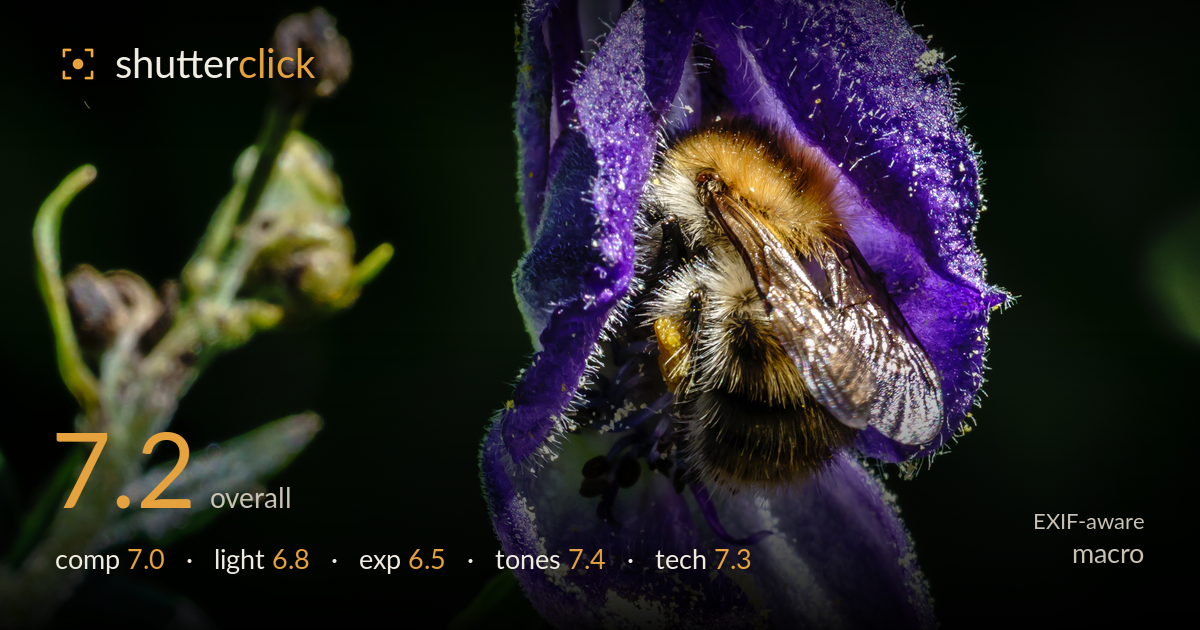
Bumblebee in a monkshood bloom
Photo by Franz van Duns

| Focal length | 90 mm |
| Aperture | f / 13.0 |
| Shutter | 1/80 s |
| ISO | ISO 160 |
| Exp. comp. | -3.0 EV |
| Shot at | 11:39 · Jul 1, 2018 |
A bumblebee half-buried in the hood of a monkshood flower makes a genuinely absorbing subject, and the pollen-dusted petals reward close viewing. The dark background isolates the bloom cleanly. What most holds the image back is the light: hard, high-contrast sun that blows the wing and the lower petal into featureless white while the bee's underside falls into deep shadow. The critical plane — the bee's head and the flower's throat — sits partly in shade, softening the impact. Toning down the harsh highlights and shooting in gentler light would lift this from good to strong.
The flower is placed high and right, leaving the diagonal stem and out-of-focus buds to anchor the lower left — a workable balance that gives the eye a path in. The bee tucked into the hood is a strong focal point. The dark negative space reads cleanly. The bloom sits close to the top edge, though, and a touch more headroom would let it breathe. The lower petal drooping out of frame is fine, but the composition leans slightly top-heavy overall.
Direct, hard sunlight is the weakest link. It rakes across the flower and catches the pollen texture nicely on the upper petals, but it also drives the wing and the pale lower petal to pure white and drops the bee's belly into near-black. The contrast range exceeds what the scene can hold gracefully. Backlight glancing through the wing is attractive, yet the harsh quality flattens the tonal transitions that give macro subjects their form. Softer, diffused light — or a diffuser between sun and subject — would tame it.
The -3.0 EV compensation protected the background and much of the purple, but the brightest specular areas — the translucent wing and the lower petal — still clip to white with no recoverable detail. Meanwhile the bee's shaded underside and the flower's deep throat sit very dark. This is the signature of a scene whose dynamic range outstrips the light. The midtones on the petals are well placed, but the histogram is stretched at both ends. A brighter fill or shaded conditions would compress that range.
The purple of the monkshood is rendered richly, with good saturation that stops short of turning garish, and the pollen's warm yellow plays well against it. White balance sits neutral to slightly cool, which suits the subject. The green stem and background carry natural hues without a colour cast. Contrast is high — partly the light, partly the grade — and that costs some mid-tone gradation in the petals. Pulling back global contrast slightly would restore subtlety to the velvety flower surfaces.
At f/13 on the 90mm Macro G, depth of field is stretched about as far as it usefully goes without diffraction robbing crispness — a sensible compromise for a subject this three-dimensional. The bee's near wing and the flower's front edge are sharp, and the pollen grains resolve beautifully, which speaks to solid focus placement on the critical plane. ISO 160 keeps noise a non-issue. The 1/80s shutter is the risk: handheld at this magnification, and with any bee movement, it is borderline, and slight softness in the bee's head suggests either a hair of motion or the subject falling just off the focus plane. On a tripod with a still subject that speed is fine, but for insect work a faster shutter with a touch more ISO, or flash to both freeze motion and fill shadow, would be the safer route. Focus stacking could also have carried sharpness deeper without pushing the aperture.
What would elevate it
Tags
Shot something like this?
Expert photo critique, on demand — scored across six categories, EXIF-aware. Start with 3 free critiques, no credit card.
critique my photo — free