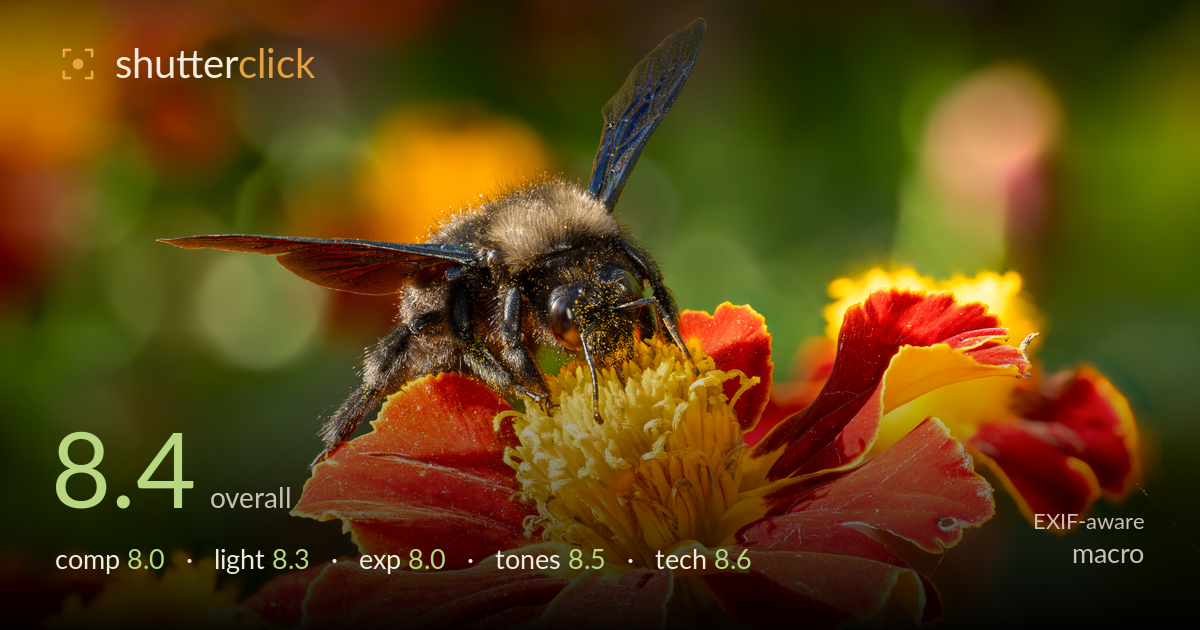
Bumblebee on a marigold
Photo by Reinhold Möller Ermell

| Focal length | 90 mm |
| Aperture | f / 5.0 |
| Shutter | 1/800 s |
| ISO | ISO 1000 |
| Exp. comp. | 0.0 EV |
| Shot at | 15:27 · Oct 26, 2024 |
A strong macro that pairs a sharp, textured bee with a vivid marigold and a warm, painterly wash of complementary bokeh. The eye and near facial detail carry crisp focus, and pollen grains dusting the fur and face are the payoff detail that rewards close viewing. What holds it back is the wing tips clipping the top edge and the depth of field falling off across the bee's abdomen and far wing, so the insect is only partly rendered sharp. The busy, high-saturation background occasionally competes with the subject. Tighter focus discipline and a hair more breathing room would push it higher.
The diagonal thrust of the bee across the flower head gives good energy, and the subject sits at a natural intersection rather than dead centre. The out-of-focus marigolds left and right frame nicely with a warm glow. The main weakness is the wing tips clipping the top frame edge, which cramps the insect and truncates its most graphic feature. The dense cluster of buds along the bottom adds context but pulls some attention downward. A little more headroom above the wings would let the subject breathe.
Warm, directional daylight rakes across the scene from the upper right, catching the yellow rim of the petals and separating the bee's fur from the darker body. The light shapes the fuzzy thorax and picks out individual pollen grains, which is exactly what this subject needs. It leans slightly hard, edging toward specular highlights on the petal margins, but stays within control. A touch of diffusion or shooting under lighter cloud would soften the harshest petal-edge highlights while keeping the modelling on the bee.
Exposure is well judged for a high-contrast, high-saturation scene. The bee's face and eye hold detail without muddying the dark body, and the yellow flower centre retains texture rather than blowing out. The brightest petal rims and background hotspots sit close to clipping but largely hold. Shadow areas in the black fur keep enough separation to read as form. Overall a confident, deliberate exposure; pulling the very brightest highlights back a fraction in post would protect the petal edges completely.
The colour is the picture's engine — the red-orange marigold against green and yellow bokeh is a rich, harmonious palette, and the warm grade suits the sunlit garden mood. Saturation runs high but stops just short of feeling artificial. White balance is warm and appropriate. Contrast between the dark bee and the glowing flower gives strong separation. The one risk is the reds edging toward saturation clipping in the deepest petals; a slight pullback there would preserve tonal gradation in the folds.
The 90mm macro at f/5.0 is a sensible choice for working distance and subject size, and 1/800s comfortably freezes both the bee and any petal sway. ISO 1000 on the OM-1 is well handled — noise is negligible and fine detail survives cleanly. Focus lands precisely on the near eye and facial region, with the pollen-dusted fur beautifully resolved. The trade-off is depth of field: at f/5.0 and this magnification, the far wing and the rear of the abdomen drift soft, so the insect isn't sharp end to end. Stopping down to f/8–f/9 would extend the plane, though it would demand more light or a higher ISO the OM-1 can absorb. A focus-stacked sequence would be the cleaner route to full-insect sharpness while keeping the background creamy. Execution is otherwise excellent — sharp where it counts, clean files, and shutter speed with margin to spare.
What would elevate it
Tags
Shot something like this?
Expert photo critique, on demand — scored across six categories, EXIF-aware. Start with 3 free critiques, no credit card.
critique my photo — free