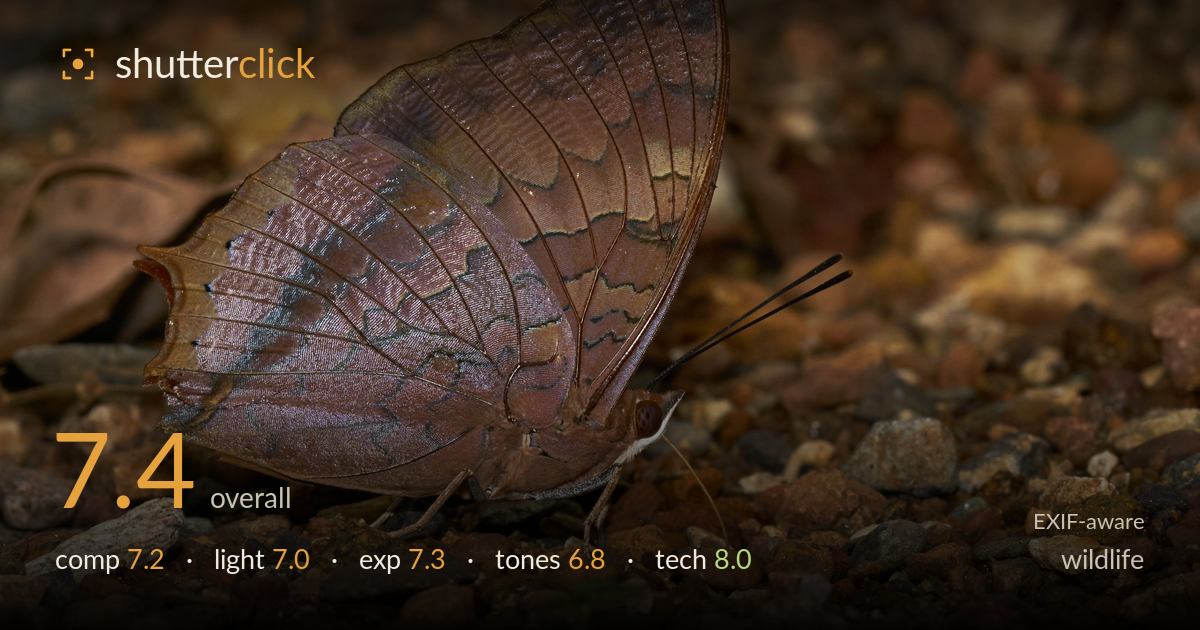
Butterfly puddling on gravel
Photo by Jeevan Jose, Kerala, India

| Focal length | 150 mm |
| Aperture | f / 14.0 |
| Shutter | 1/250 s |
| ISO | ISO 100 |
| Exp. comp. | 0.0 EV |
| Shot at | 10:49 · Oct 29, 2016 |
A clean, well-executed portrait of a butterfly mud-puddling, with the eye and antennae sharp and the wing patterning rendered in fine detail. The profile pose reads clearly and the shallow-looking background does its job of isolating the subject. What most holds the image back is the tonal monotony: the butterfly's brown-mauve wings blend with an equally brown gravel bed, so separation relies almost entirely on focus rather than contrast or colour. The frontal-fill lighting is even but flat, muting the iridescent scales that could have been the shot's strongest feature. A different light angle and a cleaner backdrop would lift a competent record into something more striking.
The side-profile placement works well, with the butterfly filling the left-central frame and antennae leading into open space on the right — good breathing room in the direction it faces. The low, near-ground-level angle puts the viewer in the subject's world. The wing tips brush close to the left edge, and a fraction more space there would ease the crop. The diagonal of the antennae adds a subtle dynamic line. Foreground gravel occupies useful space, but the busy substrate competes for attention rather than framing the subject cleanly.
Illumination is even and frontal, likely fill or diffused daylight, which keeps the whole insect legible and avoids blown highlights on the wing. The trade-off is flatness: the wings carry iridescent blue-violet and green scales that only flicker faintly here because the light hits them head-on rather than raking across. Shadows are soft and unobtrusive, keeping the eye and body detailed. A lower, more angled light source would catch and amplify those structural colours, turning a well-lit record into something with more depth and shimmer.
Exposure is well judged for a low-contrast subject on a bright substrate. Highlights on the pale wing edges and the gravel hold detail without clipping, and shadow areas beneath the body retain information. ISO 100 keeps the file clean with a smooth tonal ramp across the wing. The midtones sit slightly heavy, giving the overall frame a somewhat dark, muddy cast that suits the mood but flattens separation. A touch more brightness in post would open the shadowed underwing without risking the highlights.
This is the weakest link. The butterfly's brown-purple wings and the brown gravel occupy nearly the same tonal and colour range, so the subject doesn't pop as it should. White balance leans warm, reinforcing the overall brown wash. The subtle iridescence — the blues, greens and mauves in the wing scales — is present but undersaturated and easily lost against the background. Selective adjustment to cool and lift those structural colours, or to warm the background separately, would create the contrast the frame currently lacks.
The technical execution is the strongest aspect. At 150mm and f/14, depth of field is deep enough to hold the entire near wing, the body, the eye and the antennae in acceptable focus while still throwing the gravel background into soft blur — a sensible compromise for a subject of this depth. Focus lands precisely on the compound eye and head, exactly where it should for wildlife. ISO 100 delivers a clean, noise-free file with excellent detail retention in the wing scales. 1/250s is adequate here given the stationary, puddling subject and presumed flash or stable support; there's no visible motion blur or camera shake. The APS-C body with the 150mm macro gives useful working distance and magnification. The only refinement worth considering is that f/14 on this format begins to introduce diffraction softening — f/9 to f/11 with careful plane alignment might have preserved marginally crisper fine detail while still covering the subject depth. Overall, a technically assured capture.
What would elevate it
Tags
Shot something like this?
Expert photo critique, on demand — scored across six categories, EXIF-aware. Start with 3 free critiques, no credit card.
critique my photo — free