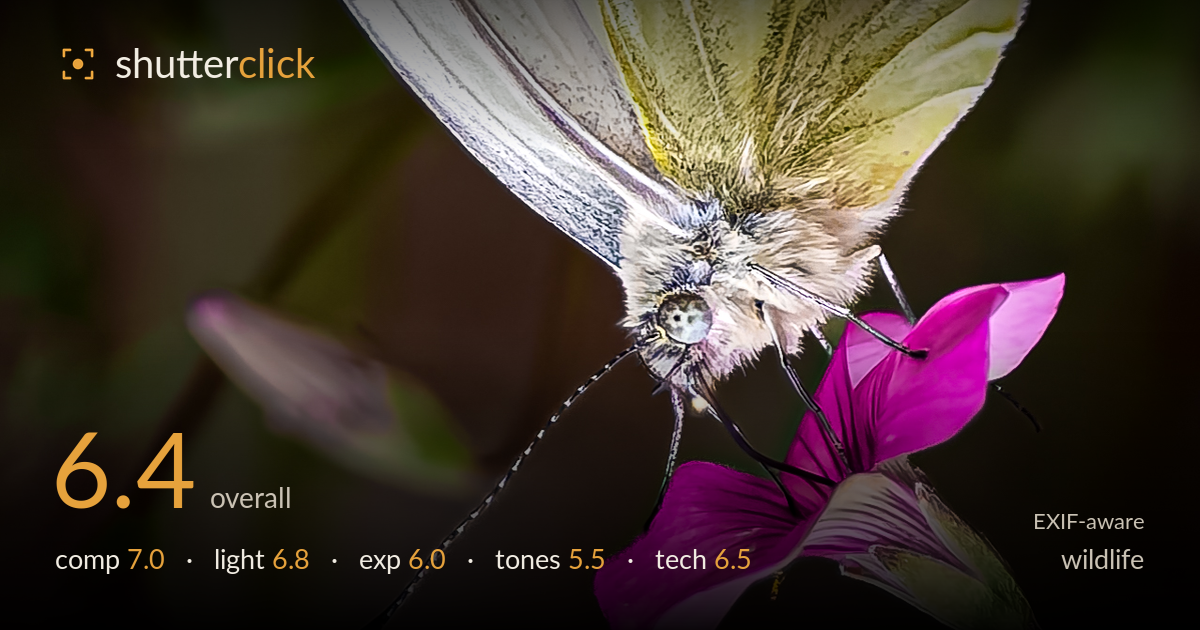
Cabbage white on a pink flower
Photo by Kresimir Jukic

| Focal length | 250 mm |
| Aperture | f / 5.6 |
| Shutter | 1/3200 s |
| ISO | ISO 1600 |
| Exp. comp. | 0.0 EV |
| Shot at | 12:59 · May 19, 2024 |
A cabbage white on a vivid pink flower makes a clean, colour-contrasting subject, and the low-key background isolates it well. What holds the frame back most is heavy-handed processing: aggressive sharpening and clarity have introduced haloing along the wing edges and a crunchy, over-textured look across the wing surface, while saturation has been pushed to a point where the pink flower and green tones read as artificial. The wings themselves are handled sharp, but the eye — the single most important plane in a wildlife shot — sits slightly soft. Dial back the processing and nail focus on the eye and this becomes a much stronger image.
The butterfly occupies the upper two-thirds with its wing sweeping diagonally into the frame, a strong arrangement, and the pink flower anchors the lower right as a natural resting point. The dark negative space gives the subject room to breathe. The proboscis and antennae lead the eye down to the flower nicely. Slightly more space beneath the flower would prevent the anchor feeling cramped against the bottom edge, and the wingtip at upper left brushes close to the frame border. Overall a well-judged, uncluttered layout.
The light is soft and directional, raking across the wing from the upper right to reveal the vein structure and delicate scaling — good timing for showing texture. The dark, shaded background makes the subject glow, a flattering separation. Highlights on the pale wing hold together reasonably, though the brightest yellow-green sections edge toward blown. A touch of fill or a shallower angle would soften the slightly harsh transition between the lit wing and its shadowed underside, but the overall quality of light suits the subject.
Exposure favours the pale wing, which is sensible given it is the largest tonal mass, but the brightest wing areas approach clipping and lose subtle gradation. The dark background retains adequate detail without crushing entirely. The pink flower is bright and holds together. The main issue is the overall processing lifting local contrast so aggressively that midtones feel forced rather than the exposure itself. A slightly more conservative highlight rendering would preserve the finer wing detail that currently borders on flat white in the top sections.
This is where the image suffers most. Saturation and local contrast are pushed hard, giving the magenta flower an electric, unnatural intensity and the wing a greenish cast that reads more like processing than reality. The heavy clarity produces a gritty, over-textured surface across the wings. White balance leans warm-green. Pulling saturation back, softening the clarity, and letting the whites of the wing stay clean would restore a more believable, delicate palette better suited to a butterfly's subtle colouring.
The settings are well chosen for the situation: 250mm at f/5.6 gives reach and a smooth background, 1/3200s freezes any wing tremor easily, and ISO 1600 is a reasonable trade for that shutter, with noise largely controlled in the shadows. Depth of field at f/5.6 and this magnification is shallow, which shows — the near wing edge and surface are sharp, but the eye and head are slightly soft, and in a wildlife image the eye must be the sharpest point. Stopping down to f/8 with such a fast shutter to spare would have brought the head and eye into the plane of focus without sacrificing background separation. The 1/3200s is far faster than needed here; lowering ISO or narrowing aperture were both available. Sharpness that does exist is partly the result of post-processing rather than optical resolution, evident in the haloing along wing edges — evidence the capture was slightly under-sharp and pushed in post.
What would elevate it
Tags
Shot something like this?
Expert photo critique, on demand — scored across six categories, EXIF-aware. Start with 3 free critiques, no credit card.
critique my photo — free