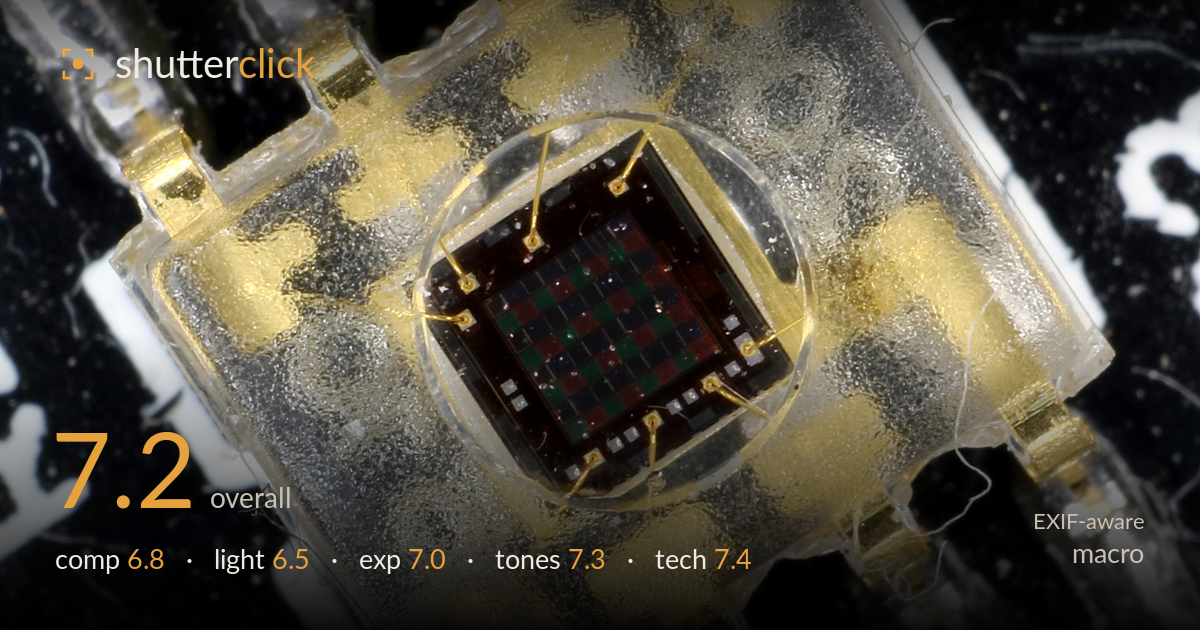
Camera sensor die up close
Photo by Prosthetic Head

| Focal length | 28 mm |
| Aperture | f / 14.0 |
| Shutter | 1.3 s |
| ISO | ISO 100 |
| Exp. comp. | 0.0 EV |
| Shot at | 20:44 · Apr 16, 2018 |
The diagonal orientation of the package gives the frame energy and the color Bayer array of the exposed sensor die reads as the clear focal point, well anchored near center inside its glass window. The lead pins radiate outward and act as leading lines toward the die. The tradeoff is that the subject sits almost dead-center, and the surrounding lens plastic occupies a lot of frame without adding much interest. A slightly tighter crop on the die and its bond wires would concentrate attention where the detail lives.
The lighting is broad and fairly flat, which keeps the transparent lens dome and gold pads legible but does little to model form or reveal micro-texture. The specular hits on the silver leads and the gold surfaces have some sparkle, but the glass dome scatters light unevenly, creating milky patches that obscure the die beneath. Raking, more directional light — or diffused axial light to control the dome reflections — would separate the wafer color array from the surrounding fog and give the metal contacts crisper definition.
Exposure is well controlled for a high-contrast subject: the bright gold and silver hold detail without blowing out badly, and the dark sensor die retains its color-filter pattern rather than crushing to black. The stray fibers against the black background are visible without lifting the shadows into mud. A few small specular clips on the polished pins are unavoidable and acceptable. The base ISO 100 keeps everything clean, and the overall midtone placement lets the die's Bayer grid stay readable, which is the shot that matters here.
The color palette is the strongest tonal element — warm gold pads, cool silver leads, and the jewel-like red/green/blue mosaic of the sensor die all coexist without a color cast. White balance looks neutral against the black substrate. Contrast is healthy and the transparent encapsulant carries a subtle range of grays. The one weakness is the milky, low-contrast haze in the dome plastic, which flattens local tonality where the eye most wants clarity. Slightly deeper local contrast on the die would make those tiny color squares sing.
At f/14 on a macro-scale subject the depth of field is stretched to cover the tilted package, and it mostly succeeds — the die, bond wires, and nearer leads hold acceptable sharpness. But f/14 on this sensor is well into diffraction territory, softening fine detail that a focus-stacked series at f/5.6–f/8 would render far crisper, especially on the Bayer grid and the hair-thin gold wires. The 1.3s exposure at ISO 100 is the right call for a static subject on a tripod, keeping noise negligible. Focus appears placed on the die plane, which is correct, though the front and rear pins fall off. The 28mm focal length on this body gives moderate magnification; a dedicated macro lens or higher-magnification setup would resolve the pixel array more convincingly. Overall the execution is deliberate and technically sound for a single frame — the main gains lie in trading the single deep-stop capture for a diffraction-free stack.
What would elevate it
Tags
Shot something like this?
Expert photo critique, on demand — scored across six categories, EXIF-aware. Start with 3 free critiques, no credit card.
critique my photo — free