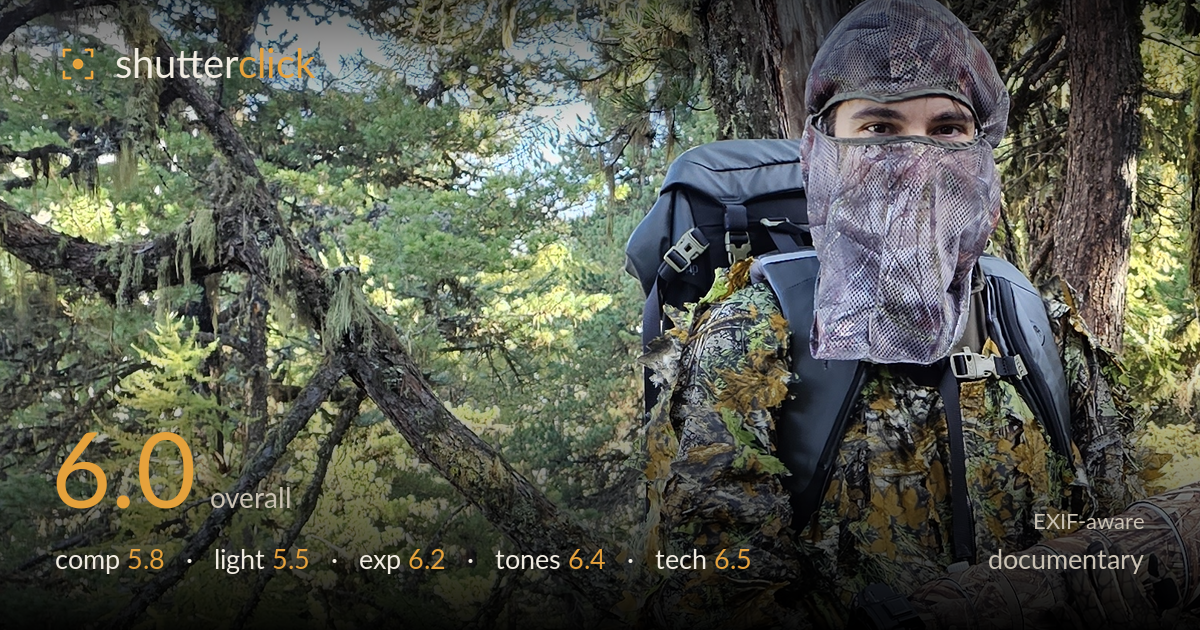
Camouflaged photographer on a forest trail
Photo by Giles Laurent

| Focal length | 6 mm |
| Aperture | f / 1.7 |
| Shutter | 1/100 s |
| ISO | ISO 125 |
| Exp. comp. | 0.0 EV |
| Shot at | 08:27 · Sep 24, 2023 |
A wildlife photographer in full leafy ghillie camouflage holding a lens is a strong documentary premise — the story of the person behind the reach lens is genuinely interesting. What most holds the frame back is that the camouflage does its job too well: the subject dissolves into the busy forest, and there's no separation or clear read. Dappled midday light scatters harsh highlights across the scene, further fragmenting attention. The moment is static rather than active — a posed standing figure. The narrative is there, but it needs a cleaner background, softer light, and a gesture that shows the work of stalking.
The subject stands roughly centred on a well-worn root-laced trail, which reads as documentary context. But the leafy camouflage merges almost completely with the surrounding foliage, robbing the figure of separation and forcing the eye to hunt for it. The tangle of exposed roots on the right is visually compelling and nearly competes with the subject. A vertical framing suits the standing figure, though the trees crop awkwardly at the top. Placing the subject against a simpler backdrop — the darker trunk or open trail — would let the story read instantly.
Dappled light filtering through the canopy is the central challenge here. It scatters bright hotspots across the ground, the roots, and the ghillie suit, breaking the scene into competing patches of highlight and shade. The subject's masked face sits in relative shadow, which works for a covert theme but loses the eyes. This is the flat, high-contrast light of an overhead sun through trees — difficult to control. An overcast moment or a position where the figure catches even, open light would unify the frame and lift the subject from the clutter.
Exposure is handled reasonably for a phone in mixed forest light. The brightest sky patch upper-left clips, and a few sunlit highlights on the ground blow, but the trail and camouflage retain detail, and shadow areas under the trees hold texture rather than crushing to black. The masked face is a touch dark, understandable given the light. Overall the histogram appears well spread with no gross error. Slight negative exposure compensation would have protected the sunlit highlights while the shadows had room to lift in post.
Colour is the phone's typically punchy rendering — the greens are saturated and the earthy trail warm, which suits the woodland documentary mood. White balance leans slightly warm but stays believable for filtered daylight. The tonal range is wide but the contrast is fragmented by the dappled light rather than by grading. Greens dominate to the point of monotony, and the camouflage's yellow-and-green pattern folds into that palette. A modest saturation pullback and a small contrast lift on the subject would help him stand apart from the foliage.
The Galaxy S23 Ultra's main sensor at f/1.7, 1/100s and ISO 125 was a sound automatic choice for the conditions — the low ISO keeps noise negligible and the shutter is ample for a static standing subject with no motion to freeze. Focus appears to land on the subject and the held lens, which is what matters. The tiny 6mm (roughly 24mm equivalent) wide focal length, however, is the core limitation: it renders everything front-to-back sharp, so the deep depth of field offers no background blur to lift the heavily camouflaged figure from the equally busy forest. A phone can't defeat that optically at this focal length. Framing from further back with the telephoto module, or stepping in closer, would compress the background and create separation. Sharpness and detail are good across the frame, and there's no visible motion blur or noise issue — the execution is clean; the choice of focal length for this subject-versus-background problem is what to reconsider.
What would elevate it
Tags
Shot something like this?
Expert photo critique, on demand — scored across six categories, EXIF-aware. Start with 3 free critiques, no credit card.
critique my photo — free