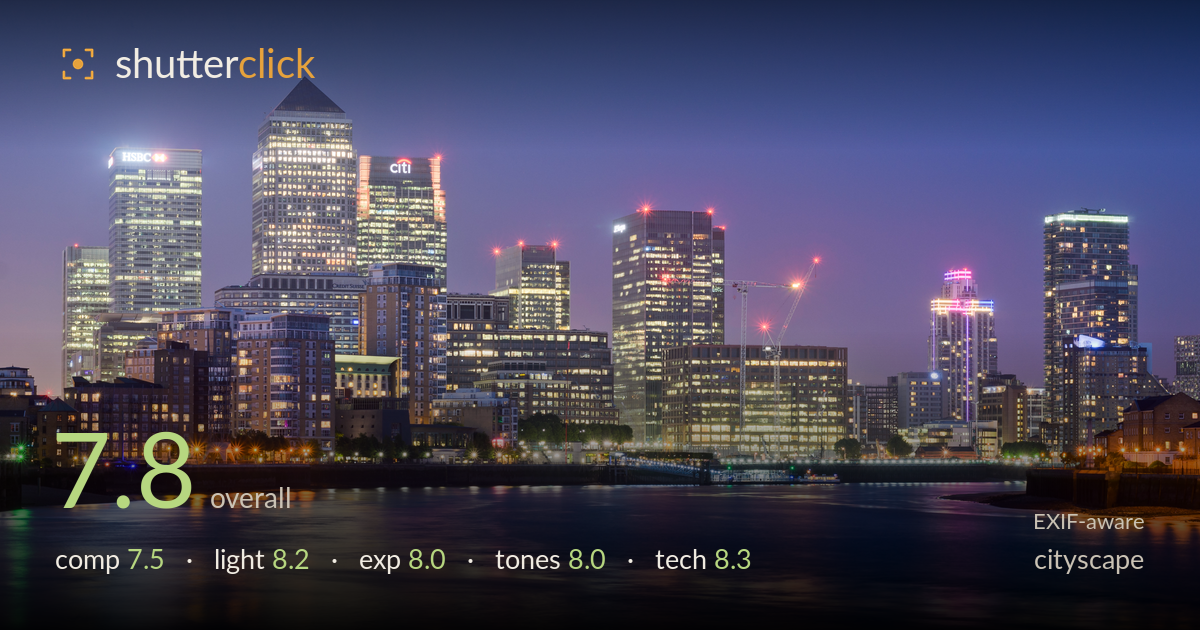
Canary wharf skyline at blue hour
Photo by King of Hearts

| Focal length | 50 mm |
| Aperture | f / 8.0 |
| Shutter | 4.0 s |
| ISO | ISO 100 |
| Exp. comp. | 0.0 EV |
| Shot at | 22:10 · Jun 5, 2016 |
A clean, well-timed blue-hour view of Canary Wharf, its greatest strength the balance between residual sky colour and the warm-cool mix of artificial light on the water. The reflections in the foreground river carry the frame and give it depth. What holds it back is a somewhat static skyline arrangement — the cluster of towers weights the left half heavily while the right thins out, and the horizon sits close to centre. A stronger anchor or a touch more layering in the foreground would lift a competent, technically sound image toward something more memorable.
The skyline layering reads well and the reflections anchor the lower third effectively. The tower cluster on the left, however, carries most of the visual weight, leaving the right side comparatively sparse and unresolved. The horizon sits near the vertical centre, splitting sky and water evenly rather than favouring one. The illuminated waterfront line runs cleanly across the frame as a horizontal divider. A slightly lower horizon to emphasise the reflections, or a foreground element to break the water's emptiness, would give the eye a clearer entry point.
The timing is the strongest decision here — caught at the tail of blue hour when the sky still holds deep blue-violet and the building lights read fully without going harsh. The balance between ambient sky and artificial illumination is well judged, neither overpowering the other. Warm sodium tones along the waterfront play nicely against the cooler tower glass. The starbursts on point lights confirm a controlled small aperture. Overall the light does exactly what a cityscape needs at this hour.
Exposure is handled with restraint. The bright window and signage highlights are largely held, with only minor clipping in the most intense lit panels — acceptable and hard to avoid at this brightness. Shadow areas retain enough detail to keep the lower buildings and waterfront legible without muddiness. The four-second exposure smooths the river while preserving the reflected colour. Midtones sit comfortably, and the overall brightness feels deliberate rather than lifted, giving a natural blue-hour weight throughout.
The colour grade leans into the blue-hour palette effectively, with the violet-blue sky reading true and the warm reflections providing welcome contrast. White balance is well managed given the mixed light sources — sodium, LED and fluorescent — without an overall cast dragging the scene one way. Saturation is healthy without tipping garish. The gradation from the deeper sky at top to the lighter horizon band is smooth. The water's colour reflections are the tonal highlight, carrying pinks and golds cleanly.
The settings are well matched to the task. f/8 on the 50mm sits in the lens's sharp range and gives adequate depth across a distant skyline while producing the tidy starbursts on point light sources. ISO 100 keeps noise negligible, and the four-second shutter is the right call for smoothing the river into soft reflected colour while the buildings remain static and sharp. A tripod is clearly in use given the crisp results at that duration. The 50mm on the D7000's crop sensor yields a roughly 75mm equivalent, a sensible focal length for compressing the skyline into layered planes. Focus appears accurately placed on the building cluster, and detail holds well through the mid-distance. The only technical caveat is a faint softness or atmospheric haze around the tallest towers, likely humidity rather than a focus miss. Overall this is a clean, deliberate execution with no significant flaws — the kind of technical baseline that lets composition do the deciding.
What would elevate it
Tags
Shot something like this?
Expert photo critique, on demand — scored across six categories, EXIF-aware. Start with 3 free critiques, no credit card.
critique my photo — free