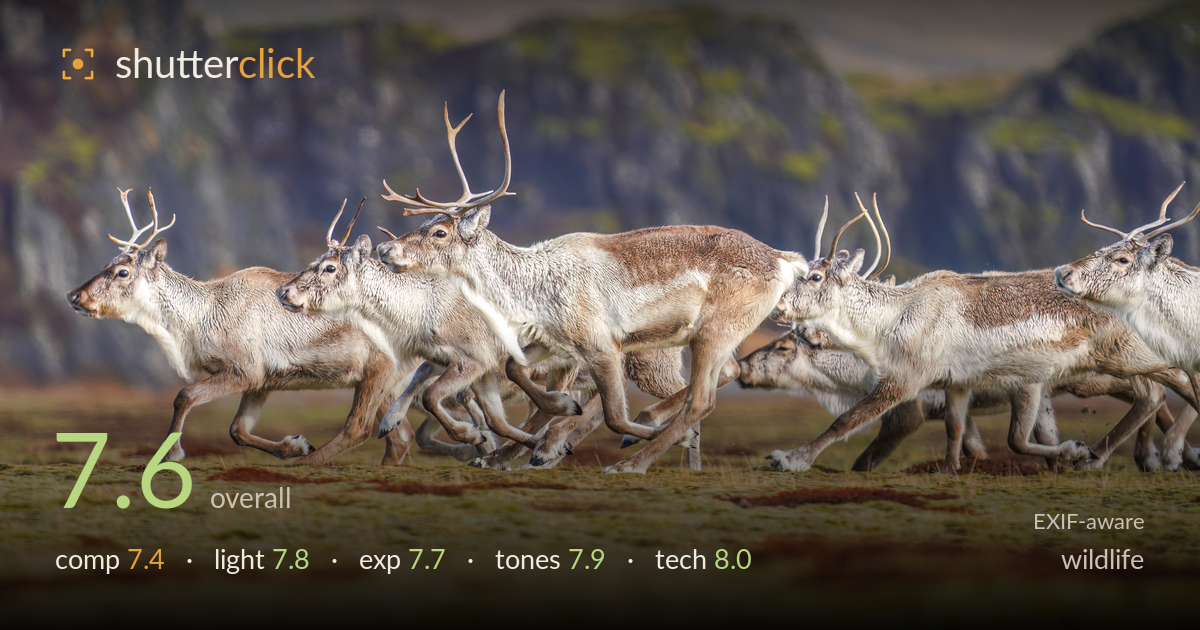
Caribou herd running across the tundra
Photo by Giles Laurent

| Focal length | 600 mm |
| Aperture | f / 6.3 |
| Shutter | 1/1000 s |
| ISO | ISO 320 |
| Exp. comp. | 0.0 EV |
| Shot at | 11:09 · Mar 24, 2022 |
A dynamic herd-in-motion frame that conveys real energy — the caribou running left in unison, legs mid-stride, is the kind of behaviour that carries a wildlife image. The autumn tundra palette and soft-focus cliff backdrop do a lot to isolate the animals. What holds it back is the density of the group: overlapping bodies and a thicket of antlers make it hard for the eye to settle on one clear subject, and the lead animal, while positioned well, competes with the pack behind it. The layering reads as chaos in places rather than choreographed movement. Sharpness and moment are strong throughout.
The left-running herd fills the frame with momentum, and leaving space ahead of the lead animal gives the motion somewhere to go. The low, near-eye-level perspective connects the viewer to the running animals. The problem is subject clarity: seven or more caribou overlap into a tangle of legs and antlers with no single hero animal winning the eye. The lead bull on the left is the natural anchor but the crowd behind dilutes it. A moment with slightly more separation between individuals, or a tighter crop on the leaders, would clarify the read.
Warm, low-angle sunlight rakes across the herd from the front-left, catching the pale flanks and giving the coats dimension and a clean rim on the leading edges. It suits the autumn palette and the golden tundra. The light is directional enough to model form without crushing shadow detail. The out-of-focus cliff face behind carries a pleasant mix of warm rock and green moss that the same light activates. Slightly softer, more diffuse conditions would have tamed some of the brighter highlight patches on the white bellies.
Exposure is well handled for a bright, high-contrast scene. The pale flanks and white bellies retain texture rather than blowing out, and the darker brown backs and legs hold detail. The +0.0 EV was the right call — no compensation was needed given the balance of light and mid-tone tundra. Shadows under the animals stay open. The brightest belly patches sit near the top of the histogram but appear controlled. The overall tonal placement reads deliberate and clean, with headroom preserved in the highlights across the herd.
The autumn palette is the image's quiet strength — russet and gold tundra, warm rock, muted green moss, all coherent and seasonal. White balance leans warm, which flatters the scene without tipping into orange. The caribou coats span cream, tan and chocolate, and that range is rendered with good separation. Contrast is punchy but not harsh. The foreground grass in the lower third is a touch busy and yellow-heavy, slightly competing for attention. A subtle pullback of saturation in that band would keep the eye on the animals.
The 600mm at f/6.3, 1/1000s and ISO 320 is a textbook wildlife setup for this situation, and the execution backs it up. The shutter speed freezes the running herd cleanly — legs and hooves are crisp with no unwanted motion blur, which is difficult with a full herd moving laterally. Focus lands on the lead animals with sharp eyes and coat detail, and the shallow depth of field from the long lens at f/6.3 melts the cliff into a soft, non-distracting backdrop while still keeping the herd acceptably sharp front to back. ISO 320 keeps noise a non-issue and preserves clean shadows. The 200-600 G is well suited to the reach required. The only technical caveat is depth of field at 600mm — the deepest animals soften slightly, and stopping to f/8 would have pulled the rear of the pack into focus, though at some cost to background separation and shutter latitude. A solid, well-judged capture.
What would elevate it
Tags
Shot something like this?
Expert photo critique, on demand — scored across six categories, EXIF-aware. Start with 3 free critiques, no credit card.
critique my photo — free