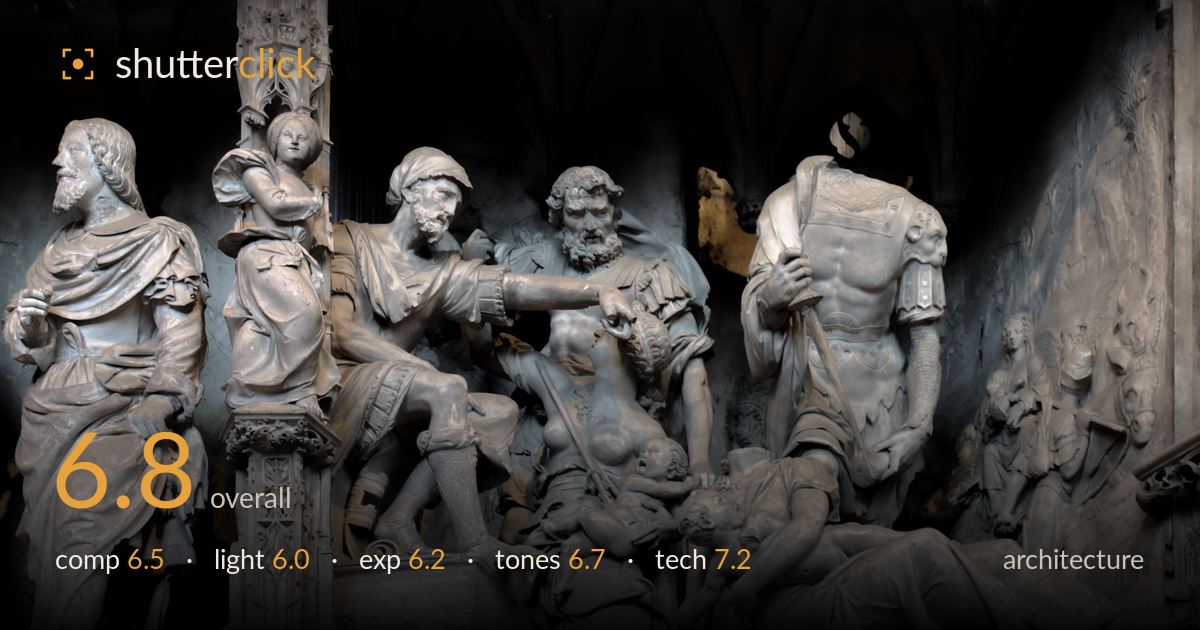
Carved figures on a gothic choir screen
Photo by Eusebius

No EXIF metadata in this file
Technical analysis based on visual assessment only.
A richly detailed record of a Gothic choir screen sculptural group, well served by even, diffuse interior light that preserves the intricate stone carving. The strongest asset is resolution and clarity across the frame — the anguished narrative figures and the delicate tracery above both hold fine detail. What most holds it back is framing: the composition sits between a documentation shot and a considered image, with a cut-off relief panel on the right and an ornamental pier bisecting the scene. The deep shadow voids behind the arches swallow detail, and the flat frontal light leaves the carving without much sculptural modelling.
The frontal, squared-on approach suits architectural documentation and keeps the tracery arcade above reasonably level. But the pier at left-of-centre awkwardly bisects the narrative group, and the relief panel on the far right is cropped mid-scene, feeling arbitrary rather than deliberate. The numbered plinth anchors the base usefully. A choice between isolating the central figural group cleanly or committing to the full bay would read more decisively than the current halfway framing, which leaves elements competing without a clear hierarchy.
The soft, diffuse ambient light is kind to the stone and avoids harsh specular hotspots on the polished surfaces, which is appropriate for capturing carved detail. The trade-off is flatness — frontal, nearly shadowless light gives the figures little three-dimensional relief, and the drama of the massacre scene is muted. The recessed arches fall into near-total black, losing the vaulting detail. A touch of raking side light, or shooting when directional window light grazed the surfaces, would reveal far more form.
Exposure is placed to protect the mid-tone stone, and the carved surfaces sit comfortably without blown highlights on the brightest polished passages. The cost is the deep arch recesses, which block up into featureless black and discard architectural information a viewer would want. There is warm colour cast bleeding in at upper mid-frame that hints at additional light sources the exposure hasn't balanced. A slightly brighter shadow lift, or bracketing to recover the vault interiors, would broaden the tonal story.
The cool grey palette reads honestly for aged limestone, and the subtle blue-grey cast lends a fitting solemnity to the scene. Contrast is moderate and the mid-tone gradation across the drapery folds is handled well, preserving the sculptor's modelling. The intrusion of a warm ochre patch upper-right sits at odds with the otherwise unified cool tone and pulls the eye. A more consistent white balance, or local correction of that warm spill, would keep the tonal mood coherent across the frame.
Sharpness is the clear strength here — detail resolves crisply from the foreground apostle figure through to the fine crocketed tracery in the upper register, suggesting a well-chosen aperture with enough depth of field to hold the shallow relief planes front to back. Noise is well controlled in the mid-tones, indicating a sensible ISO for the light available. Focus appears accurately placed on the central figural group. The lens shows good corner-to-corner rendering without obvious softness, and vertical lines stay largely true, implying either a level shooting position or careful correction. The main limitation is dynamic range capture: the darkest recesses clip to black, and no bracketing appears to have been used to recover them. For architectural sculpture at this resolution, the execution is solid; the shadow information loss is the one technical decision that leaves the record incomplete. A tripod and a longer exposure would have opened those voids without penalty.
What would elevate it
Tags
Shot something like this?
Expert photo critique, on demand — scored across six categories, EXIF-aware. Start with 3 free critiques, no credit card.
critique my photo — free