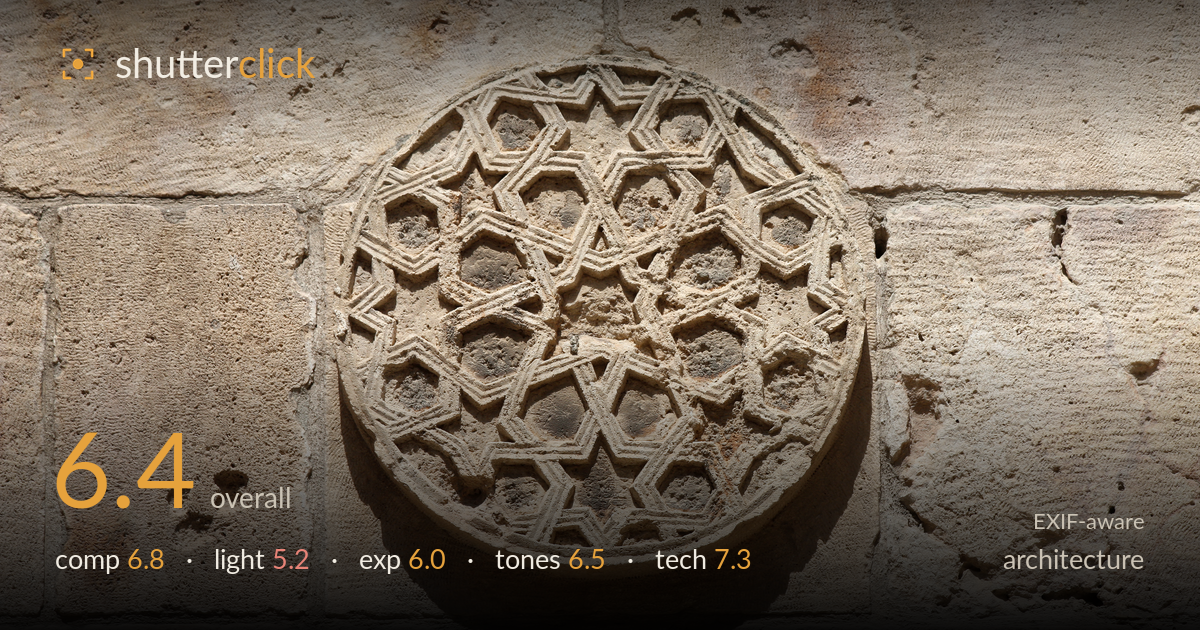
Carved star medallion in stone
Photo by Wikimedia Commons

| Focal length | 150 mm |
| Aperture | f / 8.0 |
| Shutter | 1/400 s |
| ISO | ISO 100 |
| Exp. comp. | 0.0 EV |
| Shot at | 12:39 · Apr 15, 2010 |
A well-centred documentation of a carved stone rosette that captures the geometric interlace clearly, but harsh overhead light flattens the very relief the subject depends on. The medallion sits slightly high and left of centre against a symmetrical grid of ashlar blocks, giving a reasonable sense of place. The strongest problem is timing: midday sun with the disc in near-full flat frontal light leaves the star-and-hexagon carving reading as pattern rather than sculpture, and blows the upper stones toward white. Raking light and a colour reference would lift this from a record shot toward a photograph that conveys the carving's depth.
The medallion is placed just off dead-centre, high and left, which reads as intentional and lets the surrounding ashlar grid frame it symmetrically. Mortar lines act as a quiet supporting geometry that echoes the disc. The shadow beneath the disc anchors it and gives a small hint of relief. The framing is a touch loose — the stone extends uniformly on all sides without adding information, and a tighter crop would let the interlace fill more of the frame. Slight rotation would true up the horizontal joints.
The single biggest limitation. Near-frontal midday sun strikes the carving almost head-on, minimising the micro-shadows that would reveal the depth of the incised star pattern, so much of the relief reads flat. Only the bottom rim casts a meaningful shadow. The upper wall stones receive stronger light and drift toward the highlight end, adding to the flatness. Low, raking side light — early morning or late afternoon — would rake across the grooves and turn the pattern into genuine three-dimensional sculpture.
Overall brightness is acceptable and the shadowed rim retains detail, but the upper wall stones are pushed close to clipping under the direct sun, losing texture in the brightest patches. The carving itself sits in the upper midtones with room preserved, so the detail is recoverable. A third-stop of negative compensation, or metering for the brightest stone, would have protected those highlights. The histogram likely leans right; pulling it back would keep the whole ashlar surface tonally consistent.
The warm sandstone palette is coherent and pleasant, with earthy ochres and buff creams that suit the subject. White balance sits slightly warm, which flatters the stone without feeling artificial. Contrast is moderate but the flat light limits tonal separation within the carving, so the interlace lacks the tonal punch that would make it read at a glance. Micro-contrast in the shadowed lower grooves is the strongest area. A subtle clarity or local-contrast lift on the disc would help the pattern stand out.
The settings are well matched to the task. f/8 on the 150 mm end is the sweet-spot aperture for edge-to-edge sharpness across a flat, frontal subject and delivers ample depth of field to hold the entire disc and surrounding stone crisply. 1/400 s at 150 mm is well above the safe hand-held threshold for this focal length, so any softness is not from shake. ISO 100 keeps noise absent and tonal gradation clean, ideal for a static architectural detail in bright light. Focus appears accurately placed on the carving, and the interlace edges resolve well where light permits. The 450D's older sensor shows its age slightly in highlight latitude, which compounds the near-clipped upper stones, but that is a lighting-timing issue more than an execution error. The one refinement would be a polarising filter to cut the sheen on the sunlit stone and deepen the surface texture. Solid, deliberate technical choices throughout.
What would elevate it
Tags
Shot something like this?
Expert photo critique, on demand — scored across six categories, EXIF-aware. Start with 3 free critiques, no credit card.
critique my photo — free