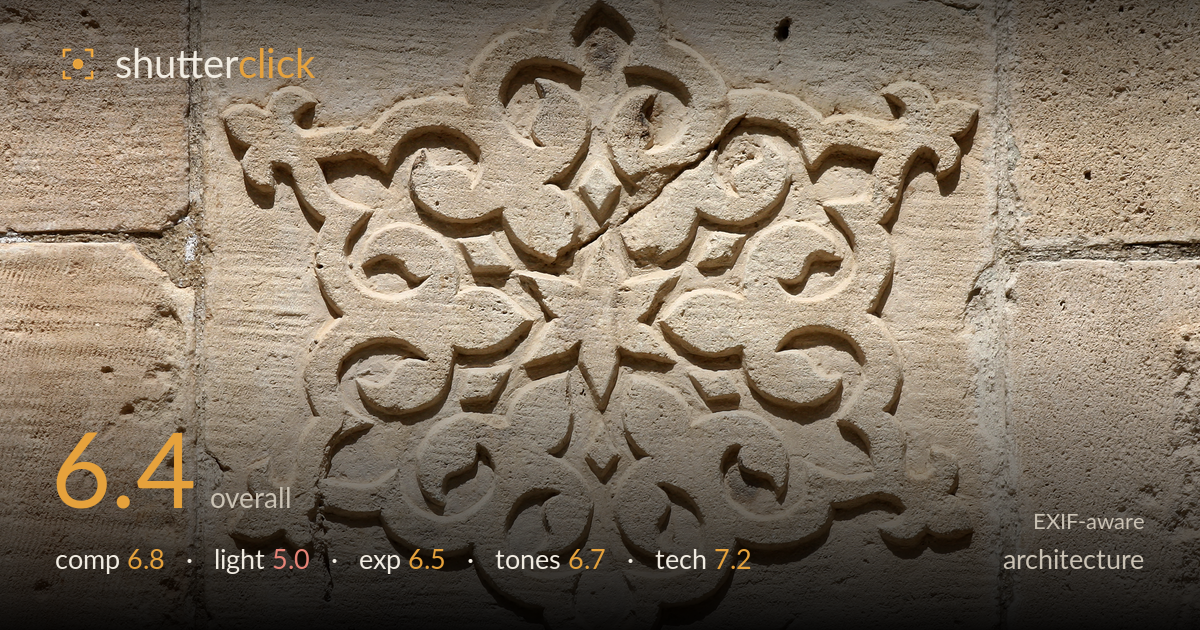
Carved stone rosette on a wall
Photo by Wikimedia Commons

| Focal length | 140 mm |
| Aperture | f / 9.0 |
| Shutter | 1/400 s |
| ISO | ISO 100 |
| Exp. comp. | 0.0 EV |
| Shot at | 12:39 · Apr 15, 2010 |
A well-centred document of a carved stone rosette, competently squared to the wall and sharp enough to read the tooling in the stone. The flat, near-frontal midday light is what most holds it back: it renders the relief without the raking side illumination that would separate the carving from its background block and give the scrollwork dimension. As a straight architectural-detail record the framing works, but the ornament and the surrounding masonry sit at almost the same brightness, so the motif never fully lifts off the wall. Light timing is the single biggest lever here.
Centring the rosette suits a symmetrical, catalogue-style architectural record, and the square crop matches the roughly square host block. The surrounding masonry joints frame the motif reasonably, though the block above is cut tight while more room is given below. The dark stone intruding at the bottom edge is a distraction that pulls the eye out of the frame. Squaring to the wall is clean and the verticals hold. A slightly higher placement to balance the lower margin would tighten the geometry.
Hard, near-frontal midday sun is the weakest element. Because the light strikes the wall almost head-on, the carved relief casts minimal shadow and the ornament reads flat, barely separating from the stone block behind it. Raking side light would deepen the recesses, model the scrollwork, and reveal the depth of the carving. The current light does render surface texture in the stone evenly, but for relief sculpture it sacrifices the dimensionality that defines the subject. Timing, not exposure, is the fix.
Exposure is safely handled for a bright stone surface in full sun. Highlights on the pale limestone hold detail without clipping, and the midtones sit where they should for a light subject. Shadow detail is present throughout, though there is little shadow to speak of given the flat light. The frame reads slightly bright overall, which combined with the frontal light flattens contrast. A touch of negative compensation would have added density and helped the carving read against its surround.
The warm sandstone palette is rendered honestly, with white balance leaning appropriately warm for sunlit limestone. Tonal range is narrow by nature of the subject and light, everything sitting in a band of pale beige, which limits separation. The intrusion of the darker, redder stone at the base breaks the otherwise consistent colour. Contrast is on the low side; a modest boost or local dodging of the carved recesses in post would help the ornament stand apart from the wall.
The settings are well matched to the task. At 140mm on the APS-C sensor the field of view is a sensible tight-detail crop, and f/9 gives ample depth of field to hold the entire relief plane sharp against the wall, which it does across the frame. ISO 100 keeps the file clean with no visible noise in the flat stone areas, and 1/400s is far more than needed for a static subject on a tripod-steady or handheld shot at this focal length. Focus lands accurately on the carving. The main technical limitation is not a settings error but the choice to shoot in flat frontal light, which no aperture or shutter value can compensate for. Everything the gear controls is executed correctly; the improvement lies in when the frame was made rather than how. A polariser could also have cut some of the surface glare on the brighter stone and marginally deepened the tone.
What would elevate it
Tags
Shot something like this?
Expert photo critique, on demand — scored across six categories, EXIF-aware. Start with 3 free critiques, no credit card.
critique my photo — free