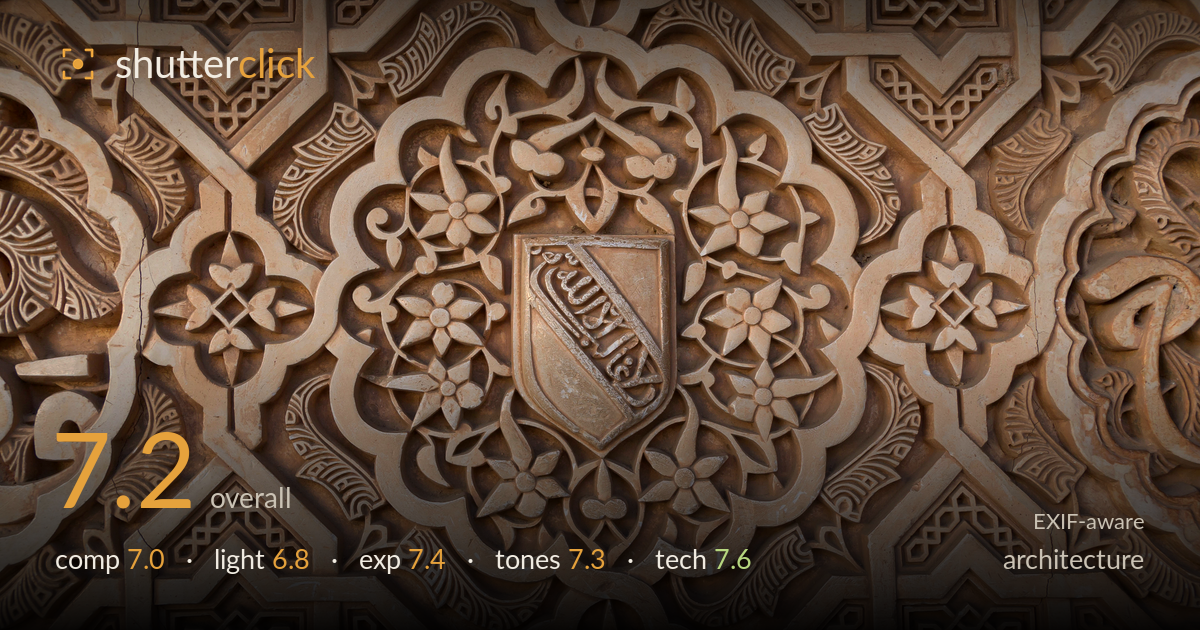
Carved stucco shield and arabesque
Photo by Jebulon

| Focal length | 20 mm |
| Aperture | f / 8.0 |
| Shutter | 1/60 s |
| ISO | ISO 200 |
| Exp. comp. | 0.0 EV |
| Shot at | 08:43 · Aug 14, 2012 |
A richly detailed frame-filling study of Nasrid stucco carving, anchored by the central inscribed shield within its scalloped medallion. The chief strength is the density and legibility of relief across the plane — the eye lands cleanly on the escutcheon, then wanders the surrounding arabesque. What most holds it back is the flatness of the light, which is even enough to read the ornament but too soft to carve the deep undercuts into full dimensionality. The overall pattern is symmetrical in spirit but the framing is slightly off-centre, leaving the geometry feeling almost but not quite resolved. Strong reference-quality documentation with room for more sculptural drama.
The scalloped medallion and central shield give the frame a clear anchor, and filling the frame edge to edge with the pattern is the right instinct for this subject. The problem is the shield sits low and slightly left of true centre, so the surrounding symmetry reads as almost-aligned rather than deliberately balanced. The eight-pointed stars at the corners are cropped unevenly, which betrays the underlying grid. A squarer, more precisely centred crop on the medallion, or a wider capture including complete surrounding motifs, would let the geometry resolve rather than feel arbitrarily bounded.
The light is soft and directional enough to reveal the carving without harsh shadow, which keeps the fine incised detail legible across the whole plane. But that same softness is the limiting factor: the deep undercuts and layered relief that make this stucco so three-dimensional stay muted, and the surface reads flatter than it is. A lower, more raking side light would rake across the relief and separate foreground scrollwork from the recessed ground. As shot, texture is described rather than dramatised.
Exposure is well judged for the pale sandstone tones — highlights on the raised edges hold detail without clipping, and the recessed shadows retain information rather than blocking to black. The histogram sits comfortably in the upper midtones, appropriate for the light-coloured stucco. Nothing looks accidental here. The only reservation is that the even, midtone-heavy exposure reinforces the flatness; a touch more shadow depth in the undercuts would add dimensionality, but that is a lighting choice rather than an exposure error. Technically clean and deliberate throughout.
The warm sandstone palette is rendered honestly — a coherent range of ochre, cream and pale tan with believable white balance under what appears to be shaded daylight. Contrast is gentle, which suits the material but contributes to the overall softness. The tonal gradation across the relief is smooth and free of colour casts. A modest contrast lift or a slight cooling of the shadows against the warm highlights would add separation and let the shield's inscription stand out more decisively from its surround.
The settings are well matched to the subject. At 20mm and f/8 on this APS-C body the whole carved plane sits within the depth of field, and since the wall is essentially flat and parallel to the sensor, front-to-back sharpness is a non-issue — f/8 also lands near the lens's optimal aperture, so corner-to-corner detail is strong. ISO 200 keeps noise negligible and preserves the fine incision in the stucco. The 1/60s shutter is safe for a static subject handheld at this focal length, and there is no visible motion blur or camera shake. Focus is placed accurately on the central shield and holds across the frame. The main technical caution is that the flat, frontal capture, while dimensionally clean, does nothing to counter the soft light — a tighter aperture would gain nothing here, but a small tripod-enabled shift to a longer exposure at lower ISO would allow shooting in the raking light of early or late day without shake. Execution overall is precise.
What would elevate it
Tags
Shot something like this?
Expert photo critique, on demand — scored across six categories, EXIF-aware. Start with 3 free critiques, no credit card.
critique my photo — free