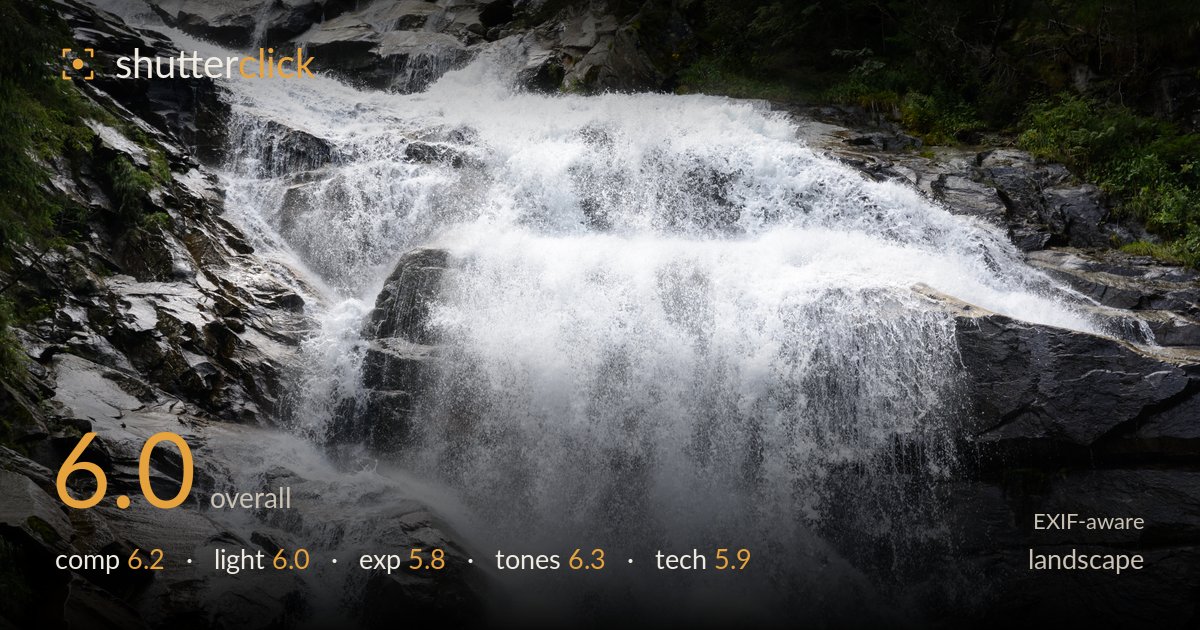
Cascade over wet granite
Photo by Uoaei1

| Focal length | 60 mm |
| Aperture | f / 8.0 |
| Shutter | 1/350 s |
| ISO | ISO 400 |
| Exp. comp. | 0.0 EV |
| Shot at | 12:54 · Aug 17, 2021 |
A powerful waterfall rendered with a fast shutter that freezes the spray into frozen droplets rather than the silky flow this subject usually invites. The diagonal cascade carries the eye well from upper right to lower left, and the wet granite offers good textural contrast against the white water. What most holds the image back is the shutter decision: at 1/350s the water reads as chaotic and busy rather than deliberate. Flat overcast light keeps the whites near clipping while the surrounding rock stays murky. A stronger point of interest and a longer exposure would elevate the raw energy on offer here.
The diagonal flow from upper right down to lower left gives the frame a natural sense of movement and energy. The wet dark rock frames the white water effectively, and the ledge in the mid-frame creates a foreground anchor. However, the composition lacks a single clear focal point — the eye wanders across competing streams. The top edge crops the falls somewhat arbitrarily, and the busy dark forest at right adds little. A tighter framing on one cascade, or including more of the plunge base, would give the eye a stronger place to rest.
Soft, even overcast light suits waterfall work by taming the extreme contrast between white water and dark rock, avoiding blown highlights from direct sun. It renders the wet granite's texture without harsh shadow. The trade-off is flatness: there's no directional modeling to give the rock dimension or the scene mood. The light is workable but unremarkable, and the diffuse conditions leave the whole frame feeling slightly grey and low in energy despite the water's obvious force. A break of directional light on the water would add sparkle.
Exposure is a difficult balancing act here and the brightest cascades push right against clipping — the densest whitewater loses texture in places. Meanwhile the shadowed rock and forest sink into muddy near-black with little recoverable detail. The dynamic range of the scene simply exceeds what a single frame handles comfortably under this metering. A third-stop of negative compensation would have protected the highlight structure in the foam. The midtones on the grey rock sit reasonably, but the extremes at both ends are compromised.
The muted palette of grey granite, white water, and deep forest green reads naturally and suits the damp mountain setting. White balance is neutral, perhaps very slightly cool, which is appropriate for overcast conditions. Contrast is moderate and the tonal range is compressed by the flat light — the image wants for a bit more separation in the darker rock. The greens in the surrounding vegetation are subdued and slightly desaturated. Overall the tones are honest and cohesive, if lacking a little punch and depth.
The f/8 aperture is a sound choice for front-to-back sharpness across this rock face, and ISO 400 keeps noise negligible at this exposure. Focus appears accurate on the central cascade, and 60mm on the 16-80 is a reasonable focal length to isolate this section of the falls. The critical misstep is shutter speed: 1/350s freezes the water into a mass of individual frozen droplets, robbing the falls of the flowing motion that gives waterfall images their appeal. For this subject, a tripod and a shutter around 1/4 to 1s — requiring a smaller aperture, base ISO, or an ND filter given the daylight — would render the silky, deliberate flow that overcast light is ideal for. Handheld at 1/350s the sharpness is fine, but the aesthetic opportunity of long exposure is left on the table. The gear was entirely capable; the exposure triangle was simply optimized for the wrong outcome.
What would elevate it
Tags
Shot something like this?
Expert photo critique, on demand — scored across six categories, EXIF-aware. Start with 3 free critiques, no credit card.
critique my photo — free