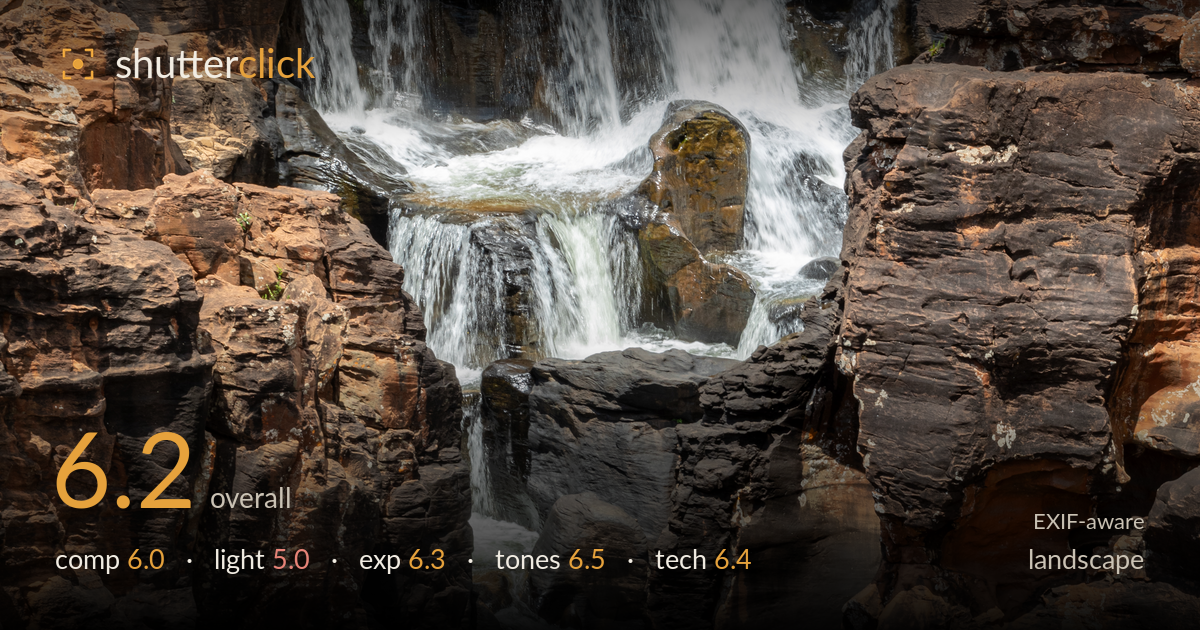
Cascade tumbling through carved rock
Photo by Dietmar Rabich

| Focal length | 50 mm |
| Aperture | f / 18.0 |
| Shutter | 1/50 s |
| ISO | ISO 200 |
| Exp. comp. | 0.0 EV |
| Shot at | 09:36 · Feb 20, 2024 |
A dramatic multi-tier cascade rendered with strong rock texture, but flat midday light and only partial motion softening keep it short of its potential. The waterfall snakes convincingly through the frame, and the layered rock formations carry real visual interest. What most holds it back is the hard, contrasty overhead sun that flattens the water and blows the brightest cascades while leaving deep, detail-starved shadows in the crevices. A softer light, a longer exposure to smooth the flow, and a cleaner resolution of the busy lower-right foreground would lift this from a competent record into a compelling image.
The vertical framing suits the cascading, stepped flow, and the water's diagonal path from top to bottom-left gives the eye a clear route through the scene. The dark central boulder anchors the middle tier well. However, the frame is crowded — rock fills nearly every edge with little breathing room, and the pool at the bottom is cut awkwardly. The grassy tuft and mottled rock in the lower right compete for attention without adding much. A slightly wider view or a cleaner base to the falls would resolve the congestion.
This is the weakest element. Harsh, near-overhead midday sun produces high contrast that flattens the moving water into bright, texture-less streaks while plunging the rock recesses into dense shadow. The lit rock faces show pleasant warmth, but the light does little to model the falls' three-dimensional structure. Overcast light or the softer angle of early morning would tame the specular highlights on the water, open the shadows, and reveal the rock's carved detail far more evenly. The current timing fights the subject rather than serving it.
Exposure is broadly balanced given the difficult contrast range. The whitewater holds most of its detail, with only the brightest cascade sections edging toward clipping, and the warm sunlit rock sits at a healthy midtone. The shadowed crevices retain some information but are close to blocking up in the deepest pockets. The single 1/50s frame handles this scene about as well as one exposure can, though the dynamic range is stretched. A bracketed blend would recover both the highlight sparkle and the shadow texture more comfortably.
The earthy palette of rust, ochre and charcoal in the rock is rich and natural, and white balance reads accurate for the daylight conditions. The water stays neutral without a colour cast. Contrast, however, runs high courtesy of the light, giving the tonal range a somewhat harsh feel with limited gradation between the bright water and the dark rock. The greens in the lower right add a welcome accent. Slightly lifted shadows and reined-in highlights would restore mid-tone smoothness and a more inviting overall tonality.
The settings show sound thinking with one key mismatch for the subject. At 50mm, f/18, 1/50s and ISO 200, focus and depth of field are well handled — the rock texture is crisp front to back and diffraction is kept in check. The problem is shutter speed for a waterfall: 1/50s is neither fast enough to freeze crisp droplets nor slow enough to render the silky, cohesive flow that suits cascades. The result is a partially blurred, slightly mushy water texture that reads as neither deliberate choice. A tripod with an ND filter allowing 1/2s to 2s would produce the smooth, flowing water this scene calls for. Alternatively, dropping to f/11 with a faster shutter would sharpen the spray if a frozen look were intended. ISO 200 is appropriately low, and the L-series lens delivers clean detail across the frame. Focus accuracy is solid throughout.
What would elevate it
Tags
Shot something like this?
Expert photo critique, on demand — scored across six categories, EXIF-aware. Start with 3 free critiques, no credit card.
critique my photo — free