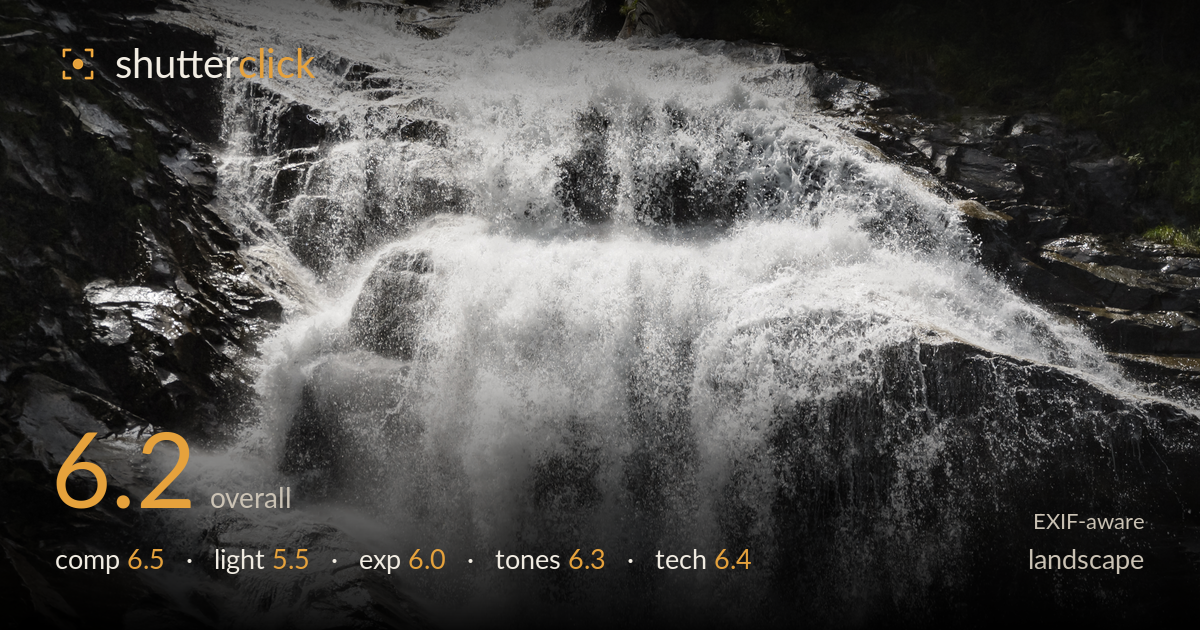
Cascade tumbling through the forest
Photo by Uoaei1

| Focal length | 38 mm |
| Aperture | f / 8.0 |
| Shutter | 1/1500 s |
| ISO | ISO 100 |
| Exp. comp. | -2.0 EV |
| Shot at | 12:59 · Aug 17, 2021 |
A dynamic cascade with strong diagonal flow, held back by harsh midday light and a fast shutter that freezes the water into a busy, textureless spray. The waterfall reads as a bright, chaotic mass rather than the silk-and-detail rendering that gives falls their sense of motion and depth. The forested surround is heavily shadowed, creating a stark tonal split that the eye struggles to bridge. The vertical framing and the diagonal descent of the water work well, but the light timing and shutter choice are the decisive factors limiting this frame. Softer light and a longer exposure would transform it.
The vertical format suits the tumbling descent, and the water carries the eye diagonally from upper left down to the foreground, a natural leading line. The dark forest frames the top and provides scale. However, the brightest water mass sits low-centre, pulling weight toward the bottom while the upper third is dense, undifferentiated shadow that offers little to hold attention. A touch more foreground rock, or a lower angle emphasising the base pool, would anchor the composition. The framing feels slightly tight on the right where the flow exits.
This is the frame's main limitation. Harsh, near-overhead sun creates blown highlights on the white water and crushes the surrounding forest and wet rock into deep shadow, producing a tonal range the scene can't hold gracefully. The sunlit spray glares while the frame's edges go murky. Waterfalls reward soft, diffused light — overcast skies or open shade — that tames the white water and reveals detail in the rock and foliage. Shooting on a cloudy day or in early/late side light would soften this dramatically.
The -2.0 EV compensation was a reasonable move to protect the bright water, and much of the spray retains detail rather than clipping fully. But the trade-off is heavy: the forest and shadowed rock lose most detail, reading as near-black. The histogram is split hard between highlights and shadows with a thin midtone bridge. Bracketing and blending, or lifting shadows in raw, would recover the forest without sacrificing the highlights. The exposure choice is deliberate but the scene's contrast exceeds a single frame's range.
The greens of the conifers are rich where light reaches them, and the wet rock shows some pleasing grey gradation. White balance sits neutral to slightly cool, appropriate for the setting. The problem is contrast: the tonal gap between the glaring white water and the inky shadows leaves little mid-tone connective tissue, so the image feels harsh rather than layered. A gentler contrast curve and some shadow recovery would restore gradation and let the greens and rock textures breathe across the frame.
At f/8, 38mm on the D7100, depth of field is ample and the scene is sharp front to back, an appropriate aperture choice for landscape. ISO 100 keeps the file clean with no visible noise. The critical decision is the 1/1500s shutter: it freezes the water into a spray of frozen droplets and a hard, busy white mass, robbing the falls of the flowing, silken quality that defines the genre. A tripod with a 4-in ND or polariser to reach 1/2 to 2 seconds would render the water as smooth ribbons and lend motion and elegance. Focus appears accurately placed on the mid-fall rock and water. The lens is well suited and 38mm frames the fall naturally. The polariser would also cut glare off the wet rock and deepen the foliage. Technically competent execution, but the shutter speed works against the subject rather than for it — the single most impactful setting to reconsider.
What would elevate it
Tags
Shot something like this?
Expert photo critique, on demand — scored across six categories, EXIF-aware. Start with 3 free critiques, no credit card.
critique my photo — free