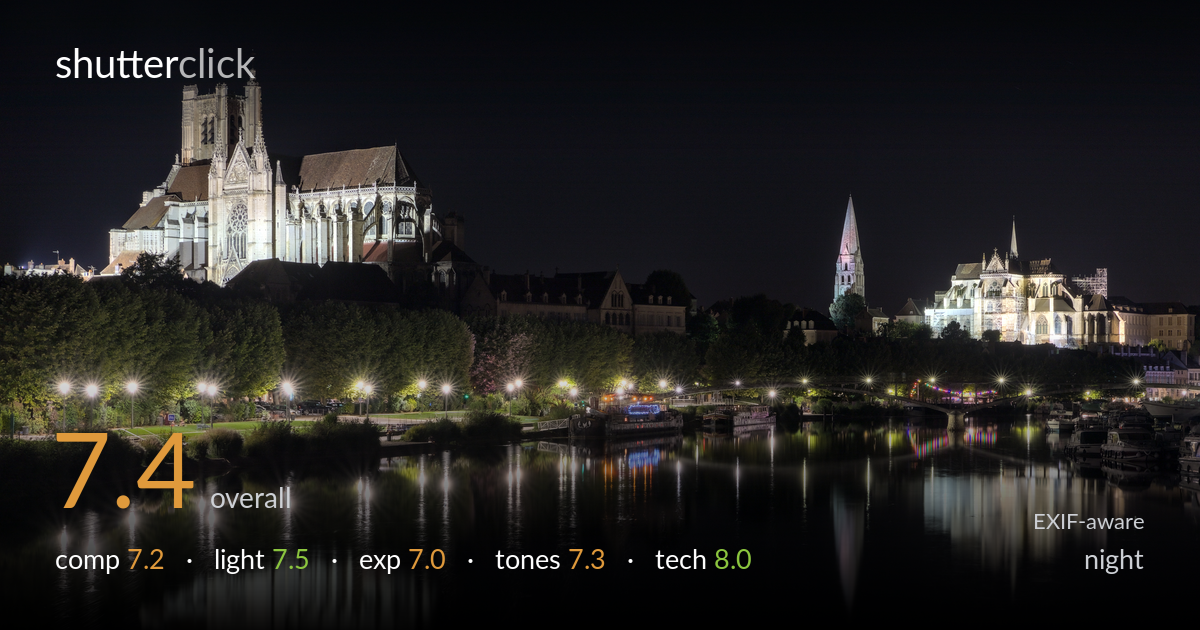
Cathedral reflected on the night river
Photo by Benjamin Smith

| Focal length | 51 mm |
| Aperture | f / 13.0 |
| Shutter | 30.0 s |
| ISO | ISO 250 |
| Exp. comp. | -1.0 EV |
| Shot at | 21:28 · Aug 12, 2025 |
A confident night cityscape carried by the floodlit cathedral and a long, layered river of reflections. The composition reads as two competing centres — the bright cathedral hard left and the second illuminated church to the right — separated by a wide, low-contrast band of dark trees and town that drains energy from the middle of the frame. The reflections are the strongest asset, the long exposure rendering the water glassy and the lamp trails as clean verticals. The sky is a featureless black; a touch of residual blue dusk would lift it. Overall a polished, well-executed frame held back by a slightly bisected layout.
The cathedral anchors the upper left with real authority, and the line of riverside lamps draws the eye smoothly across to the second church. The mirrored reflections add genuine vertical depth to the lower frame. The weakness is balance: two bright architectural masses bracket the edges while the centre sags into dark, undifferentiated trees and rooftops. The horizon also sits near mid-frame, splitting subject and reflection evenly. Weighting the cathedral more decisively, or shifting to favour one anchor, would tighten the read.
The artificial lighting is the picture's engine — warm floodlights model the cathedral's stonework and tracery well, and the cool spotlight on the right-hand spire adds welcome variety. The string of lamps along the embankment provides rhythm and the reflections that make the lower half work. The contrast between lit monuments and the black surroundings is dramatic but verges on too stark, leaving the central buildings as flat, muddy shapes. A little ambient fill or a dusk-shot base layer would knit the lit and unlit zones together.
The -1 EV pull holds the bright cathedral facade in check, and the highlights on the floodlit stone keep detail rather than blowing out — a sound choice for high-contrast night work. The histogram is heavily weighted to the shadows, which suits the scene, but the trees, town centre, and sky collapse into near-black with little recoverable separation. The lamp cores and a few specular reflections clip slightly, which is acceptable. Exposing marginally brighter and recovering highlights would open the dead midtones.
White balance is well handled, letting the warm sodium floods sit against the cooler spotlit spire without either feeling wrong. The reflections carry pleasant colour — ambers, greens, and a pop of blue from the moored boat. Contrast is high and deliberate, though the deep blacks swallow the central buildings into a flat tonal mass. The sky is a uniform dead grey-black with no gradation. Gentle shadow lifting and a hint of tonal separation in the darks would add dimensionality.
Settings are well chosen for the task. The 30-second exposure at f/13, ISO 250 smooths the river into a near-mirror and renders the lamp reflections as clean, elongated streaks — exactly the long-exposure payoff this scene calls for. f/13 carries front-to-back sharpness across the considerable depth from foreground water to distant spires, and the modest ISO keeps noise negligible in the shadows, which matters given how dark the frame sits. 51mm is a sensible compression choice, stacking the two monuments and the boats without distortion. Focus appears accurate on the cathedral and the embankment lamps. The one technical caveat is diffraction softening at f/13 on a high-resolution sensor — f/9 to f/11 would have preserved fine tracery detail with no meaningful loss of motion blur or depth. A sturdy tripod and mirror lockup or a remote release clearly underpin the clean result. Solid, deliberate execution throughout.
What would elevate it
Tags
Shot something like this?
Expert photo critique, on demand — scored across six categories, EXIF-aware. Start with 3 free critiques, no credit card.
critique my photo — free