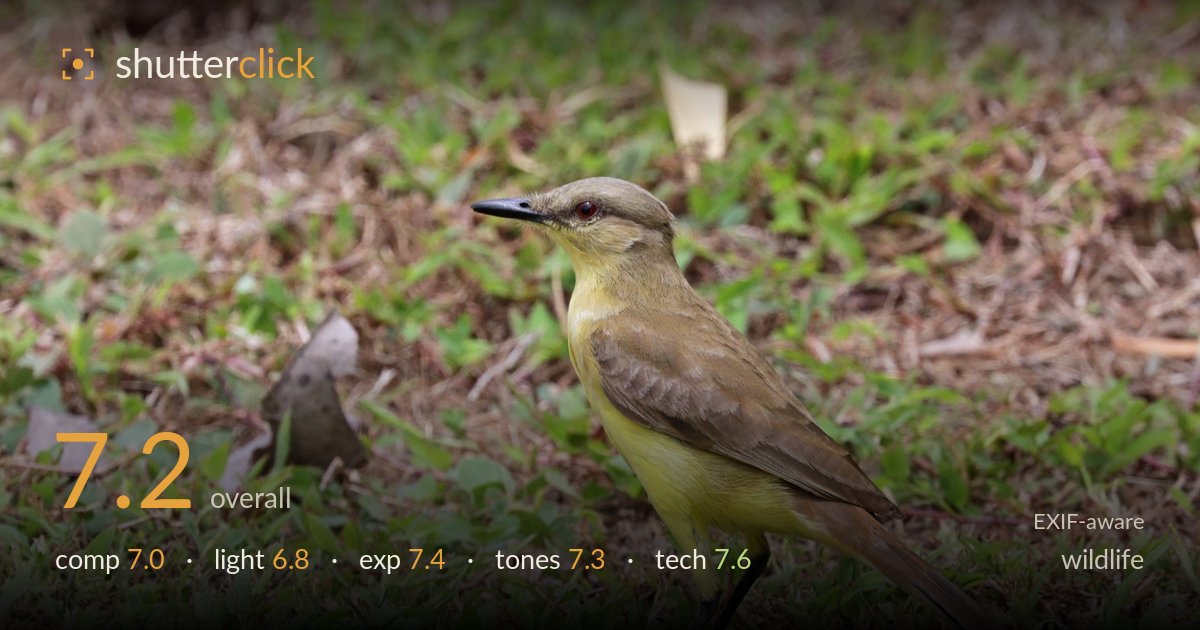
Cattle tyrant on the grass
Photo by Charles J. Sharp

| Focal length | 400 mm |
| Aperture | f / 9.0 |
| Shutter | 1/800 s |
| ISO | ISO 400 |
| Exp. comp. | 0.0 EV |
| Shot at | 11:42 · May 7, 2019 |
A clean, sharp portrait of a cattle tyrant at eye level, with the bird well isolated against a soft grass background thanks to the long lens. The red eye reads clearly and the profile pose is classic and readable. What holds it back most is the light: flat and overcast, it leaves the plumage a touch muddy and the yellow underparts less luminous than they could be. The frame also places the bird slightly high and gives it little room to look into. A stray pale leaf top-right and the mottled ground clutter compete gently for attention. Solid, competent wildlife work.
The side-on profile is textbook and the bird sits at a comfortable eye level, which gives good intimacy. Placement is reasonable but the subject reads a little high and central-right, with more space behind it than in front of the beak — reversing that would give the gaze somewhere to travel. The bright pale leaf top-right pulls the eye and the busy patchwork of grass and dead leaves adds mild clutter. A tighter or lower angle would simplify the ground plane and strengthen isolation.
Soft, even overcast light avoids harsh shadows and holds detail across the plumage, which suits the fine feather texture. But it is flat and directionless, so the bird lacks modelling and the yellow belly never lifts into the glow it could. The catchlight in the eye is weak, softening the sense of life. Directional early or late light, ideally raking from the side, would carve out feather contours and make the colours sing rather than sitting evenly lit and slightly dull.
Exposure is well judged for the conditions. The yellow underparts and pale throat hold detail without clipping, and shadow areas under the wing retain information. The midtones sit comfortably and nothing looks crushed or blown. Zero exposure compensation was the right call under flat overcast light. If anything, the whole frame is a fraction low in overall brightness, contributing to the muted feel, but there's ample latitude in the file to lift midtones cleanly without introducing noise.
White balance is believable and the greens read naturally without an overcast blue cast. The bird's olive-brown back, rufous tail and lemon belly are all rendered honestly. Contrast is on the gentle side, matching the diffuse light but leaving the image feeling slightly flat. The yellow could carry more saturation and separation from the green surround. A modest contrast and vibrance lift, targeted at the plumage, would add punch without pushing the ground clutter into distraction.
The settings are well chosen for the situation. At 400mm on the 80D, f/9 provides enough depth of field to hold the whole bird sharp from beak to tail while still throwing the background into pleasant blur — a sensible compromise for a side-on subject at this distance. Focus is accurately placed on the eye, which is critical and nailed here; the feather detail across the back and wing coverts is crisp. 1/800s comfortably freezes a stationary perched bird, and ISO 400 keeps noise negligible with clean shadows. The 100-400L is the right tool and its rendering is smooth. The only reservation is that f/9 is marginally stopped down for maximum background melt — f/6.3 to f/7.1 would have softened the ground clutter further while still keeping the bird sharp given its shallow depth along the sensor plane. Overall a technically assured capture with excellent focus discipline and appropriate exposure settings.
What would elevate it
Tags
Shot something like this?
Expert photo critique, on demand — scored across six categories, EXIF-aware. Start with 3 free critiques, no credit card.
critique my photo — free