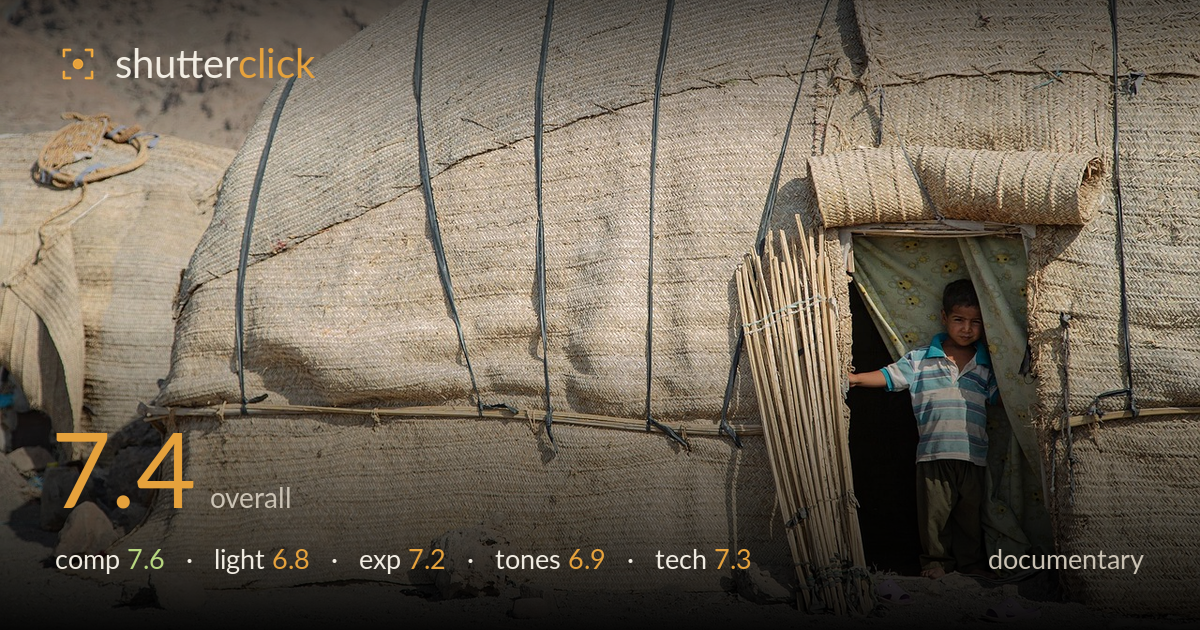
Child in a woven tent doorway
Photo by mostafa_meraji

No EXIF metadata in this file
Technical analysis based on visual assessment only.
A strong sense of place carries this frame — the woven nomadic dwelling fills the composition with texture and cultural specificity, and the child in the doorway supplies the human anchor that makes it a story rather than a study. The dwelling's curved ribs and dark binding cords create natural leading lines toward the boy. What holds it back is flat midday light that flattens the surface texture, and a monochromatic sand palette that risks the whole frame feeling washed out. The child, the true subject, sits small and slightly shadowed in the lower right, competing with a large expanse of empty woven wall.
The sweep of the dwelling's ribs and binding cords draws the eye rightward toward the boy in the doorway, an effective use of built-in leading lines. The bundle of reeds adds foreground interest and balances the human element. The subject sits on the right third, which works, but the vast area of textured wall left of frame is a lot of real estate for a single repeating pattern. The neighbouring shelter at far left and the barren slope above frame the setting well and establish scale and context.
The light is hard, high, and directional — typical harsh daylight that renders the woven surface with some raking texture on the left flank but flattens contrast across much of the wall. The doorway falls into open shade, leaving the child softly lit but slightly murky against the interior curtain. Early or late raking light would have carved far more relief into the woven ribs and lifted the whole surface into three dimensions. As shot, the sunlight is functional for documentation but not shaping the subject with intent.
Exposure is well judged for a high-key sand-toned scene: the bright woven walls hold detail without clipping, and the shaded doorway retains information on the boy's face and clothing. The histogram sits high, appropriately, given the pale palette. Some of the deepest shadow in the doorway interior goes slightly muddy, but nothing critical is lost. The overall reading is deliberate and controlled — no accidental blowout on the sunlit surfaces, which is the main exposure risk in a scene this bright and reflective.
The palette is almost entirely warm sand and straw, which suits the setting but leaves the frame monochromatic and low in contrast. The boy's blue-striped shirt is the one saving colour accent, and it earns its place drawing the eye. White balance leans warm, reinforcing the arid feel, though it borders on flat overall. A touch more contrast separation and a slightly cooler shadow rendering would give the tonal range more depth and stop the woven surfaces from blending into one continuous beige mass.
Focus appears accurately placed on the boy and the doorway area, with the woven texture rendering crisply across the sunlit wall, indicating a sound aperture choice that kept both the near reeds and the mid-distance dwelling acceptably sharp. The background slope falls into gentle softness, which helps separate the shelter from the hillside without isolating it artificially — appropriate for documentary work where context matters. No motion blur is evident; the shutter clearly handled the still subject. Noise is not a factor in this bright light. The main technical observation is depth-of-field management: the frame reads as broadly sharp front to back, which suits the establishing intent but means nothing is optically emphasised — the eye relies on the leading lines rather than focus to find the child. A slightly longer focal length or a step closer would have given the boy more presence without sacrificing the environmental read. Execution is clean and competent throughout.
What would elevate it
Tags
Shot something like this?
Expert photo critique, on demand — scored across six categories, EXIF-aware. Start with 3 free critiques, no credit card.
critique my photo — free