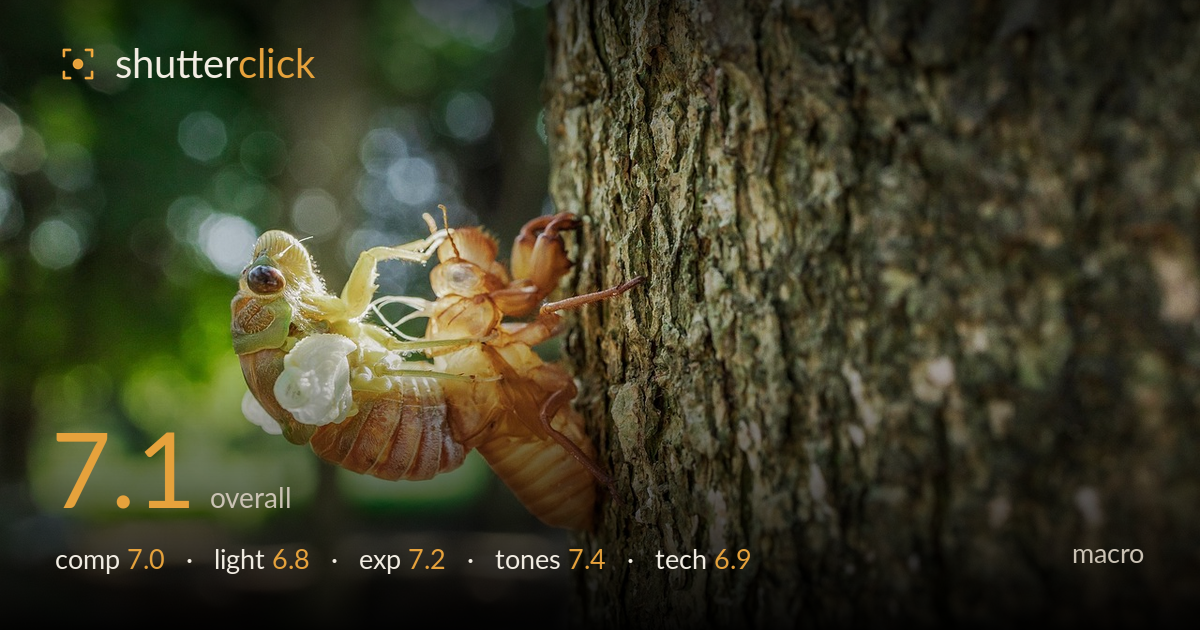
Cicada emerging on tree bark
Photo by PhiDucToan

No EXIF metadata in this file
Technical analysis based on visual assessment only.
A genuinely compelling subject — an emerging cicada mid-moult clinging to bark — carries this frame. The translucent amber body against the mottled trunk reads beautifully, and the green bokeh gives depth without distraction. What holds it back is the focus plane: the sharpest detail lands on the head and the pale unfurling wings, while the abdomen and the freshly-emerged pale body soften noticeably. For macro, precision on the key plane is everything, and here it's slightly off the most dramatic element. The subject also sits very close to the left edge, cramping the negative space. Strong material, a hair short of tack execution.
Placing the subject at the left third against the vertical bark works, and the diagonal split between the sharp trunk and soft green background gives the frame a clean structural logic. The trunk occupies a lot of real estate on the right, though, and the cicada is pushed hard against the left edge, leaving little breathing room in front of the emerging body. A touch more space to the left and a slightly lower angle would let the moult read as forward motion. The bokeh depth is well used.
Soft, diffused daylight filtered through the canopy suits the delicate translucency of the shedding body — hard sun would have blown the pale wings and glinted off the wet surfaces. The light comes from the upper left, giving gentle modelling on the amber shell and a small catch in the dark eye. It's a little flat overall, though; the subject could use a hint more directional raking light to separate the layered wing membranes and pull texture from the abdomen. Pleasant but slightly muted.
Exposure is well controlled for a high-contrast woodland scene. The bright green background highlights hold together without harsh clipping, and the amber body retains detail in its warm midtones. Shadows in the bark stay open enough to read the texture. The pale, translucent wing area sits close to the top of the range but keeps just enough gradation. Nothing looks accidental here — the brightness placement is deliberate and balanced. A marginally darker background would have made the subject pop a touch more.
The colour relationship is the frame's quiet strength: warm honey-amber against cool, desaturated greens and grey-green bark, a natural complementary pairing that feels unforced. White balance reads accurate and true to a shaded summer setting. The bark's muted olive tones give a restrained backdrop that lets the glowing body do the talking. Contrast is gentle and appropriate for the delicate subject. Saturation is tasteful — the greens could arguably be pulled back a hair further to isolate the amber even more.
The shallow depth of field is characteristic of close-focus macro work and creates lovely separation, but it also exposes the core issue: focus lands on the head, dark eye, and the pale forward wing structures, while the abdomen and the freshly emerged pale body drift soft. In a moulting subject where the whole transformation is the story, that plane placement costs some of the most interesting detail. Even a slightly smaller aperture, or a focus-stacked pair of frames, would have held both the head and the emerging body sharp — the classic macro trade-off between separation and coverage. The sharpness that is present is clean and crisp, with no visible noise, so the capture itself is well executed; this is a focus-plane decision rather than a resolution problem. A tripod or focus rail would make stacking practical here. The bark on the right is nicely detailed where it falls in the sharp zone, confirming the lens resolves fine texture well.
What would elevate it
Tags
Shot something like this?
Expert photo critique, on demand — scored across six categories, EXIF-aware. Start with 3 free critiques, no credit card.
critique my photo — free