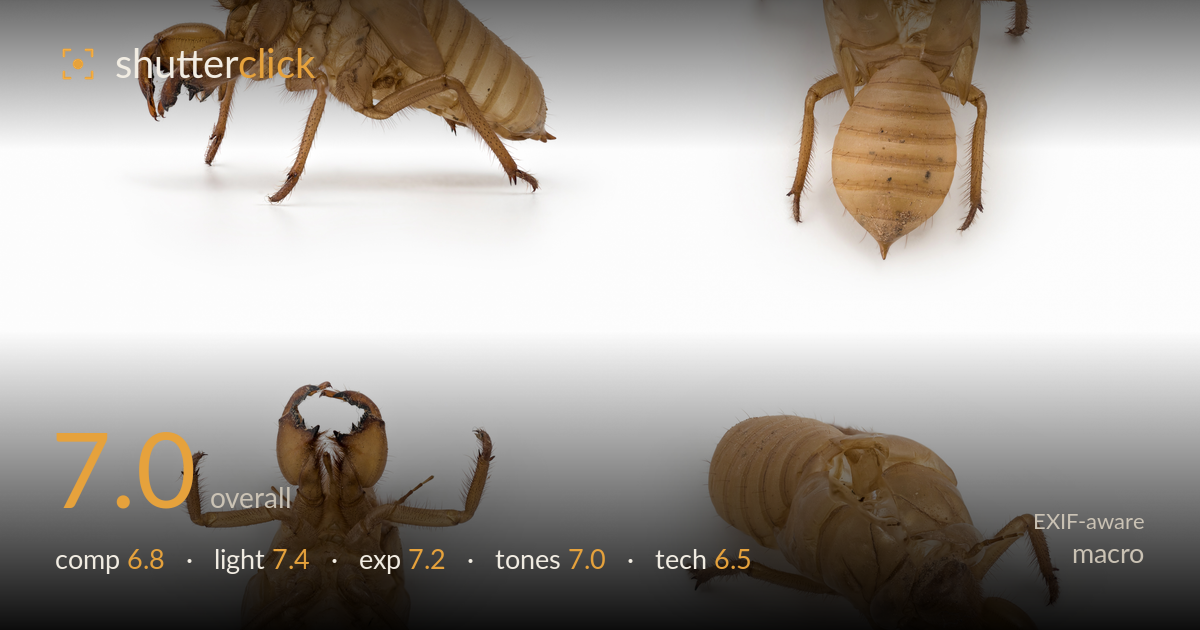
Cicada shells from four angles
Photo by Basile Morin

| Focal length | 100 mm |
| Aperture | f / 4.5 |
| Shutter | 1/125 s |
| ISO | ISO 250 |
| Exp. comp. | 0.0 EV |
| Shot at | 13:55 · Apr 25, 2018 |
A clean, informative specimen study of cicada exuviae presented as a four-view grid on white — the multi-angle approach reads almost like a scientific plate, and the amber translucency of the shed skins is rendered with real appeal. The lighting is soft and even, keeping the delicate detail legible from every angle. What most holds the image back is focus: at f/4.5 on a 100mm macro this close, depth of field is too shallow to hold any single specimen sharp front-to-back, so each one has soft passages. The grid spacing is also a touch uneven, leaving the composition slightly loose.
The four-view arrangement is a smart, catalogue-style approach that shows the specimen from lateral, dorsal, ventral, and three-quarter angles — genuinely useful and visually orderly. The pure white ground isolates each subject cleanly. Balance is imperfect, though: the lower-right specimen crowds toward the frame edge and sits larger than the others, while the top-left has more breathing room. Slightly more consistent scale and even gutters between the four would tighten the grid. The varied poses do keep the eye moving through the plate.
Soft, near-shadowless lighting suits specimen documentation, revealing the translucent shell and fine leg hairs without harsh glare. The faint drop shadows anchor each subject to the surface and give a subtle sense of dimensionality. Directionality is gentle enough that surface texture on the thorax and abdomen still reads. A touch more raking side light would carve out the sculptural ridges of the exoskeleton more assertively, but for clarity and even rendering across four subjects this lighting choice is well judged.
Exposure is well controlled for a high-key white-ground subject — the background sits bright and clean without blowing so far that the drop shadows disappear, and the amber tones retain detail in their brighter passages. Highlights on the glossy eye regions hold just short of clipping. Shadow areas under the legs keep enough information to read structure. The overall brightness feels deliberate rather than accidental, appropriate to the documentary intent. Nothing here fights the subject.
White balance is neutral and believable, letting the honey-brown and amber hues of the shed skins carry the image. The tonal range is gentle and mostly mid-to-high key, which fits the subject but leaves the image slightly flat overall. The translucent passages where light passes through the shell are the tonal highlight — quietly lovely. A hint more contrast or micro-contrast would give the exoskeleton texture more bite without disturbing the clean, clinical feel.
The EF 100mm f/2.8L Macro is the right tool, and 100mm gives comfortable working distance. The core issue is depth of field: f/4.5 at macro magnification yields a paper-thin plane of focus, and it shows — on the top-left lateral view the eye and forelegs are sharp while the abdomen falls off, and each specimen has soft zones somewhere. For specimens of this size, f/8–f/11 or focus stacking would hold each subject sharp front-to-back. ISO 250 is clean and appropriate, and 1/125s is fine for a static specimen, though a tripod and shorter-than-hand-held shutter or a self-timer would eliminate any residual movement. Focus placement varies by subject rather than landing consistently on the same plane across the four. Sharpness where achieved is good, and the lens resolves the fine leg hairs well. Combining a smaller aperture with stacking is the single biggest technical upgrade available here.
What would elevate it
Tags
Shot something like this?
Expert photo critique, on demand — scored across six categories, EXIF-aware. Start with 3 free critiques, no credit card.
critique my photo — free