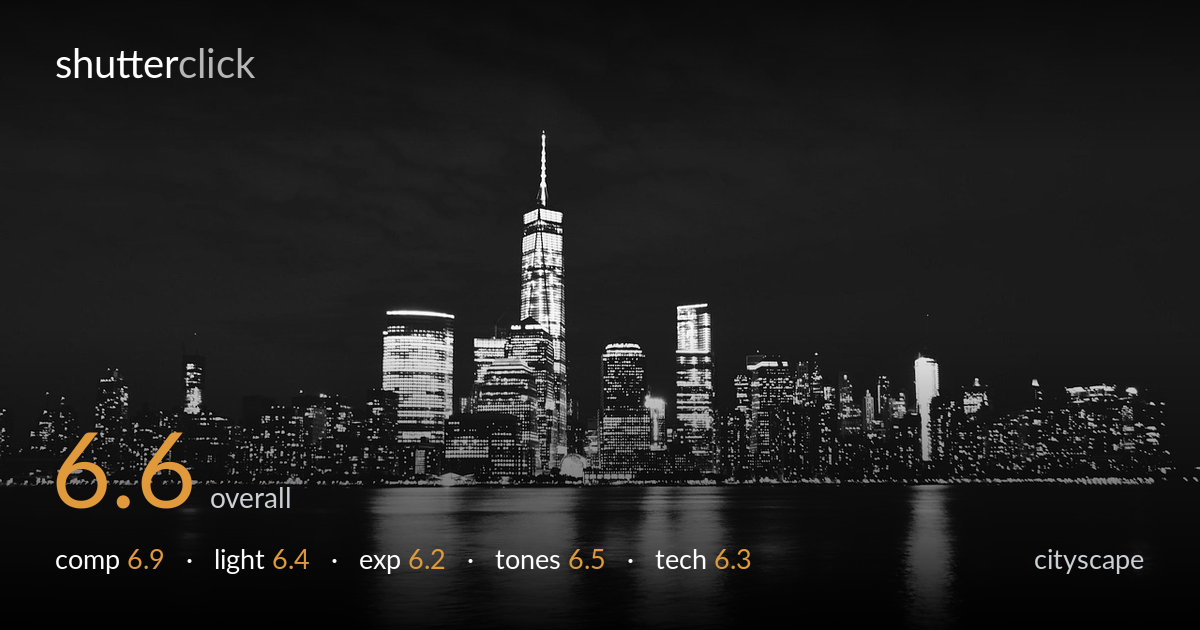
City skyline across the water at night
Photo by Pexels

No EXIF metadata in this file
Technical analysis based on visual assessment only.
A clean, classic skyline-across-the-water composition anchored by the central spire, with reflections that draw the eye downward. The monochrome treatment suits the subject. What most holds it back is softness throughout the skyline — the buildings lack the crisp detail a tripod-stabilised long exposure would deliver — and a slightly muddy tonal floor where shadows and mid-greys merge into one another. The vast empty sky also eats frame real estate without contributing. With sharper capture, a tighter crop, and more separation between the deep blacks and the lit windows, this would move from a competent record shot to a striking one.
The skyline is well placed in the lower-middle third, with the spire near centre giving a natural anchor, and the water reflections create a satisfying vertical pull. The horizon sits roughly on a third, which works. However, the upper half is almost entirely featureless sky that adds little beyond mood, and the framing reads slightly static. A tighter crop emphasising the building cluster, or waiting for cloud structure to occupy that empty sky, would balance the frame and give the composition more purpose top to bottom.
The city's own lights do the work here, with the lit windows and the bright tower reading nicely against the dark surroundings. The brightest building faces on the left create a pleasant tonal accent. The flat, overcast night sky offers no drama, though, and without any ambient glow or twilight in the upper frame the light feels one-dimensional. Shooting during blue hour, when residual sky light separates buildings from the heavens, would have added depth and a colour-temperature contrast the all-black sky currently lacks.
Exposure is reasonable for a night scene — the lit windows hold detail without blowing out badly, and the water retains a soft luminance. The shadow areas, however, sink into an undifferentiated near-black, swallowing the darker buildings and the sky cloud structure that's faintly present. The overall image sits a touch dark and muddy in the mid-greys. Lifting the shadows slightly and adding a small amount of local contrast to the skyline would recover detail without sacrificing the moody night atmosphere.
The black-and-white conversion is appropriate and the bright window clusters provide useful highlight punch. The reflections in the water carry a nice tonal gradient. The grading falls short in the mid-tones, which feel flat and slightly greyed, and the deep shadows lack a true clean black that would give the image snap. The sky is a single dull tone. A stronger contrast curve — deepening the blacks while protecting the lit highlights — would sharpen the separation and make the skyline read more crisply.
Visual evidence points to softness across the entire skyline — the buildings never resolve to crisp edges, and the spire and window grids look smeared rather than sharp. For a static night cityscape this usually indicates camera shake from a handheld or unstable exposure, slight focus miss, or heavy noise reduction smoothing detail away. The water's smoothness suggests a moderately long shutter, which makes the lack of building sharpness more likely a stability or focus issue than motion in the scene. A sturdy tripod with a remote or timer release, focus locked carefully on the lit skyline, and a base ISO would yield the resolution this subject deserves. There's mild noise grain visible in the darker zones, consistent with either a raised ISO or aggressive shadow lifting. Stopping down moderately for front-to-back sharpness and bracketing exposures to blend shadow and highlight detail would lift the technical execution considerably.
What would elevate it
Tags
Shot something like this?
Expert photo critique, on demand — scored across six categories, EXIF-aware. Start with 3 free critiques, no credit card.
critique my photo — free