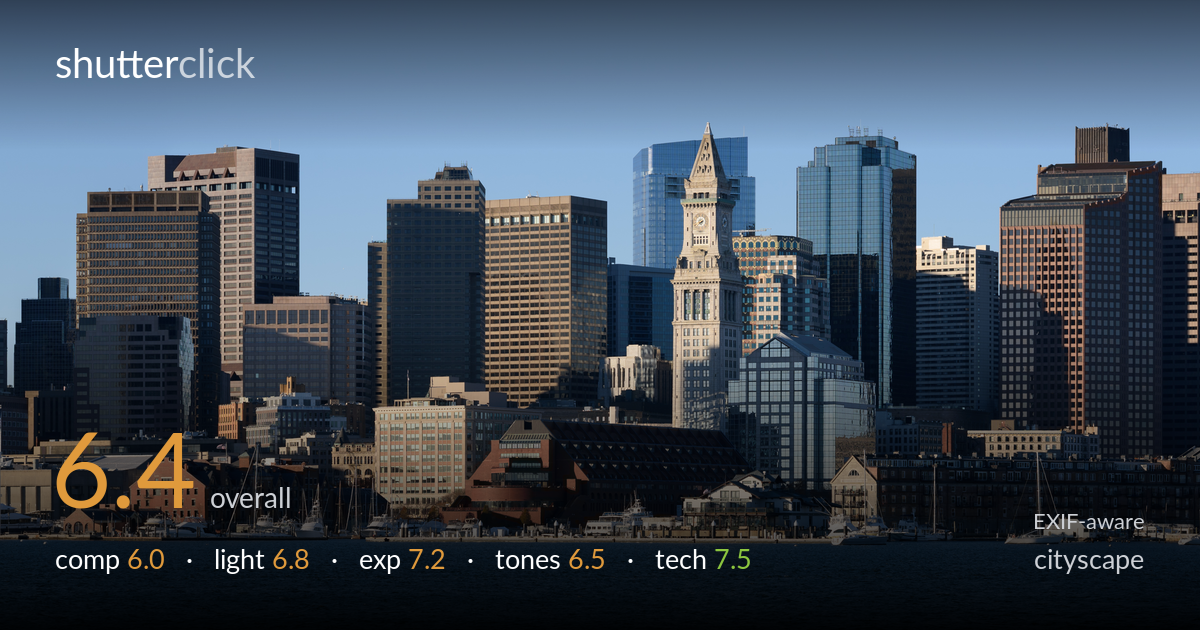
City skyline across the water
Photo by King of Hearts

| Focal length | 105 mm |
| Aperture | f / 8.0 |
| Shutter | 1/320 s |
| ISO | ISO 100 |
| Exp. comp. | 0.0 EV |
| Shot at | 07:41 · Nov 12, 2016 |
A clean, well-executed panoramic stitch of a skyline in low-angle sunlight, held back mostly by its horizontal arrangement — a long band of buildings sitting on an equally long band of water and sky, with little to organize the eye. The light from the left rakes across the facades nicely and gives the towers dimension, and the exposure is disciplined with intact highlights and shadow detail. What it lacks is a hierarchy: no anchor, no leading element, no foreground to build depth. A more dramatic time of day and a stronger compositional focal point would lift this from a competent record to a memorable image.
The panoramic sweep captures the full skyline cleanly, and the waterline runs level across the frame. But the layout is three parallel horizontal bands — sky, city, water — with no depth cues or foreground interest to draw the eye in. The horizon sits low, which sensibly gives the buildings room, yet the composition reads as an inventory rather than a picture. There is no dominant anchor; the eye drifts along the band without settling. A boat, pier, or piling in the near water would add scale and a foreground layer.
Low, warm side light from the left rakes across the tower facades, separating the buildings and giving them modelling and dimension — the strongest thing the image has going for it. Shadows fall to the right of each structure, reinforcing form. The clear sky is flat and untextured, though, contributing nothing. Shooting into golden hour or blue hour, when facade lights come alive and the sky carries colour, would give this skyline the atmosphere the current midday-adjacent light cannot provide despite the pleasing angle.
Exposure is well controlled. The bright sunlit facades hold highlight detail without clipping, and the shadowed sides and darker foreground water retain information rather than blocking up. ISO 100 keeps everything clean. The overall brightness is neutral and accurate, with a full range from the deep water to the lit stone. Nothing here is a technical fault — the histogram is used well. The only limitation is that the even, safe exposure matches an even, safe scene; a more dramatic light would demand and reward more deliberate exposure decisions.
White balance is accurate — the warm sunlit stone against the cool blue sky and water reads naturally. Contrast is moderate and the tonal range is complete, from bright facades to dark water. The blue sky gradient is smooth. Overall the palette is honest but somewhat muted and literal; the water in particular is a flat, uninflected blue-grey that adds little. A touch more contrast and clarity on the buildings, plus richer sky and water tones from a better hour, would give the frame more visual energy.
Technically this is executed well. At 105mm, f/8, 1/320s and ISO 100 on the D750, the settings are ideal for a distant skyline: f/8 sits in the lens's sharp aperture range and delivers front-to-back sharpness across a subject that is effectively all at infinity, so depth of field is not a concern. 1/320s comfortably freezes any subtle motion and the low ISO keeps the file clean and detailed. The 105mm focal length compresses the buildings into a tight, layered stack, which suits the skyline treatment. Focus appears accurate across the frame. This is clearly a multi-frame panoramic stitch, and the blend is clean — the waterline is continuous and there are no obvious seams or ghosting, which is well handled. The main technical observation is that the long telephoto stitch flattens depth; that compression is a stylistic choice rather than a flaw. Execution overall is solid and dependable, with no sharpness, noise, or focus issues to correct.
What would elevate it
Tags
Shot something like this?
Expert photo critique, on demand — scored across six categories, EXIF-aware. Start with 3 free critiques, no credit card.
critique my photo — free