Clouds over a high desert
Photo by sebadelval

No EXIF metadata in this file
Technical analysis based on visual assessment only.
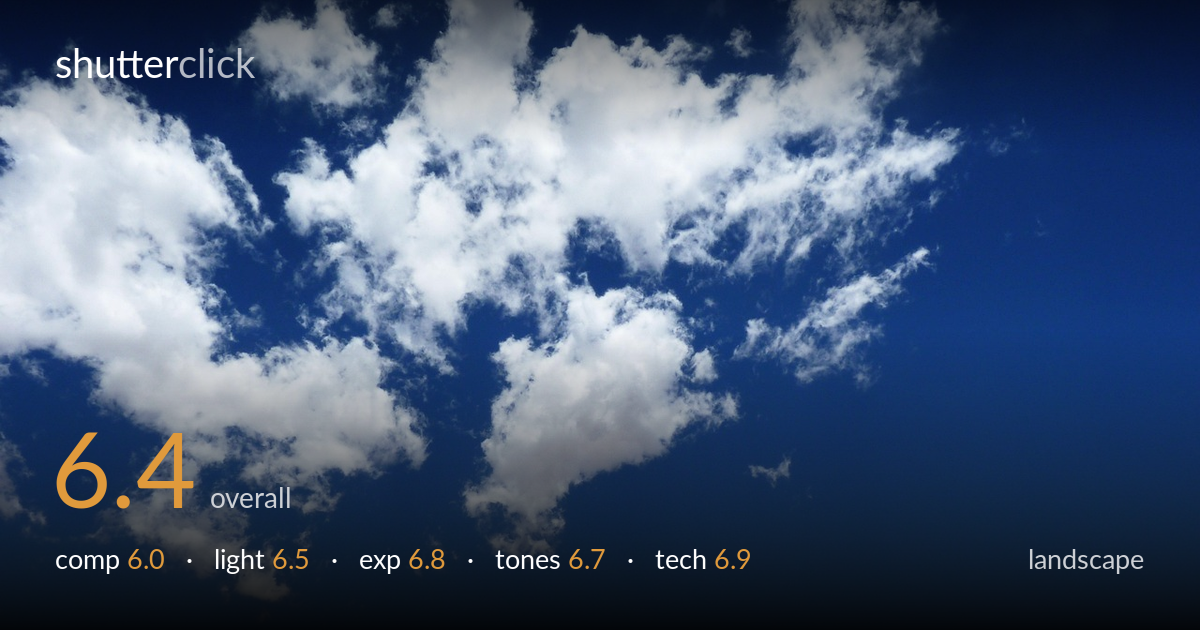
A high-altitude desert scene where a dramatic cloudscape dominates over a pale, textured terrain — the sky carries most of the interest while the land struggles to compete. The roughly 70/30 split in the sky's favour leaves the lower third feeling thin, and a near-central horizon flattens the depth. The clouds are the real asset: dynamic, well-shaped, and rendered against a deep blue. What holds the back is the lack of a clear foreground anchor and the muted, almost colourless terrain. A stronger ground subject and a recomposed horizon would let the landscape match the sky's energy.
The frame gives roughly two-thirds to sky, which suits the spectacular cloud formation but starves the terrain of presence. The horizon sits just below centre, a placement that neither commits to the sky nor grants the land room to breathe — pushing it lower would have let the clouds dominate intentionally. The small dune ridge in the lower left offers a hint of foreground interest but isn't strong enough to anchor the eye. The mountain ridges recede pleasantly, yet without a clear focal point the composition reads as open rather than directed.
Hard, high midday light flattens the pale desert floor, washing out much of its surface texture and detail. The clouds, however, catch that same light well — bright, sculpted volumes with believable shadow on their undersides against a saturated blue. The terrain loses modelling because the sun is near-overhead, robbing the dunes and ridges of the raking shadows that would reveal their form. A lower sun angle, near golden hour, would have brought out contour and depth across the foreground while keeping the sky's drama.
Exposure is well controlled given the high-key terrain and bright clouds. The whites in the cumulus hold detail rather than blowing out entirely, and the deep blue sky retains saturation without going muddy. The pale desert floor sits bright but keeps subtle tonal separation in its ridges and dunes. Shadows on the distant mountains stay open with detail intact. The overall balance is deliberate and clean — there's little clipping at either end, and the dynamic range of a difficult bright scene is handled with care.
The blue-to-white contrast in the sky is the strongest tonal element, deep and clean without oversaturation. White balance reads neutral, perhaps slightly cool, which fits the high-altitude feel. The terrain, however, is nearly monochromatic — a flat grey-beige that lacks the warmth or colour variation that would give it life. This drains energy from the lower frame. A touch more warmth or contrast in the ground tones, or shooting under warmer light, would help the land hold its own against the vivid sky.
Focus appears sound across the scene, with the distant ridges and cloud edges rendering crisply, consistent with a small aperture and deep depth of field appropriate for landscape work. There's no visible motion blur, and noise is well controlled in both the bright terrain and the blue sky, suggesting a low ISO and good light. The wide framing captures the sweep of the cloudscape effectively. The main technical limitation isn't gear execution but timing and choice of light — midday conditions that no setting can fully compensate for. Detail in the pale desert floor is somewhat lost to the harsh overhead sun, an issue of when rather than how the shot was taken. A polarizing filter would have deepened the blue further and cut some of the haze on the distant peaks. Overall the capture is clean and competent, with sharpness and noise handled well; the ceiling on this image is set by light and composition rather than technical execution.
What would elevate it
Tags
Shot something like this?
Expert photo critique, on demand — scored across six categories, EXIF-aware. Start with 3 free critiques, no credit card.
critique my photo — free