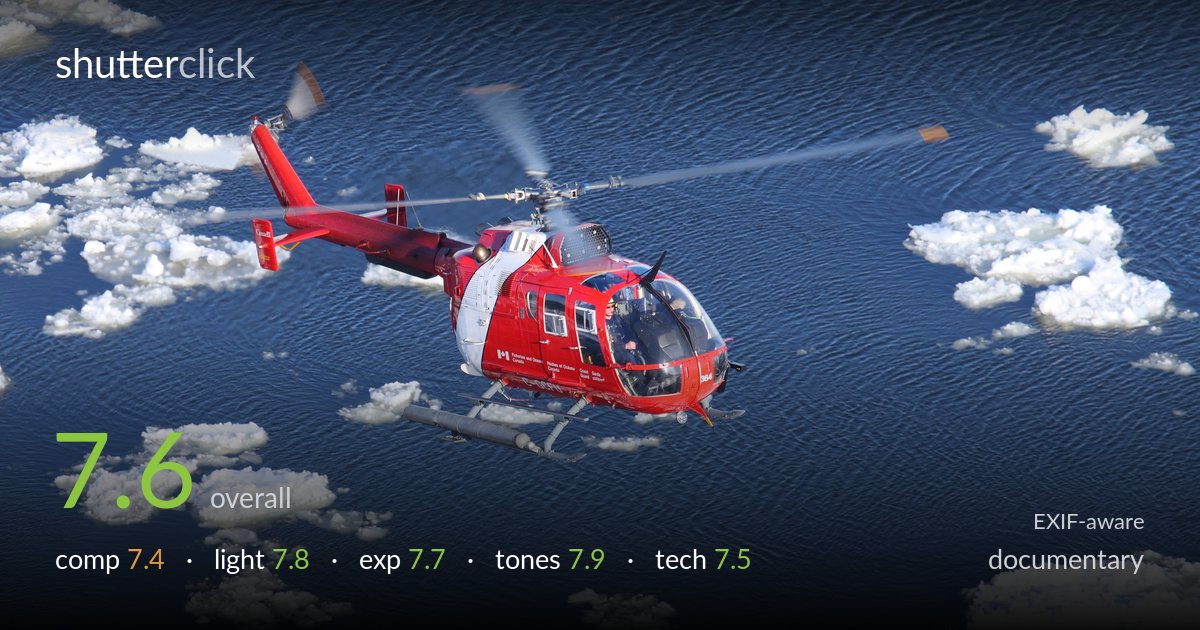
Coast guard helicopter over icy water
Photo by Cephas

| Focal length | 275 mm |
| Aperture | f / 6.3 |
| Shutter | 1/400 s |
| ISO | ISO 100 |
| Exp. comp. | 0.0 EV |
| Shot at | 16:31 · Mar 8, 2011 |
A clean, well-executed air-to-air capture of a Coast Guard helicopter over ice-flecked water, with the red airframe popping vividly against the deep blue. The rotor blur reads as genuine motion, confirming the machine is flying rather than parked — a key documentary win. What holds it back most is the rotor disc: both main and tail blades are partly cut by the frame's top and right edges, costing the aircraft a little breathing room. The slightly nose-down, descending placement is dynamic but leaves generous empty water below. Strong colour and clean execution carry it; tighter framing of the rotor span would lift it further.
The helicopter sits left-of-centre with good directional space ahead, and the scattered ice floes give scale and context to the cold-water setting. The diagonal of the fuselage and rotor mast adds energy. The main weakness is the rotor disc clipping the top edge and the tail-rotor blur running off the right frame — the aircraft feels slightly boxed in. A touch more room around the rotor span would let the machine sit more comfortably. The large expanse of bare water lower-left is somewhat dead, though the ice patterns partly redeem it.
Low, clean side light rakes across the airframe, modelling the curved canopy and fuselage panels nicely and pulling out the red against the cold blue water. The directional sun creates legible shadow under the skids and engine cowling, giving the aircraft volume. Highlights on the canopy glass and skid pontoon are bright but controlled. The water reads with subtle ripple texture under this angle. It is straightforward, favourable daylight rather than dramatic, but it serves the documentary purpose well and keeps the subject crisply readable.
Exposure is well judged for a bright-on-dark subject. The red bodywork holds saturation without blowing out, and the white panels and canopy reflections retain detail rather than clipping to paper. Shadow areas under the cabin and skids stay open enough to read structure. The deep blue water sits at a rich midtone, preserving the ice highlights without dulling them. ISO 100 keeps the file clean across the tonal range. A marginally brighter lift on the underside shadows would reveal a touch more skid detail, but the balance is sound.
The colour relationship is the photo's strongest asset — vivid Coast Guard red against the cold, saturated blue water, with the white ice and fuselage stripe providing crisp accents. White balance is accurate and neutral, with no unwanted cast on the water or aircraft. Contrast is healthy without crushing, and the blue holds even gradation across the surface. Saturation is punchy but stays believable. The mid-tones in the water ripples are well preserved, giving the surface texture and depth rather than a flat field of blue.
At 275mm, f/6.3, 1/400s and ISO 100, the settings are well matched to an air-to-air shot. The 1/400 shutter is the deliberate sweet spot here: fast enough to keep the fuselage sharp from a moving platform, yet slow enough to render the main and tail rotors as a natural arc of blur, confirming powered flight — a freeze of the blades would have looked artificial. Focus lands on the cabin and canopy, with the registration markings and door details crisp. The aperture gives enough depth to hold the whole airframe sharp while the distant water falls off softly. ISO 100 yields a clean, noise-free file. The telephoto reach was appropriate for the working distance. The only execution note is the rotor disc extending beyond the frame edges, a framing rather than a settings issue. Overall a technically assured capture that balances motion rendering and sharpness with skill.
What would elevate it
Tags
Shot something like this?
Expert photo critique, on demand — scored across six categories, EXIF-aware. Start with 3 free critiques, no credit card.
critique my photo — free