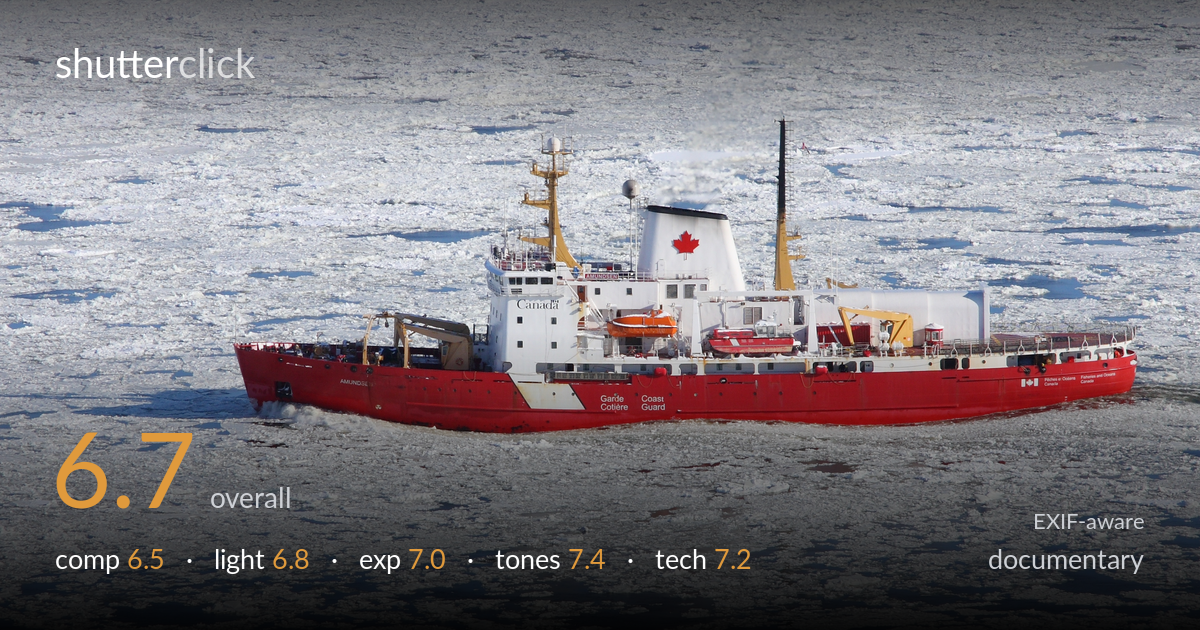
Coast guard icebreaker amundsen in pack ice
Photo by Cephas

| Focal length | 85 mm |
| Aperture | f / 11.0 |
| Shutter | 1/320 s |
| ISO | ISO 100 |
| Exp. comp. | 0.0 EV |
| Shot at | 16:07 · Mar 8, 2011 |
A clean, well-exposed record of the Canadian Coast Guard icebreaker Amundsen working through pack ice — strong on documentary clarity, weaker on storytelling tension. The red hull reads brilliantly against the fractured white-and-blue ice, and the full broadside view captures the vessel and its markings legibly. What holds it back is the static, side-on framing and the centred placement that leaves the ship feeling parked rather than pushing through. The ice the bow breaks is the real subject of an icebreaker shot, yet it goes unemphasised. A lower, tighter angle or a moment of churned wake would lift this from inventory to narrative.
The broadside view shows the whole vessel and its markings clearly, which serves the documentary record, but the framing is static. The ship sits centred and parallel to the frame, giving no sense of forward motion or the act of breaking ice. The bow has acres of empty ice ahead while the stern crowds the right edge. Shifting the vessel left with room to move into, or angling slightly toward the bow, would create direction. The horizon-less ice field is a fine clean backdrop but adds no depth layering.
Bright, high, frontal sunlight lights the hull evenly and makes the red pop against the ice, which works for legibility. But this flat top-light flattens the vessel's form and leaves few shadows to model the superstructure or give the ice texture relief. The ice reads as a uniform bright mass rather than a sculpted surface. Lower, more raking light — earlier or later in the day — would carve shadow into the broken floes and give the hull dimensional shaping rather than this clear but unmodelled rendering.
Exposure is well controlled for a bright, snow-and-ice scene that easily fools meters into underexposure. The white ice holds detail without blowing out, and the red hull retains saturation rather than clipping in the channel. Shadow areas under the hull and in the superstructure keep enough information. The histogram sits high but disciplined. If anything, a touch more exposure could have brightened the ice toward true white, but the conservative choice preserves highlight texture in the floes, which is the right call here.
The colour relationship is the strongest element: the vivid red against cool blue-white ice gives the frame immediate impact, and the white wheelhouse provides a clean tonal anchor. White balance is accurate, with the ice reading neutral-to-cool as expected in shade. Contrast is healthy and the red stays rich without oversaturating. The blue cast in the ice shadows is natural and pleasant. The only limitation is that the midtone separation in the ice is slightly flat under the frontal light, so the surface reads as a single tonal mass rather than gradated texture.
The settings are well matched to the subject. At f/11 on the 85mm, depth of field comfortably covers the entire vessel front to back, and the focus appears accurate across the hull and superstructure — markings and rigging are legible. ISO 100 keeps the file clean with no visible noise, appropriate for bright daylight. The 1/320 shutter easily freezes the slow-moving ship and any hand-held shake at this focal length. The 85mm focal length suggests shooting from some distance across the channel, which compresses the scene slightly and keeps the ship in proportion. Sharpness is solid though not biting — likely a mix of atmospheric haze over the cold water and the diffraction softening that creeps in around f/11; f/8 would have given marginally crisper detail with still-ample depth of field. Overall the execution is technically sound and dependable, the kind of disciplined capture that gets the documentary job done without drawing attention to errors.
What would elevate it
Tags
Shot something like this?
Expert photo critique, on demand — scored across six categories, EXIF-aware. Start with 3 free critiques, no credit card.
critique my photo — free