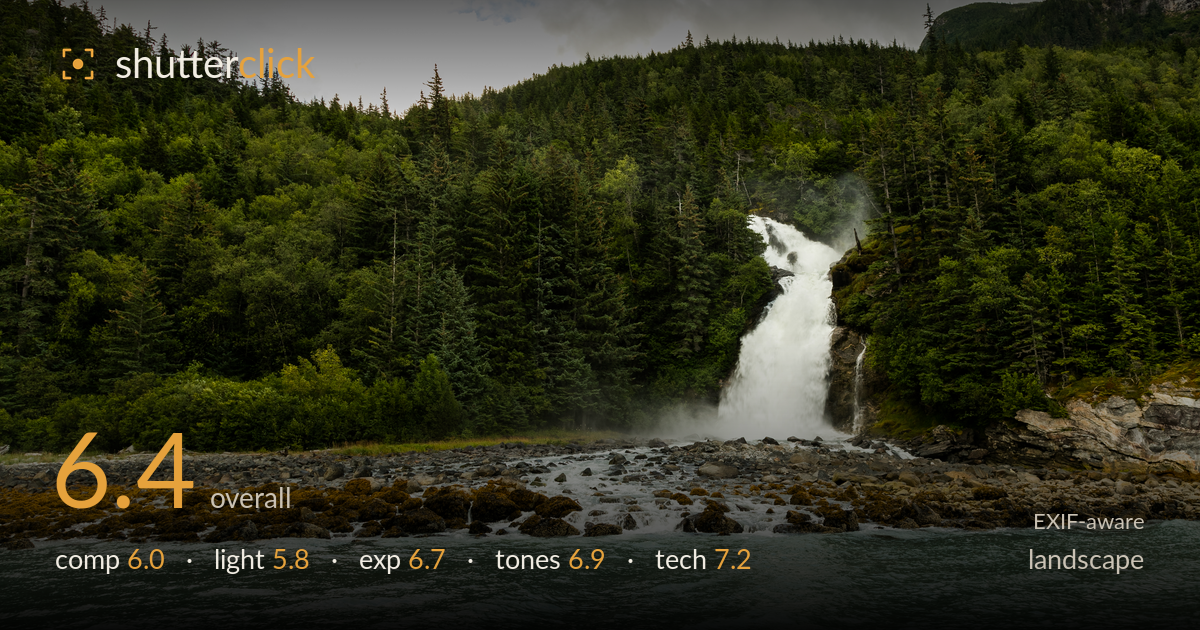
Coastal waterfall through the spruce
Photo by Diego Delso

| Focal length | 28 mm |
| Aperture | f / 13.0 |
| Shutter | 1/30 s |
| ISO | ISO 200 |
| Exp. comp. | 0.0 EV |
| Shot at | 19:53 · Aug 18, 2017 |
A powerful coastal waterfall set against dense spruce forest, with a strong sense of place and Alaskan mood. The scene reads clearly and the mist rising off the falls adds atmosphere. What most holds it back is the flat, overcast light that mutes contrast and depth, and a composition that places the waterfall too far right while the mid-frame band of trees dominates. The foreground rocks and kelp are interesting but the water in the immediate foreground is unresolved and slightly murky. A stronger anchor point and better light timing would elevate the frame considerably.
The waterfall, the clear subject, sits well right of centre and competes with the broad wall of forest that fills the middle third. The horizon line of the treetops runs high, leaving a heavy sky band that adds little. Foreground rocks and kelp provide texture and a sense of depth, but they read as a scattered band rather than a leading element toward the falls. Shifting weight so the cascade anchors nearer a third intersection, and finding a foreground rock to lead the eye, would tighten the relationship between water, rock, and falls.
The overcast sky delivers soft, even light that avoids harsh highlight clipping on the white water, which suits a waterfall reasonably well. But the diffuse light also flattens the forest into a single dark mass with little modelling, and the sky is a bright, featureless grey-white that draws attention without reward. There's no directional light to separate the tiers of trees or give the rocks dimension. Shooting in softer directional light — early or late — would carve depth into the forest and warm the scene.
Exposure is well controlled for a tricky high-contrast scene. The white water holds detail rather than blowing out, and shadow areas in the dense forest retain enough information to read as texture rather than black mush. The bright sky is close to clipping in the upper cloud but stays just within range. Midtones in the green foliage sit a touch dark, giving a slightly heavy feel. A modest lift to the forest shadows in post, or a graduated adjustment to tame the sky, would balance the tonal spread more evenly.
The greens are rich and believable, and the teal glacial water in the foreground gives a distinctly cold, northern palette that grounds the location. White balance leans slightly cool, which fits the mood. The forest tones are somewhat monotonous — a large expanse of similar dark green with little tonal separation between near and far trees. The sky's grey-white lacks the tonal interest to justify its size. A gentle contrast and clarity adjustment in the foliage, plus warmth in the kelp, would add tonal variety and separation.
The settings are sound for the scene. At 28mm on the 5DS R, f/13 delivers deep front-to-back sharpness appropriate for a landscape, keeping foreground rocks and distant forest acceptably crisp, and diffraction is not yet a serious concern on this body at that aperture. ISO 200 keeps noise negligible and preserves the sensor's considerable detail. The 1/30s shutter is the interesting choice: it partially softens the falling water into a silky texture while the foreground rapids show some motion streaking, a reasonable compromise handheld or on a steady support. Focus appears well placed across the scene, and the falls are rendered with good micro-detail in the mist. A tripod with a slightly longer exposure — around 1/4 to 1/2 second — would render the water more cohesively silky throughout, including the foreground. Alternatively, a faster shutter would freeze the spray for a different, crisper look. As executed, the technical foundation is solid and gives plenty of latitude to refine in post.
What would elevate it
Tags
Shot something like this?
Expert photo critique, on demand — scored across six categories, EXIF-aware. Start with 3 free critiques, no credit card.
critique my photo — free