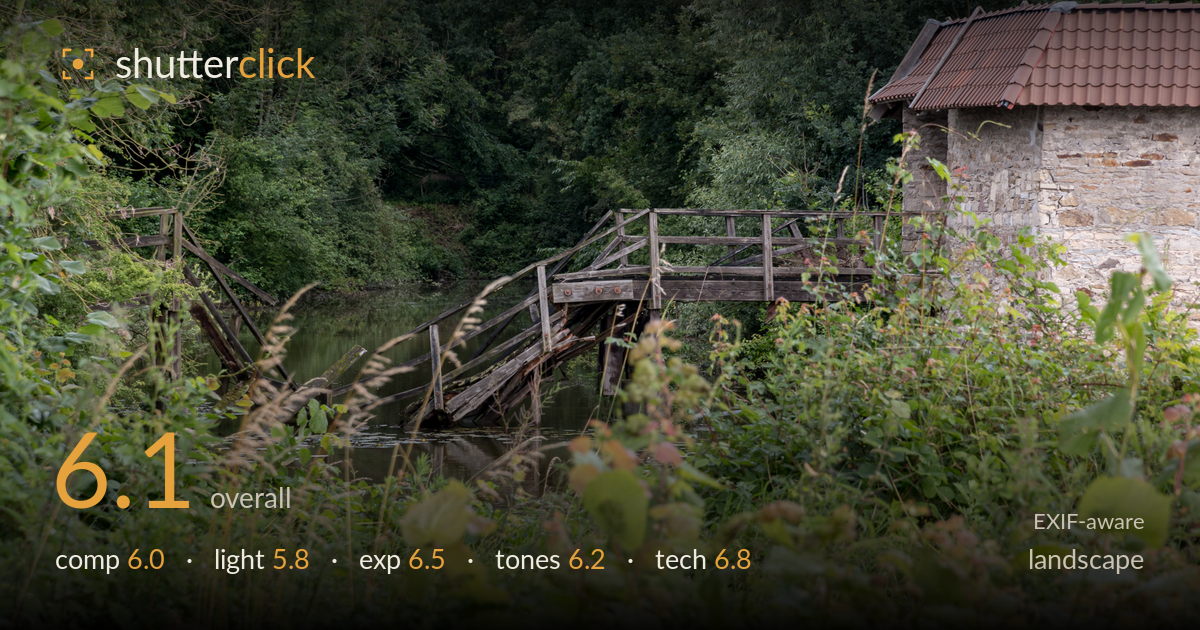
Collapsed footbridge over a quiet river
Photo by Dietmar Rabich

| Focal length | 85 mm |
| Aperture | f / 8.0 |
| Shutter | 1/100 s |
| ISO | ISO 400 |
| Exp. comp. | 0.0 EV |
| Shot at | 07:44 · Jul 3, 2016 |
A collapsed wooden footbridge makes a genuinely compelling subject — the broken span sagging into the water tells a story of decay and abandonment, and the stone outbuilding on the right adds context. What most holds the frame back is the heavy foreground vegetation, which sprawls across the lower third and edges without leading the eye or framing the bridge cleanly. The flat, overcast light also mutes the drama the collapse deserves. The bridge sits well in the middle band, but tighter management of the foreground and stronger directional light would let the subject carry the weight it earns.
The broken bridge is placed effectively across the middle of the frame, and its diagonal sag draws the eye toward the collapse point over the water. The stone building anchors the right and gives scale. The problem is the foreground: tall grasses and leaves fill the entire lower third and intrude on both sides, competing with the subject rather than framing it. Some soft out-of-focus foliage as a frame can work, but here it's dense and unstructured. A cleaner sightline or lower angle finding a gap would let the bridge breathe.
The light is flat and diffuse under heavy overcast, which suppresses the texture of the weathered timber and the terracotta roof tiles — the exact surfaces that would reward directional light. Shadows are minimal, so the collapsed structure reads without depth or modelling. The even illumination does keep the dense greenery from blowing out and holds detail across the scene, but it robs the abandonment of atmosphere. A break of low, raking light or the moody softness of a slightly darker sky would give the decay more presence.
Exposure is well controlled for tricky conditions. The dark forest holds detail without blocking up, the water retains its subtle reflections, and the terracotta roof and stone wall on the right are not clipped despite being the brightest elements. The green foliage stays within range. Midtones sit a touch flat, in keeping with the overcast light, and the shadowed woods behind the bridge could carry marginally more separation, but nothing is lost at either end. The histogram appears balanced and the decisions look deliberate rather than accidental.
The palette is dominated by a wide range of greens, which risks monotony but is broken usefully by the warm terracotta roof and the greyish stone wall. White balance looks neutral and believable for the conditions. Contrast is on the gentle side, contributing to the somewhat muted feel; the greens verge on flat and could use more tonal separation between the shadowed forest and the sunlit foreground. Saturation is restrained and natural. A slight contrast lift and selective dodging of the bridge would help it stand out.
The settings are sensible for the situation. At 85mm the compression pulls the bridge, building, and background trees into a pleasing spatial relationship, and f/8 is a reasonable choice that keeps the bridge and stone wall acceptably sharp while letting the near foreground fall soft. ISO 400 is a fair compromise under dim overcast light, keeping noise negligible. 1/100s at 85mm is adequately fast for a static subject, though it's near the edge of the reciprocal rule and demanded steady handling. Focus appears placed on the bridge structure, which is the right call, and it holds detail there. The main technical limitation is depth of field: at f/8 and this focal length, the intrusive foreground grasses render as soft blur rather than either sharp framing or clean separation — neither fully committed. A smaller aperture would have carried the foreground, or a wider one with a repositioned viewpoint would have cleaned it entirely.
What would elevate it
Tags
Shot something like this?
Expert photo critique, on demand — scored across six categories, EXIF-aware. Start with 3 free critiques, no credit card.
critique my photo — free