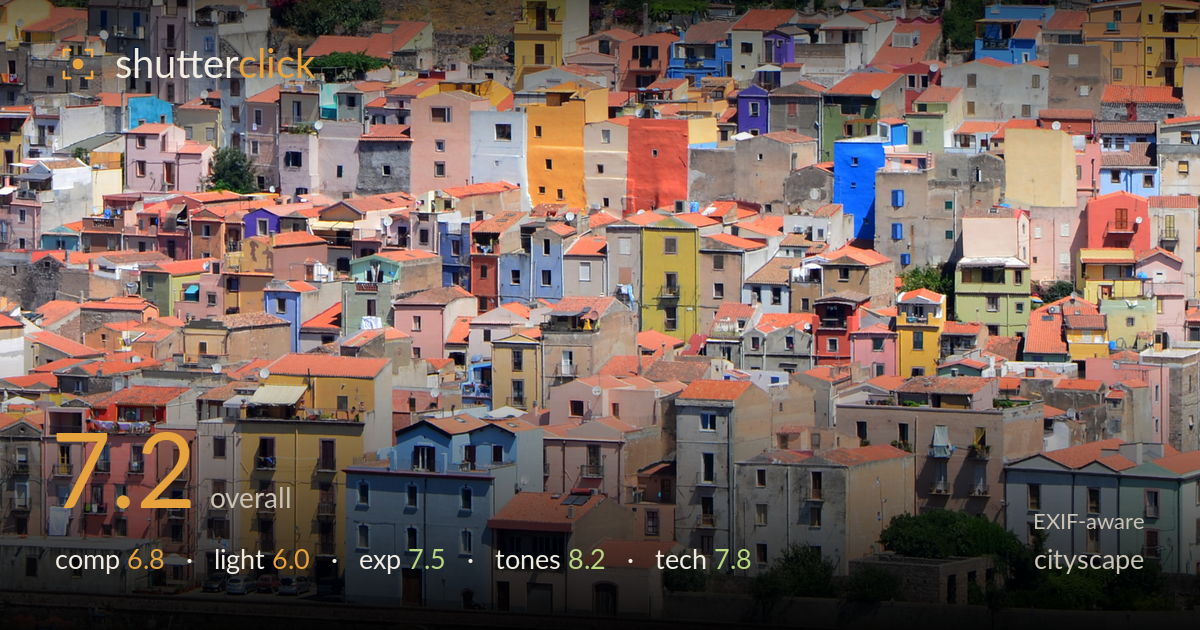
Colourful houses stacked on a hillside
Photo by Gzzz

| Focal length | 105 mm |
| Aperture | f / 11.0 |
| Shutter | 1/160 s |
| ISO | ISO 100 |
| Exp. comp. | 0.0 EV |
| Shot at | 11:48 · Jul 19, 2011 |
A dense, joyful tapestry of colour is the clear draw here — the stacked pastel and terracotta houses of a hillside town read as a rich, almost abstract patchwork. Colour rendering and exposure are the strongest assets. What holds the frame back is flat midday light that suppresses depth and dimensionality, and a compositional strategy that fills the frame edge to edge without an anchor to lead the eye through the chaos. A stronger sense of hierarchy or a focal moment — and softer, more directional light — would elevate this from a pleasing pattern into a compelling image.
The tight telephoto compression stacks the houses into a flat, all-over pattern, which suits the colour-tapestry approach. But the frame is uniformly busy with no clear entry point or resting place — the eye wanders without settling. The strip of railway and greenery along the bottom edge gives a thin foundation, yet the top crop lops buildings awkwardly. A slightly higher vantage, or isolating a cluster with more breathing room, would give the composition hierarchy rather than relentless density across every square inch.
The light is high, hard midday sun, which flattens the scene and does little to model the three-dimensional stacking of the buildings. Shadows fall short and vertical faces lack the raking definition that would separate one house from the next. Colours stay bright, but the overall effect is even and dimensionless. Late-afternoon or golden-hour light, striking the hillside at an angle, would carve shadow into the alleys and gables, adding the depth this flat pattern currently lacks.
Exposure is well controlled across a demanding range of bright pastels and dark terracotta. Highlights on the white and cream facades hold detail without clipping, and the shaded window recesses retain shadow information. The histogram sits comfortably in the midtones, and the neutral exposure compensation was the right call for this evenly lit scene. Nothing looks accidentally under- or over-exposed. A touch more highlight restraint on the brightest whites would be the only refinement worth considering.
This is the image's standout strength. The riot of colour — coral, mustard, cobalt, mint, terracotta — is rendered vividly yet stays believable, without oversaturation tipping into garishness. White balance reads accurate under the midday sun, greens and reds sit naturally, and tonal separation between adjacent hues is clean. The contrast is moderate, appropriate for preserving detail across so many surfaces. The colour palette alone carries much of the photograph's appeal and rewards close inspection.
The technical execution is sound and well matched to the subject. At 105mm the telephoto compression is precisely what packs the hillside into a dense, flattened plane of colour — a deliberate and effective choice. f/11 delivers front-to-back sharpness across the receding rows of buildings, which is exactly right when the whole frame is the subject rather than any single plane. ISO 100 keeps the image clean, with no visible noise even in the shaded recesses, and preserves the fine detail in roof tiles and window frames. At 1/160s the shutter is more than adequate for a static handheld telephoto shot at this focal length, and the frame shows no motion blur or camera shake. Focus is accurate across the field. The only technical consideration is that the flat light works against the resolving power on display — the sharpness is there, but harder-edged shadow would let it read more clearly. Overall, a well-judged set of settings for the scene.
What would elevate it
Tags
Shot something like this?
Expert photo critique, on demand — scored across six categories, EXIF-aware. Start with 3 free critiques, no credit card.
critique my photo — free