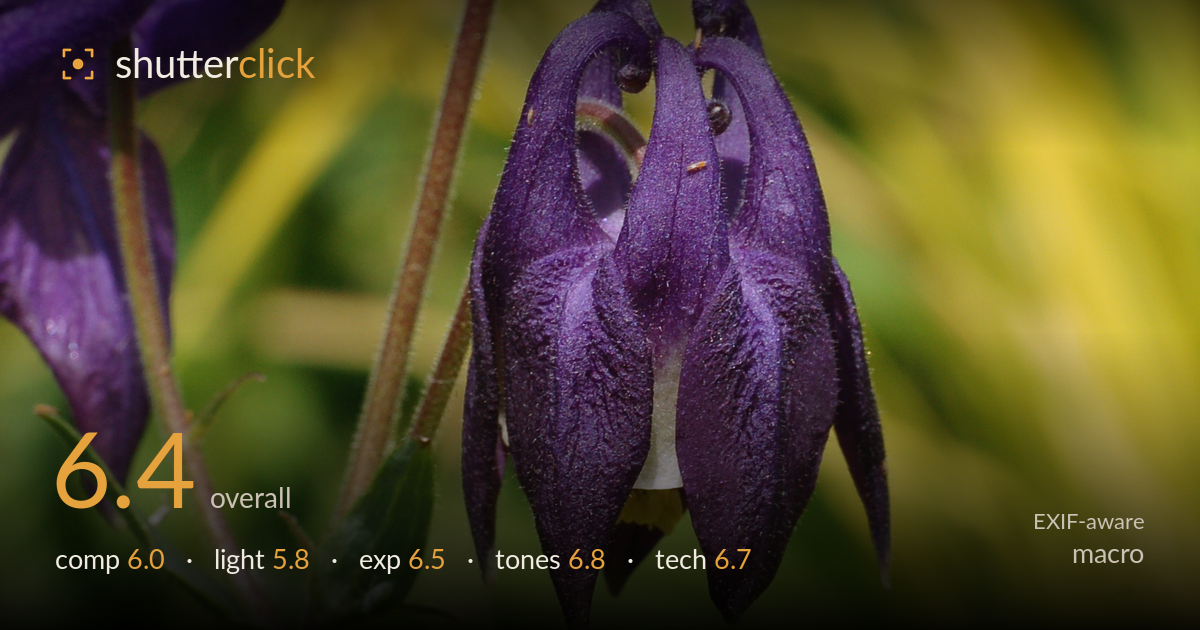
Columbine bloom and seed pod
Photo by Photo by and (c)2007 Derek Ramsey (Ram-Man). Location credit to the Chanticleer

| Focal length | 70 mm |
| Aperture | f / 13.0 |
| Shutter | 1/250 s |
| Exp. comp. | 0.0 EV |
| Shot at | 14:44 · Jun 16, 2007 |
A clean study of a columbine bloom paired with its seed pod above, telling a small botanical story of the plant's cycle. The deep violet flower reads richly against the warm green wash behind it, and the aperture choice keeps both the flower and pod acceptably sharp. What most holds it back is the light: flat, mid-day illumination that leaves the petals feeling matte and low in dimension. The secondary flower at the far left edge is a distraction, half-cropped and competing for attention. Tightening the frame and shooting under softer, directional light would lift this considerably.
Pairing the pendant flower with the upright seed pod above is a thoughtful choice, showing two stages of the plant on one stem. The main bloom sits low-left of centre with reasonable breathing room. The partial flower bleeding off the left edge is the weak point — it pulls the eye and adds clutter without resolving. The vertical stem provides a spine, but the frame carries a lot of soft background. A crop that excludes the left-edge flower and tightens toward the pod-and-bloom pairing would sharpen the intent.
The light is the limiting factor. This reads as direct mid-day sun, hard and roughly frontal, which flattens the flower's form and leaves the petal surfaces looking matte rather than luminous. Small specular highlights on the deep violet hint at the harsh source. The background greens are pleasantly lit and warm, but the subject itself lacks the shaping a raking or diffused light would give. Overcast light or a diffuser would open the shadows within the bell and reveal the velvety texture of the petals.
Exposure is largely sound. The deep violet petals retain detail without blocking up, and the pale white throat and yellow anthers hold just short of clipping. The bright background sits high but the subject is well placed in the histogram. There is a slight risk in the brightest green highlights behind the pod, though nothing distracting survives. Overall the brightness reads deliberate and controlled, with the dark flower rendered richly rather than muddily — a good result given the high-contrast midday conditions.
The colour is the strongest aspect. The saturated violet of the bloom plays well against the yellow-green background, a natural complementary pairing that gives the frame energy. White balance looks accurate, the greens warm without turning yellow-sickly. Contrast within the flower is a touch low because of the flat light, so the petal folds lack the tonal separation they could have. The pod's cool green with its pale ribbing adds a welcome secondary note. A modest contrast lift on the flower would deepen the shadows in the bell.
At f/13 on a 70mm lens, the depth of field is deep enough to hold both the seed pod and the flower reasonably sharp, a sensible call for a two-plane subject. Focus lands on the flower's front face, with the anthers and throat crisp; the pod is slightly softer but acceptable. 1/250s comfortably freezes any breeze at this magnification. The trade-off with f/13 on this sensor is diffraction softening fine detail — the petal texture never quite snaps to a crisp micro-contrast, and the older D50 sensor limits resolving power further. f/9 to f/11 might have preserved edge crispness while still covering the depth needed. ISO appears low with clean shadows, so noise is not a concern. Focus accuracy is good on the chosen plane. The main gain available here is optical: a touch wider aperture, or focus stacking two frames, would sharpen both subjects without the diffraction penalty of f/13.
What would elevate it
Tags
Shot something like this?
Expert photo critique, on demand — scored across six categories, EXIF-aware. Start with 3 free critiques, no credit card.
critique my photo — free