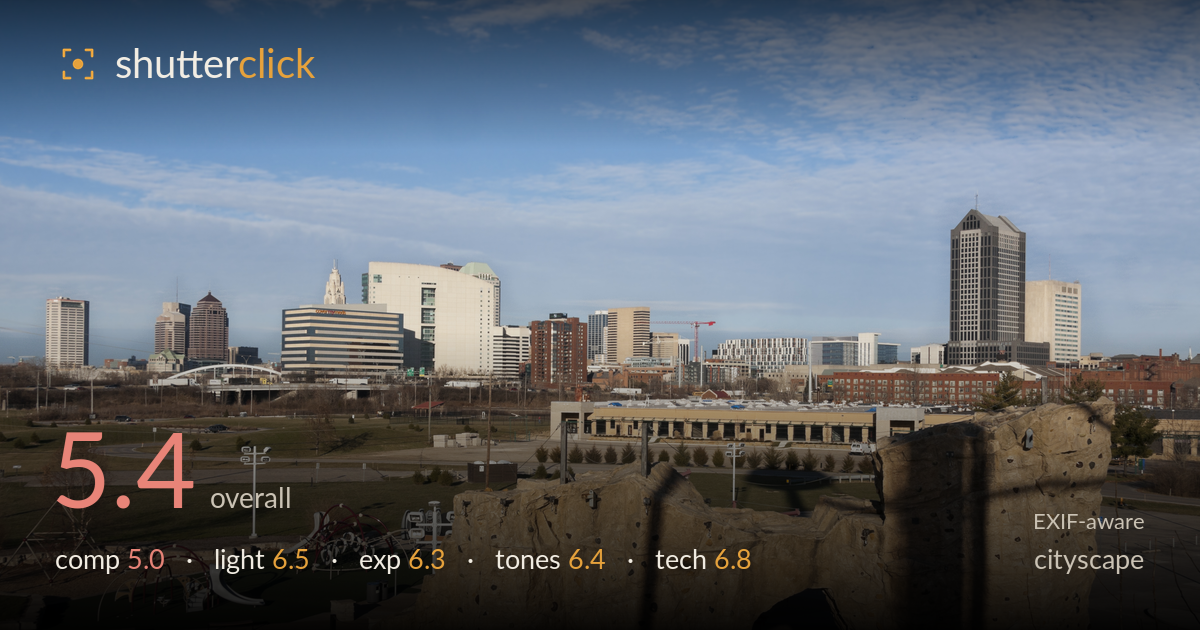
Columbus skyline beyond the climbing wall
Photo by Sixflashphoto

| Focal length | 22 mm |
| Aperture | f / 13.0 |
| Shutter | 1/500 s |
| ISO | ISO 200 |
| Exp. comp. | -2.5 EV |
| Shot at | 15:37 · Dec 21, 2017 |
The frame is undermined by a large climbing-wall structure that dominates the right and bottom without functioning as a deliberate foreground anchor — it fights the skyline rather than framing it. The distant Columbus skyline, the real subject, sits small and pushed to the left, competing for attention with a busy midground of playground equipment and parking. There's a decent late-day light quality and a clean, mostly level horizon, but the composition reads as two unresolved photos in one frame. Deciding what the subject actually is — skyline or park — would transform this.
The core problem is a split subject: the sandstone climbing structure claims the entire right half and lower third, while the actual skyline shrinks to the far left. Neither element supports the other, so the eye ricochets between them without settling. The sky occupies well over half the frame with little cloud interest to justify it, leaving the meaningful content compressed into a thin band. The playground midground adds clutter rather than depth. A clear decision — skyline as hero with clean foreground, or the park scene as story — would resolve the tension.
Low, warm late-afternoon light rakes across the sandstone structure and catches the buildings with a pleasant side-lit modelling, giving the towers dimensionality rather than flat frontal illumination. The long shadows crossing the climbing wall add texture. The sky gradient is clean and natural. The light is genuinely the strongest asset here — it's just serving a composition that doesn't fully exploit it. Positioning to let that warm glow define the skyline glass, rather than a foreground rock, would put this good light to better use.
The -2.5 EV compensation was aggressive but the result holds together: highlights on the pale towers and the bright sky are retained without obvious clipping, and the sandstone keeps detail. Shadow areas in the foreground rock and playground go a touch dense but remain readable. The overall brightness leans slightly dark, which deepens the blue sky attractively but risks muddying the park in the lower left. A half-stop lift in the shadows during processing would recover midground detail without threatening the well-controlled highlights.
White balance is accurate — the sky reads a clean natural blue and the sandstone shows warm honey tones without a cast. Contrast is moderate and the tonal range is reasonably broad, from bright building faces to shadowed rock. The blue-to-warm relationship between sky and foreground is pleasant. Saturation is restrained and believable. The upper sky is slightly flat and could use a touch more separation in the wispy clouds. Overall the colour is honest and unforced, one of the image's quieter strengths.
The settings are well matched to a daylight cityscape. At 22mm and f/13 on the D90, depth of field is deep enough to hold both the near climbing wall and the distant skyline in acceptable focus — a sensible aperture for this front-to-back sharpness. ISO 200 keeps noise negligible and preserves tonal smoothness in the sky. 1/500s is far faster than needed for a static scene but does no harm. Focus appears accurate across the plane, and the 18-200 superzoom, while not a sharpness benchmark, performs adequately here at a moderate focal length and stopped-down aperture. The horizon is close to level. The main technical caveat is diffraction: f/13 on a DX sensor sits at the edge of softening from diffraction, and f/8 to f/9 would have preserved slightly more critical detail in the distant buildings while still holding depth. Execution is otherwise clean and competent — the limitations here are compositional, not technical.
What would elevate it
Tags
Shot something like this?
Expert photo critique, on demand — scored across six categories, EXIF-aware. Start with 3 free critiques, no credit card.
critique my photo — free