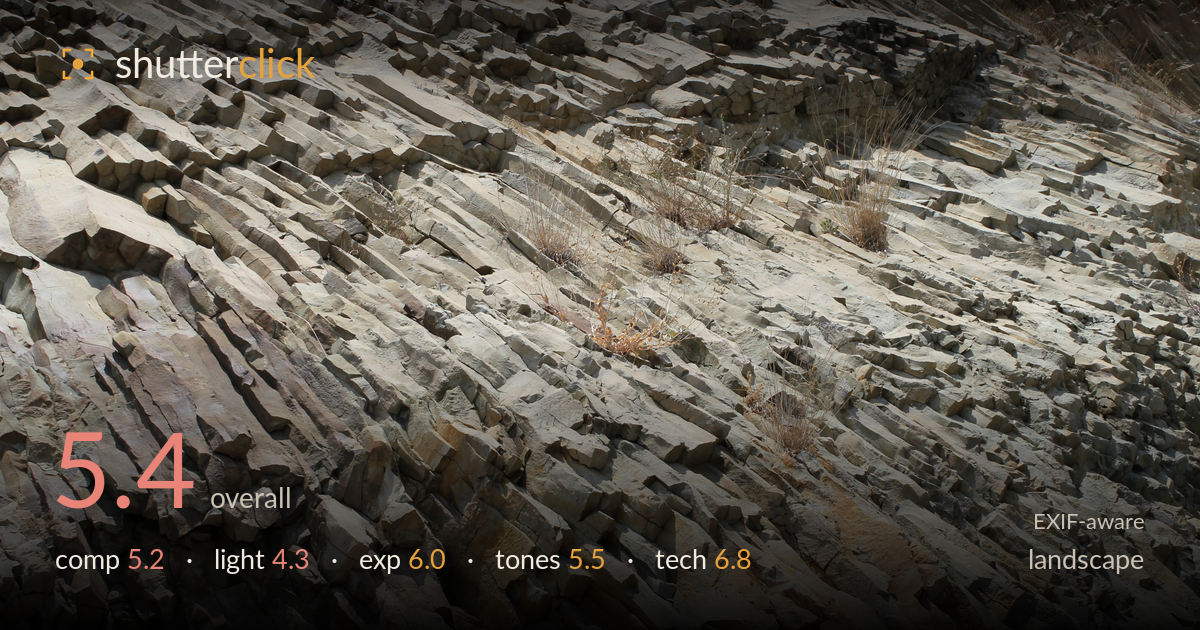
Columnar basalt on a hillside
Photo by George Chernilevsky

| Focal length | 24 mm |
| Aperture | f / 10.0 |
| Shutter | 1/250 s |
| ISO | ISO 100 |
| Exp. comp. | -0.33 EV |
| Shot at | 11:47 · Jul 28, 2012 |
A field of columnar basalt fills the frame with genuinely interesting geological texture, but the image reads as a rock-face document rather than a resolved landscape. The diagonal grain of the columns gives the frame some energy, yet there is no anchor point, no sense of scale, and no light to model the forms. The harsh overhead sun flattens everything it should be sculpting, and the tufts of dry grass are too scattered to serve as focal points. The subject has real potential — this same formation under raking side light and with a clarifying element for scale would be far stronger.
The diagonal run of the columns from lower left to upper right gives the frame a natural directional pull, and filling the whole frame with pattern is a defensible choice for a texture study. The problem is the lack of any anchor — the eye wanders across uniform rock without a resting point or a sense of scale. The scattered dry grasses are too small and dispersed to carry that weight. A single strong foreground column, a shift to isolate one cluster, or an element establishing scale would give the pattern purpose.
This is the weakest element. The near-overhead midday sun strikes the columns almost frontally, flattening the very three-dimensional structure that makes basalt columns compelling. Shadows are short and offer little modelling, so the ridges and facets read as tone rather than form. The light that should be raking across the columns to reveal their depth is instead washing over them. Early or late sun striking the face at a low angle would turn this flat pattern into a sculptural relief of light and shadow.
Exposure is handled competently for the harsh conditions. The -0.33 EV compensation protects the bright limestone-grey highlights, which mostly hold detail rather than blowing out. Shadow areas in the column recesses retain texture without blocking up. The histogram sits in a workable range with no significant clipping at either end. Given the high-contrast midday light, this is a reasonable outcome, though the overall rendering leans slightly bright and could benefit from a touch more contrast to add depth to the flat lighting.
The palette is a restrained range of greys, warm ochres, and buff yellows, honest to the rock but somewhat monotonous across the whole frame. White balance is neutral and believable. The warmer, more golden tones in the lower portion are the most appealing part of the colour story, but they are not emphasised enough to matter. Contrast is low, a direct consequence of the flat lighting, which leaves the tonal range compressed in the midtones. A little more separation between light and shadow would give the surface more dimensionality.
The settings are well matched to the subject. At f/10 the depth of field comfortably covers the receding rock face, keeping the whole plane acceptably sharp — a sensible choice for a texture-driven landscape. ISO 100 keeps the image clean, and there is no visible noise even in the shadowed recesses. The 1/250 s shutter is more than fast enough for a static subject handheld, eliminating any camera shake. Focus appears accurate across the frame, resolving the fine cracks and facets of the basalt well. The 24mm focal length on the crop sensor gives a moderately wide field appropriate to capturing the sweep of the formation. Technically there is little to fault here — the execution is sound and the limiting factors are creative rather than mechanical. The only refinement worth considering would be shooting when the light angle actually rewards the depth of field being used, so the sharpness resolves modelled form rather than flat pattern.
What would elevate it
Tags
Shot something like this?
Expert photo critique, on demand — scored across six categories, EXIF-aware. Start with 3 free critiques, no credit card.
critique my photo — free