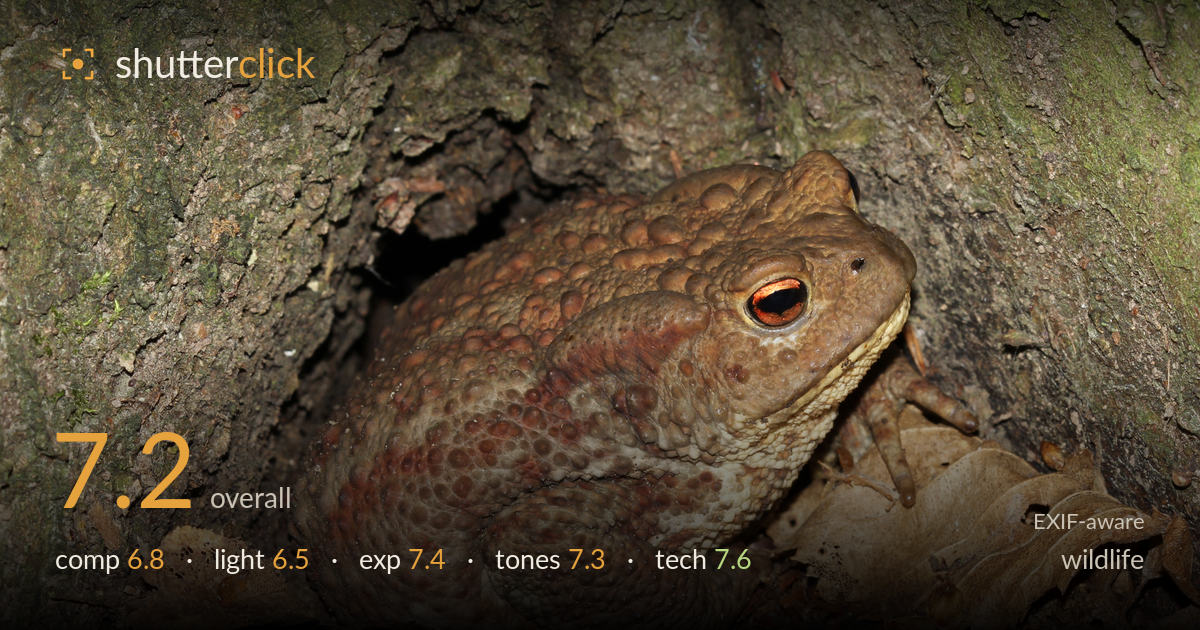
Common toad in a tree hollow
Photo by George Chernilevsky

| Focal length | 100 mm |
| Aperture | f / 11.0 |
| Shutter | 1/200 s |
| ISO | ISO 200 |
| Exp. comp. | 0.0 EV |
| Shot at | 09:42 · Jun 23, 2015 |
A tack-sharp portrait of a common toad nestled in a tree hollow, carrying real strength in the eye rendering and warty skin detail. The copper iris is the anchor, drawing the eye immediately, and the earthy palette ties the animal to its setting convincingly. What most holds the image back is the tight framing on the right — the toad's head and foot crowd the edge, and the leaf litter in the lower right clutters the composition. The flash origin is also visible in slightly flat, frontal light. A touch more space ahead of the animal and softer, more directional light would lift this from a solid record to a stronger portrait.
The toad sits solidly at the frame's centre-right, framed naturally by the dark tree hollow — an effective vignette that isolates the animal. But the head and front foot press hard against the right edge, cramping the gaze direction and denying the subject room to look into. The eye lands roughly on a thirds intersection, which helps. The lower-right leaf litter competes for attention and reads as clutter. Reframing with breathing space ahead of the toad would strengthen the balance considerably.
The frontal flash renders the warty texture legibly and lifts the toad from the shadowed hollow, but the light is flat and even, flattening the animal's three-dimensional bulk. A hard specular highlight sits in the eye, which works as a catchlight, though the overall illumination lacks direction. The surrounding bark and moss receive enough spill to hold detail without going harsh. Raking side light would have carved out the pebbled skin far more dramatically and given the form more sculptural depth.
Exposure is well controlled for a flash-lit subject. The toad's skin retains detail across the mid-tones and the copper eye holds its highlight without clipping. The dark hollow behind reads as deep shadow but avoids becoming a total void, keeping some bark texture. A few of the leaf-litter highlights in the lower right edge toward brightness but stay recoverable. Overall the histogram sits sensibly, with deliberate placement that keeps the subject bright and the background naturally receding.
The earthy brown and rust palette is cohesive and true to the subject, the reddish warts and cream throat giving welcome tonal variety. White balance leans slightly warm, which suits the woodland setting. The green moss on the surrounding bark adds a cool counterpoint that keeps the frame from monotony. Contrast is moderate and controlled, though the flat light limits tonal separation on the animal's body. The copper iris is the standout note, its saturation vivid without appearing pushed.
The 100mm macro lens at f/11 was a sound choice, delivering front-to-back sharpness across the toad and holding fine detail in the warts and eye — critical for a low, close subject like this. Focus is accurately placed on the eye, which is tack sharp. ISO 200 keeps noise negligible, and 1/200s with flash is more than adequate to freeze a stationary amphibian. The trade-off with f/11 is that the background hollow retains more texture than an out-of-focus wash, which slightly reduces subject separation, though the dark surround compensates. The flash was clearly necessary in the shaded hollow and is executed cleanly with no harsh hot spots or blown skin. On a reshoot, a marginally wider aperture — around f/8 — would soften the immediate background while keeping the animal sharp, given the shallow depth needed only spans the toad itself. Execution here is technically assured; the settings match the subject well.
What would elevate it
Tags
Shot something like this?
Expert photo critique, on demand — scored across six categories, EXIF-aware. Start with 3 free critiques, no credit card.
critique my photo — free