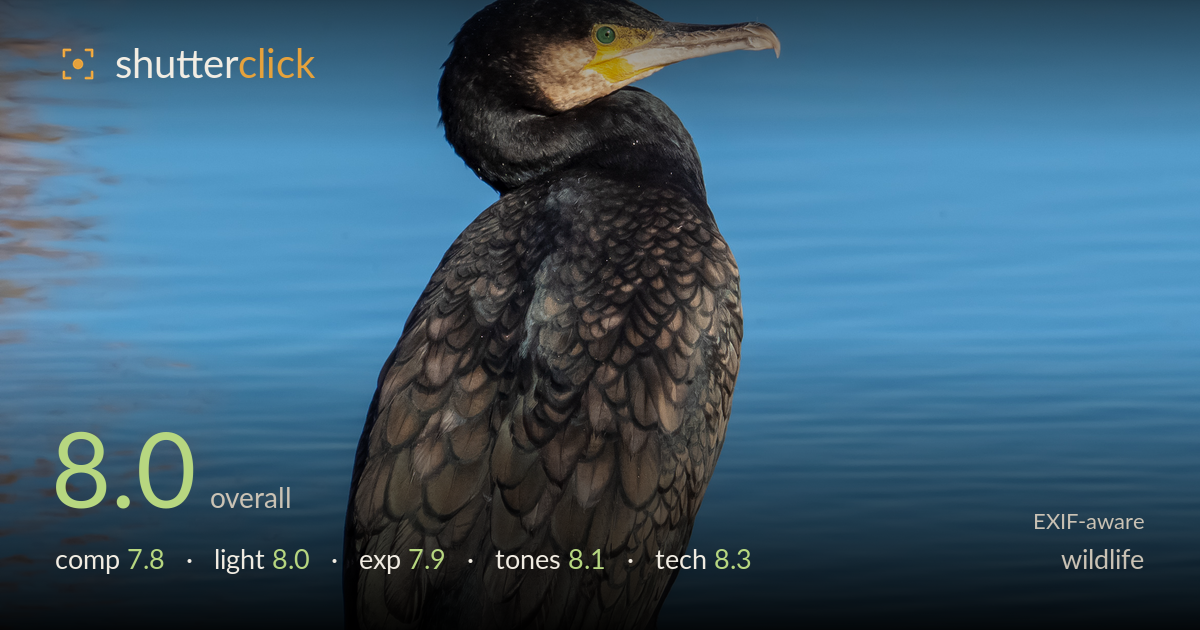
Cormorant perched over calm water
Photo by Ermell

| Focal length | 400 mm |
| Aperture | f / 9.0 |
| Shutter | 1/320 s |
| ISO | ISO 200 |
| Exp. comp. | 0.0 EV |
| Shot at | 12:20 · Nov 12, 2018 |
A clean, well-executed portrait of a great cormorant, carrying strong feather detail and a striking emerald eye against a calm blue water backdrop. The diagonal perch anchors the bird naturally and the low, warm light rakes across the plumage to reveal texture and iridescence. What holds it back most is the bird's profile facing right into a relatively tight edge, with generous empty water behind the tail — reversing that balance would give the gaze room to breathe. The perch also crowds the lower frame. Detail and colour rendition are excellent for the conditions.
The diagonal branch is a strong, natural anchor and leads the eye up to the bird, while the still water provides clean separation. The cormorant sits high in the frame, but its profile faces right into the nearer edge with the bulk of empty water pooling behind the tail — the negative space works against the gaze rather than for it. The out-of-focus branch at lower left adds a distracting bright wedge. A crop or reframe placing more room ahead of the beak would settle the balance.
Low, warm directional light rakes across the plumage from the front-right, revealing the scalloped feather texture and the subtle bronze-green iridescence that would vanish under flat midday sun. The catchlight is present and the yellow gular patch glows. Shadows on the near flank stay soft and open, keeping the dark body from reading as a black mass. Timing and angle are well chosen for a dark-feathered subject — the light does real work here, sculpting form rather than merely illuminating it.
Exposure is handled well for a difficult subject — a very dark bird against bright water. Feather detail holds throughout the plumage without crushing to black, and the water retains tonal gradation rather than blowing out. The brightest reflections stay in check. The eye and beak are cleanly rendered. If anything, the darkest tail feathers sit slightly heavy, but there is recoverable detail. A balanced, deliberate exposure that avoids both the underexposure trap and highlight clipping.
The colour palette is pleasing: cool blue water against the warm bronze and green iridescence of the plumage, with the yellow-orange face providing a focal accent. White balance looks accurate, the blues reading natural rather than oversaturated. The subtle green and copper tones in the feathers come through with good gradation. Contrast is judged well for the low light. The reflected reeds at left add a warm counterpoint. Nothing feels pushed — the tones read faithful and controlled.
The settings suit the situation well. At 400mm on the E-M1 Mark II, f/9 gives ample depth of field to hold the perched bird sharp front to back while the distant water melts to a smooth wash — a sound choice for a static subject. ISO 200 keeps noise negligible and preserves the fine feather detail, which is genuinely crisp across the plumage and tack-sharp on the eye. 1/320s is more than adequate for a motionless bird, though it would leave little margin had it moved or preened. Focus is accurately placed on the eye and head. The Leica 100-400 resolves the scalloped feather edges and beak texture cleanly. The one consideration: at f/9 on Micro Four Thirds, diffraction begins to nibble at critical sharpness, and f/6.3 to f/7.1 would have delivered comparable depth with a touch more bite. Overall this is confident, well-matched execution that gets the essentials right.
What would elevate it
Tags
Shot something like this?
Expert photo critique, on demand — scored across six categories, EXIF-aware. Start with 3 free critiques, no credit card.
critique my photo — free