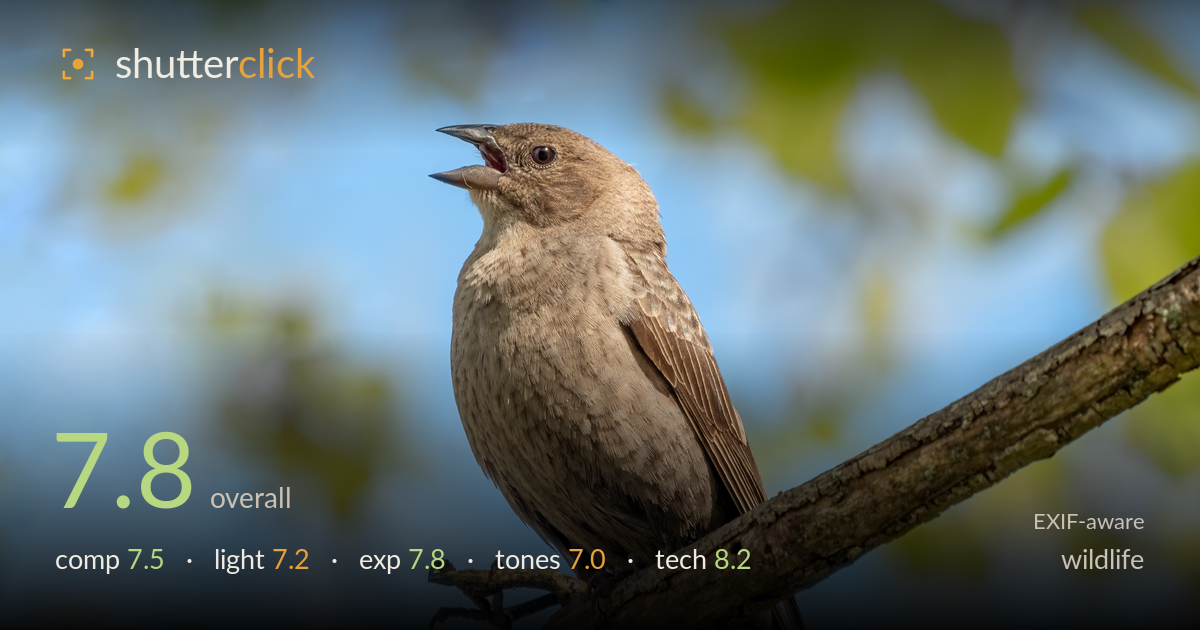
Cowbird singing on a branch
Photo by Rhododendrites

| Focal length | 300 mm |
| Aperture | f / 8.0 |
| Shutter | 1/500 s |
| ISO | ISO 400 |
| Exp. comp. | 0.0 EV |
| Shot at | 16:29 · May 12, 2021 |
A cleanly executed songbird portrait caught mid-call, with the open beak giving the frame genuine behavioural interest that lifts it above a static perch shot. The diagonal branch anchors the bird well and the soft dappled background separates the subject cleanly. The eye is sharp and the feather detail across the breast and folded wing holds up nicely. What most holds it back is the muted, near-monochrome brown palette against a slightly hazy background, and a composition that leaves considerable empty space behind the tail while crowding the beak toward the frame edge. A small crop and a touch of contrast would tighten the read.
The diagonal branch running lower-left to right is a strong structural line, and the perched bird sits at a workable intersection with the tail sweeping down to balance the head. The open beak points into frame, which is correct, though the head sits close to the top and left with limited breathing room ahead of the gape. Meanwhile a large expanse of soft background fills the lower left behind the feet. A slightly tighter crop favouring space in front of the beak would improve the visual weight and flow.
Soft, slightly diffused daylight rakes across the bird from the front-left, modelling the breast and giving gentle dimension to the feathers without harsh shadows. The catchlight in the eye is present and helps the subject read as alive. The light is flattering but a touch flat overall, lacking the directional punch that would carve more texture into the plumage. Warmer, lower-angle light would have added separation and depth. As shot, the illumination is clean and even but not dramatic.
Exposure is well judged for a brown subject against a bright sky-and-foliage background. The bird retains detail from the pale breast through the darker wing edges, and highlights on the back and branch bark are held without clipping. Shadow areas under the wing and around the feet keep detail. The histogram appears balanced with no accidental crushing. The open mouth interior stays readable rather than blocking up. A cleanly deliberate exposure that handles the tonal spread of the scene competently.
The palette is dominated by muted browns against blue and desaturated green, which is faithful but low in contrast and energy. White balance leans slightly warm, natural for the conditions. The bird's tones gradate smoothly across the breast, but the overall image feels a little hazy and flat, and the browns risk merging into one another. A modest contrast lift and a nudge of clarity on the plumage would give the feathers more definition and let the subject sing against the background.
The E-M5 II with the 40-150mm f/2.8 and MC-20 gives 300mm (600mm equivalent), a sensible reach for a small perched bird. f/8 is a touch conservative for this subject distance — the whole bird is acceptably sharp, but stopping down that far on a Micro Four Thirds sensor sacrifices some background blur and pushes toward diffraction; f/5.6 would have preserved detail while softening the background further. 1/500s comfortably freezes a stationary bird, and would only be marginal if it moved. ISO 400 is well within the sensor's clean range, and noise is a non-issue here. Focus is placed accurately on the eye, which is critical and correctly nailed, and the feather detail across the breast confirms good execution. The teleconverter costs a little bite but the result holds up well. Overall a technically sound capture with only the aperture choice worth revisiting for stronger subject isolation.
What would elevate it
Tags
Shot something like this?
Expert photo critique, on demand — scored across six categories, EXIF-aware. Start with 3 free critiques, no credit card.
critique my photo — free