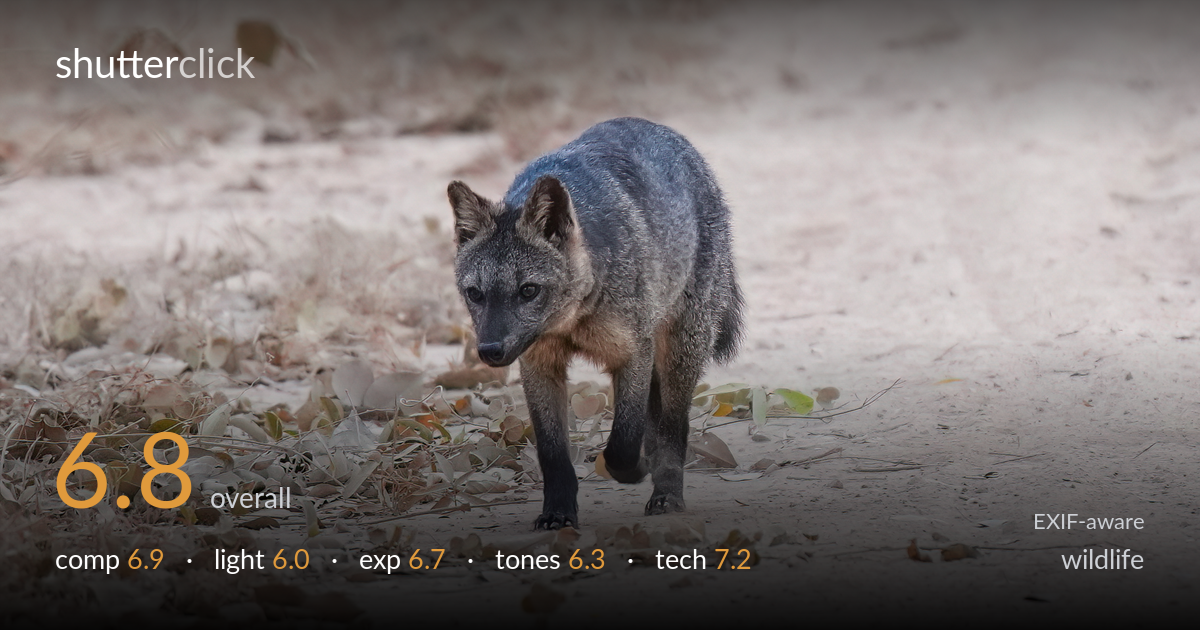
Crab-eating fox on a sandy trail
Photo by Giles Laurent

| Focal length | 600 mm |
| Aperture | f / 6.3 |
| Shutter | 1/400 s |
| ISO | ISO 640 |
| Exp. comp. | 0.0 EV |
| Shot at | 20:50 · Aug 8, 2024 |
A capable, intimate portrait of a crab-eating fox walking a sandy trail head-on, with the animal placed centrally and rendered at a low, eye-level perspective that pulls the viewer into its world. The direct, approaching gesture carries the frame. What most holds it back is flat, overcast light that gives the pale sand and dry foliage a monotone, low-contrast wash — the subject barely separates from a background of near-identical tones. The fox's dark form works to advantage here, but the scene needs more tonal punch and the eye more sparkle. A cleaner foreground and a touch more shutter would sharpen the result.
The low, ground-level vantage is the strongest choice here, placing the lens near the fox's eye and giving the head-on approach real presence. The animal sits slightly right of centre with room ahead into which it moves, which reads well. The receding sandy track offers a natural leading path. The tangle of dry leaves in the lower left is busy and competes for attention, and there's a lot of empty foreground below the subject that could be tightened. A hair more space above the ears would balance the headroom.
Flat, diffuse overcast light dominates, and it does the image few favours. The soft, even illumination avoids harsh shadows and blown highlights, but it also flattens the fox's fur and drains modelling from the coat, so the animal reads as a dark mass rather than textured detail. There's no catchlight in the eye, which costs the portrait some life. Directional side or low-angle light — a break in cloud, or shooting nearer golden hour — would carve the fur and separate the subject from the pale ground.
Exposure is well judged for a tricky scene: the bright, pale sand could easily have pushed the meter to underexpose the dark subject, yet the fox retains shadow detail in its face and legs while the sand holds texture without clipping. The 0.0 EV compensation worked out because the frame is dominated by mid-to-bright tones. The darkest fur on the legs approaches black but keeps some information. Histogram sits comfortably; a slight lift on the shadows in post would recover a touch more coat detail.
The palette is almost entirely muted beige, tan and grey — the pale sand and dried leaves envelop the frame in a low-saturation wash that risks monotony. White balance looks neutral to slightly cool, appropriate for overcast conditions. The fox's cool grey coat and warmer underbelly provide the only real tonal variation, and the scattered green leaves add welcome accents. Contrast is inherently low; a modest contrast lift and a nudge of clarity on the subject would help it stand apart from the near-identical background tones.
The 600mm on the ILCE-1 with the 200-600 G is the right tool for this subject and distance, and it delivers a compressed, softly rendered background at f/6.3 that isolates the fox reasonably well. Focus appears to land on the face and eye, which is where it counts, though the head-on pose and the flat light make it hard to confirm bite-sharp eye detail — the rendering looks marginally soft, possibly from a slightly front-focused plane on the muzzle or the overcast contrast. ISO 640 is well within the camera's clean range, so noise is a non-issue. The main technical concern is shutter speed: 1/400s for a walking animal at 600mm is on the low side. It has frozen this stride adequately, but there's little margin — a faster leg or a head turn could have blurred, and 1/800–1/1250s would offer more security while ISO still had room to climb. Depth of field is sufficient for a front-on subject.
What would elevate it
Tags
Shot something like this?
Expert photo critique, on demand — scored across six categories, EXIF-aware. Start with 3 free critiques, no credit card.
critique my photo — free