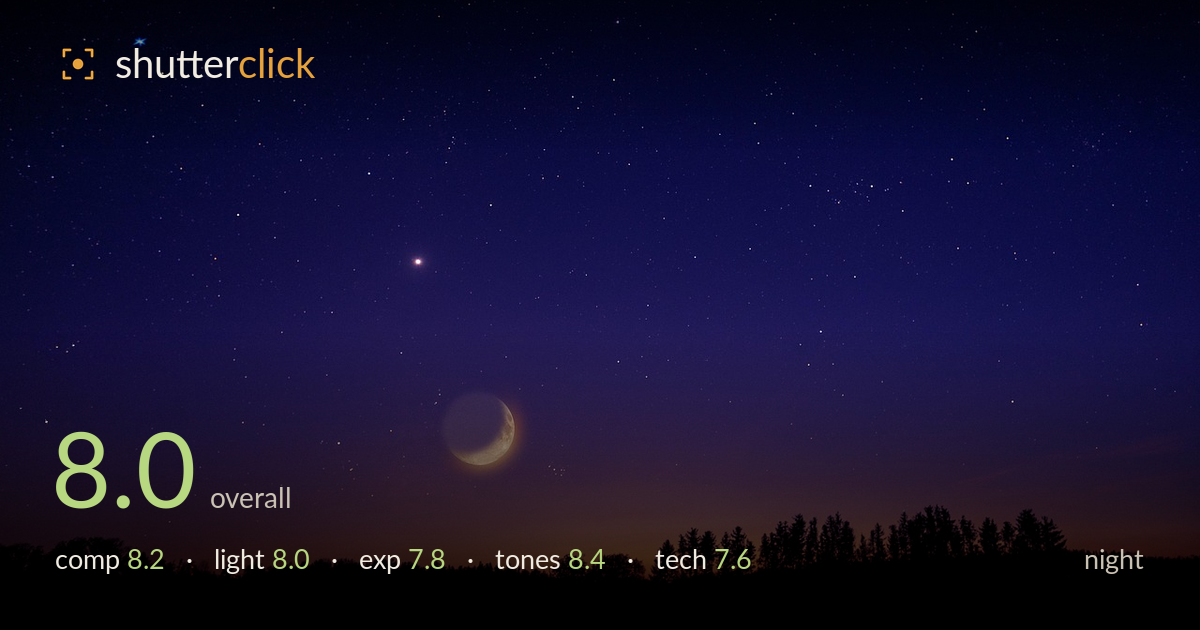
Crescent moon over a twilight treeline
Photo by Bru-nO

No EXIF metadata in this file
Technical analysis based on visual assessment only.
A quietly confident twilight scene that reads instantly and holds together as a composition. The crescent moon, earthshine visible on its dark limb, sits low over a treeline silhouette while the sky gradates from warm ember at the horizon to deep indigo above, scattered with stars and a bright planet. The layered colour transition is the strongest element and it carries the frame. What most holds it back is the low placement of the moon, which crowds it against the busy treeline and loses a touch of separation, and the deep foreground that reveals almost nothing. A cleaner moon exposure would also preserve more crescent detail.
The gradient sky does most of the compositional work, and the crescent moon is well placed off-centre to the left with the treeline anchoring the base. The bright planet above and scattered stars give the upper frame something to hold. The horizon sits low, which suits the sky-dominant intent. The weakness is that the moon sits close to the treeline, reducing separation between the two brightest, busiest elements. Lifting the moon slightly higher in frame would let it breathe against clean sky.
The residual twilight glow at the horizon is the light source doing the heavy lifting here, and its timing is well judged — caught deep into blue hour when the warm band still lingers beneath the darkening sky. Earthshine faintly filling the moon's shadowed disc is a lovely, subtle detail. The silhouetted treeline confirms the light is coming entirely from behind and below the horizon. Nothing about the light needs changing; the moment was read correctly.
A careful balancing act, mostly successful. The sky retains star detail and clean gradation without lifting the shadows into noise, and the horizon glow holds its warmth. The bright side of the crescent is close to clipping, which flattens some lunar surface texture — a shorter exposure or a blended frame would recover that detail. The foreground trees fall to near-total silhouette, which is intentional and works, though it commits the lower quarter of the frame to empty black.
The colour grading is the highlight. The vertical progression from deep indigo through violet to a warm amber-and-orange band at the horizon is smooth and natural, with no ugly banding despite the demanding tonal range. White balance is convincingly neutral in the stars while preserving the warmth low down. The blue star at upper left and the warm planet add believable colour variety. Saturation is pushed just enough to feel rich without turning artificial.
Execution is solid for the conditions. Stars render as clean points rather than trails, indicating the exposure was kept short enough to avoid noticeable motion — a sensible choice with a wide field. Noise is well controlled across the sky, and the gradient stays smooth without visible mottling in the shadows, which suggests either a low ISO with a longer exposure or effective processing. Focus appears accurate, with the moon and stars crisp. The main technical shortfall is the moon's highlight sitting near clipping, so the crescent's surface detail is partly lost — a separate, shorter exposure for the lunar disc, blended in, would resolve that. The treeline edge shows some softness, though at this scale it reads as silhouette rather than a focus miss. Overall a clean capture; the only meaningful gains lie in dynamic-range handling of the brightest element rather than in the base technique.
What would elevate it
Tags
Shot something like this?
Expert photo critique, on demand — scored across six categories, EXIF-aware. Start with 3 free critiques, no credit card.
critique my photo — free