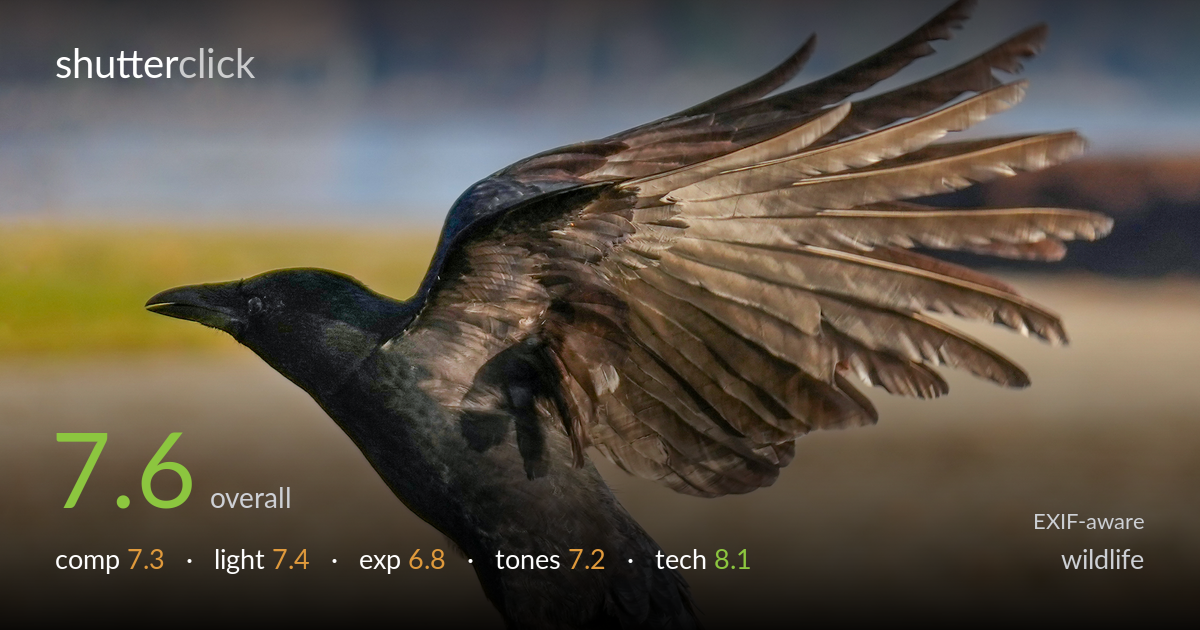
Crow coming in to land
Photo by Giles Laurent

| Focal length | 70 mm |
| Aperture | f / 2.8 |
| Shutter | 1/3200 s |
| ISO | ISO 250 |
| Exp. comp. | 0.0 EV |
| Shot at | 14:12 · Dec 30, 2021 |
A crisp landing sequence caught at a dynamic moment — the raised wing, splayed feathers, and dangling legs all read as the bird decelerating for touchdown. The gesture is the strongest asset. What holds it back most is exposure on the subject: a black corvid against a bright meadow and water pushes the darks close to blocking up, and detail in the wing coverts and body is right at the edge. The bare branch across the top adds a nice natural frame but also crowds the wingtip. Cleaner subject-shadow rendering and a touch more breathing room would elevate a well-timed capture.
The diagonal of the body and the sweep of the raised wing create strong movement, and placing the bird left-of-centre gives it room to descend into. The overhead branch works as an environmental frame, hinting at the landing perch. But the upper wingtip nearly collides with the branch on the right, creating tension without payoff, and the tail crops close to the lower edge. A slightly wider field or a reframe giving the wing clear air would let the gesture breathe more freely.
Low, warm side light rakes across the scene, catching iridescent blue-green on the head and shoulder — a genuine reward of shooting a black bird in golden light. The wing feathers pick up enough directional light to show separation and translucence at the tips. The blurred background glows warmly, reinforcing the season. The main limitation is that the underside and body fall into deep shadow, and the light does little to model the near flank, leaving a large mass of near-featureless dark.
A tricky subject handled reasonably. The bright meadow and water read cleanly without blown highlights, and the wing retains detail. However, the body and underwing sit very dark, with shadow detail on the flank and belly nearly lost — a black bird against a bright ground almost always needs positive compensation, and at 0.0 EV the darks compress. A stop of added exposure, or shadow recovery in post, would reveal the plumage texture that is currently swallowed. The eye and head are well placed tonally.
The warm-to-cool palette works well — amber grasses and sky-blue water frame the bird pleasingly, and the iridescent sheen on the head adds subtle colour interest against the matte black. White balance looks accurate for late-day light. The main tonal weakness is limited gradation within the black plumage; large areas read as flat dark mass rather than differentiated feather tone. Gentle shadow lifting and a nudge of local contrast on the body would restore separation without sacrificing the rich blacks.
The ILCE-1 with the 70-200mm f/2.8 GM is well matched to this action, and the execution is largely sound. 1/3200s freezes the wing cleanly — even the fine feather tips and the trailing legs are crisp, which is exactly what a landing sequence demands. ISO 250 keeps noise negligible and preserves clean tones in the background bokeh. Focus lands on the eye and head, sharp where it matters. The one debatable call is f/2.8: at 70mm it gives a lovely soft background, but the razor-thin plane means the far wingtip and tail drift slightly soft relative to the head. Stopping to f/4 or f/5.6 would have carried more of the outstretched wing into sharp focus while still separating the bird from the meadow. Shooting at 70mm rather than reaching longer also meant a relatively close working distance for a wild corvid — impressive access, but a touch more focal length would have filled the frame and eased the tight branch clearance up top.
What would elevate it
Tags
Shot something like this?
Expert photo critique, on demand — scored across six categories, EXIF-aware. Start with 3 free critiques, no credit card.
critique my photo — free