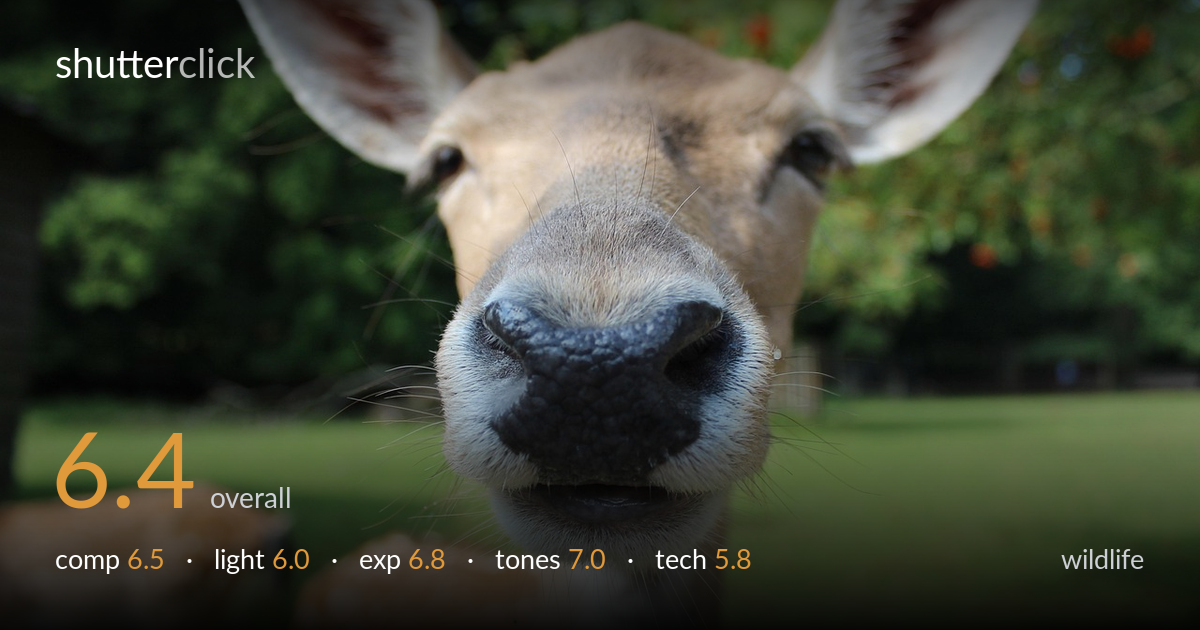
Curious deer nose to the lens
Photo by TimZur

No EXIF metadata in this file
Technical analysis based on visual assessment only.
A charming, close-quarters portrait that trades wildlife polish for personality. The wide-angle proximity puts the deer's nose front and centre, and the exaggerated snout-to-ears proportion gives the frame real comedic warmth. What holds it back is the focus plane: the nose is the sharpest area while the eyes sit slightly soft, which works against the wildlife convention of a tack-sharp eye. The shallow, distorted perspective also flattens the head. As an environmental, character-driven capture it succeeds; as a technically rigorous wildlife shot the soft eyes and busy lower-frame intrusion keep it from the top tier.
The centred snout fills the frame and exploits the wide-angle distortion for a playful, almost cartoonish proportion that earns the close approach. The symmetrical ears frame the head nicely and the green background sits back pleasantly. The weakness is the lower-left foreground: the second deer's out-of-focus rump intrudes as an unresolved blob that pulls attention without adding context. Slightly more headroom or a marginally lower angle would have balanced the heavy lower edge and given the ears room to breathe.
Soft, diffused daylight filters through the canopy and renders the fur and muzzle texture without harsh contrast, which suits the gentle subject. The light is largely flat and frontal, though, so the face lacks modelling and the snout reads slightly two-dimensional. The dappled background light is pleasant but uneven. A touch of directional side light would have carved more shape into the muzzle and brought out the velvety nose texture. Overcast-style softness is forgiving but undersells the form here.
Exposure is well controlled for mixed shade and sun. The tan fur retains detail, the dark nose holds texture rather than blocking up, and the bright green background avoids significant clipping. Midtones sit comfortably and the histogram looks balanced. The brightest background highlights through the foliage flirt with overexposure but stay recoverable. Overall a deliberate, even read of a tricky dappled-light scene, with no obvious accidental under- or over-exposure on the subject itself.
The colour palette is clean and natural: warm tan fur set against cool, saturated greens makes for a pleasing complementary balance. White balance reads accurate, with neutral whites in the ear fur and a believable grey-black nose. Greens are vivid without tipping into oversaturation, and skin and fur tones stay lifelike. The tonal range is healthy from the dark nostrils to the bright grass. A slightly reduced green saturation would keep the background from competing with the subject.
The defining technical issue is focus placement. The wide-angle lens at close range throws the depth of field onto the nose, leaving the eyes — the make-or-break plane for wildlife — visibly softer. In this genre a sharp eye is non-negotiable, and the focus drifting to the muzzle undercuts the shot's impact, however endearing the perspective. The proximity and short focal length also introduce strong perspective distortion that balloons the nose and shrinks the head; intentional or not, it reads as caricature rather than considered portraiture. Depth of field is shallow enough to render the background pleasantly but too shallow to carry both nose and eyes. Noise is well controlled and the image appears clean. A slightly smaller aperture would have extended the focus plane to cover both eyes and nose, and stepping back with a longer focal length would have reduced the distortion while keeping the engaging eye-level intimacy. Background separation is good; the execution on the critical plane is what needs work.
What would elevate it
Tags
Shot something like this?
Expert photo critique, on demand — scored across six categories, EXIF-aware. Start with 3 free critiques, no credit card.
critique my photo — free