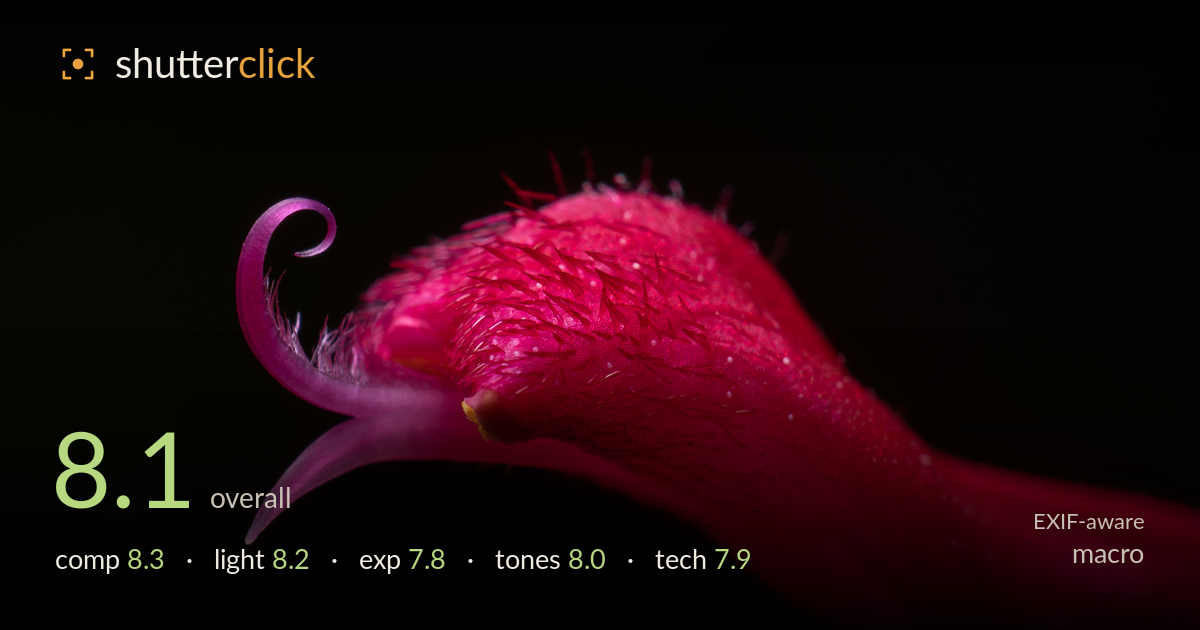
Curled tendril on a crimson bud
Photo by Jules Verne Times Two

| Focal length | 28 mm |
| Aperture | f / 1.0 |
| Shutter | 1/125 s |
| ISO | ISO 200 |
| Exp. comp. | 0.0 EV |
| Shot at | 17:19 · Feb 14, 2017 |
A striking, almost creature-like macro study that reads as a bird's head thanks to the curled appendage and the beak-like point. The black background isolates the subject completely and the raking light picks out the fine hairs beautifully, giving the surface a tactile, almost velvety character. What holds it back most is the shallow plane of sharp focus: the bristled crown sings while the trailing petal and lower foreground drift soft. The magenta also runs hot in places, flirting with clipped saturation on the brightest edges. Tightening focus depth and easing the reds would push a strong frame to an outstanding one.
The diagonal sweep from the lower-right anchor up to the hooked tendril gives the frame real momentum, and the negative space on the left is used with confidence — it lets the curl breathe and reinforces the beak-like read. The subject sits comfortably off-centre, following a natural spiral. The lower-right corner where the petal exits the frame is a touch heavy and could be simplified. The eye lands cleanly on the textured crown, which is the right place for the visual weight.
Directional side light rakes across the bristled surface and separates every hair from the body — exactly what this kind of texture needs. The falloff into the black surround is clean and controlled, giving the subject a sculptural, spotlit quality. The translucent glow through the curled tip is a lovely touch, showing light passing through the thin tissue. The brightest crown edge runs a little hot, and a hair more fill on the shadowed underside would preserve detail there without softening the drama.
The exposure holds the dark surround at a genuine black without crushing the subject's shadow transitions, which is a good balance for this high-contrast setup. Midtones on the crown are placed well. The concern is the brightest magenta highlights along the top edge and the glowing tip, where the red channel appears close to clipping and loses some tonal separation. Pulling exposure back a fraction, or recovering the red channel in post, would restore that lost gradation without dulling the overall impact.
The magenta-to-crimson gradient is rich and the shift toward cooler pink in the translucent curl adds welcome variety against the warmer body. The black backdrop makes the colour pop hard. That intensity is also the risk: the reds are near the edge of believable saturation and the hottest areas flatten into a single tone. A slight desaturation of the red channel and a touch of luminance recovery would bring back detail and keep the colour from feeling synthetic.
The reversed Porst 28mm on the X-T1 is a resourceful, budget-smart approach to high magnification, and it delivers genuine detail on the bristles and surface pores. Reporting f/1.0 is a metadata artifact — a reversed manual lens communicates no aperture, so the recorded value is meaningless; the true working aperture is whatever the lens ring is set to, and the resulting depth of field looks quite shallow. That thin plane is the main technical limitation: focus is crisp across the crown but falls away on the trailing petal and the lower foreground. Stopping the lens down a stop or two, or focus-stacking a handful of frames, would carry sharpness through the whole subject. 1/125s at ISO 200 froze any motion cleanly and kept noise negligible, so the exposure mechanics are sound. Focus placement on the key textured area was the right call given the limited depth available.
What would elevate it
Tags
Shot something like this?
Expert photo critique, on demand — scored across six categories, EXIF-aware. Start with 3 free critiques, no credit card.
critique my photo — free